Saturday Sep 19, 2026
Saturday Sep 19, 2026
Saturday, 19 September 2026 00:00 - - {{hitsCtrl.values.hits}}
 I visited Colombo in 2010 as Administrator of Lakshadweep Islands, to evaluate the progress of a newly built ship made specifically for the islands. When I was invited last week by the Indo-Sri Lanka Chamber of Commerce and Industry, for a webinar on advancing Indo-Sri Lanka trade, MSME cooperation and investment partnerships, on 25 August 2026, I felt drawn towards it.
In the course of 90 minutes of online discussion, I saw enormous potential of growth between the two countries. The moderator was clear that the webinar should focus on the movement from potential to actual partnerships and projects.
Start-up Odisha CEO S.R. Pradhan, in his keynote address, spoke about the possibilities of the two countries entering into a phase of “creative destruction, creative innovation” and therefore creating new opportunities of growth in the two economies. He particularly mentioned the orange economy, while emphasising the existing role of the blue and the green economy. He lamented that investment in R&D in both countries is yet to touch 1% GDP and hence investment partnerships in R&D are also desired.
Former Head of Southern Command Vice Admiral Anil Kumar Chawla, dwelt upon the concept of ‘Corridors and Connectivity,’ which is the foundation of his experience. In particular, he outlined close maritime ties between us and focused on four existing corridors, and their enormous value for enhancing trade, if substantial improvements can take place.
He emphasised that if these four routes can be expanded to the level of a multi-model transport network, it can expand the market on both sides, enhancing the volume of bilateral trade significantly. The possibilities of high-tech exchange also emerge, as the transport corridors become more efficient and effective.
World Skill Centre, Odisha CEO R.R. Mohapatra, revealed that this was the first Centre established by any state government. Set up in 2016, it has developed the capability to provide consultancy services to Odisha and other states. The opportunities are immense, as skill development is becoming aspirational for the youth, and WSC encourages student exchange programs for upscaling skills. In brief, WSC acts as a partner in the development of the skill ecosystem in the country. Specific areas where skilling and re-skilling is important today are agri-tech, hospitality including wellness, and the maritime sector, as new ports are coming up in a large measure.
Prasanjith Wijayatilake, highlighted renewable energy as the most promising sector, followed by transport logistics, manufacturing and tourism. Renewable energy was a big priority for the country as demand is surging from both the consumers and the industrial sector. In this context, he felt cross-border grid connection can be extremely helpful. Logistics facilitates the development of other sectors of the economy. Auto components manufacture and capital investment in creating cross-country value chains , is emerging fast as lucrative areas of interest. More and more hospitality brands are coming in the country, creating enormous potential for partnerships in the MICE sector.
Vice Admiral Chawla added that strengthening port infrastructure including harbour development is essential and urgent. Mazagon Docks and Colombo Dockyard can partner in shipbuilding and so can smaller shipyards in both the countries by fruitful collaboration. Sri Lanka and India together can create space for shipbuilding in a big way as the current players China (60%), South Korea and Japan are the leading shipbuilders, but maritime demand for ships would exceed 1000 in the next 10-15 years, offering lucrative investment scope.
Dwelling on the geopolitics in West Asia, he said, there is a need for South-Asian trade to integrate and fulfil the gaps created by West Asia war. Vizhinjam new old-weather port in Kerala is a remarkable development, but the opportunities are so large that the Colombo port need not worry about this competition. Huge demand creates complementarity between the two ports, which must be exploited to the hilt.
Prasanjith focused on critical elements of modernising the trade framework between both nations. Private sector linkages were important, as also removal of bottlenecks in logistics. Only then, a comprehensive FTA would be meaningful to reduce all regulatory friction especially at the Customs Border. Harmonisation of standards will boost the MSME sector. B2B institutional partnerships and active information sharing through exchange of delegations, in sector-specific areas would be extremely beneficial. Steps to improve investor protection, effective networking to create joint ventures , would enable better regional integration.
Mohapatra added that if Sri Lanka shows interest, WSC can initiate joint skill certification which will enable talent mobility through reskilling and upskilling. Shri Rajen Padhi of WTC, Bhubaneshwar, emphasised the role of MSMEs in expanding trade between Sri Lanka and India. Reduction of tariffs through FTA has enhanced the scope in areas like chicken exports, semiconductor chips etc.
Industry Consultant
Dr. Anna W Karunatilleke, wanted barriers to entry of women entrepreneurs be curbed, especially in areas like access to finance, technology, marketing, mentorship, and infrastructure. Her primary concern was how to bridge the information gaps that exist on both sides for larger investment.
Manu Seth, representing the private sector, also talked about the scope of larger collaboration in the MSME sector. Pradhan suggested that Sri Lanka can export ladies’ garments in the readymade garment category, and import processed food and rice from India. Under the FTA, India has already allowed zero-duty access and Sri Lanka should also follow suit. It also has to enforce the rules of origin to prevent trade distortions. Dr. Anna felt that maritime logistics is extremely crucial to improve customer coordination and meet international standards in all spheres of trade including e-commerce. Manu Seth underlined the importance of actionable projects along with adequate attention to issues of sustainability, scalability, and international collaboration for tapping foreign markets.
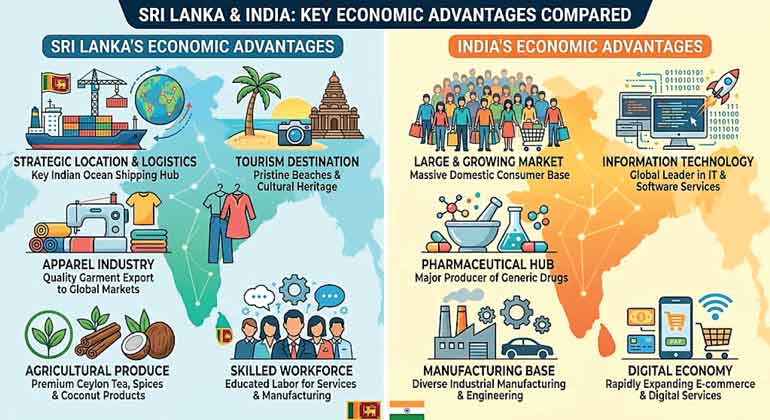
In my intervention, I spoke about the 35 Export Promotion Councils in India, that deal with sector-specific products and services and can greatly enhance product-by-product tie-up with Sri Lanka. I outlined the export strengths of India in sectors like pharmaceuticals, gems and jewelry, refined petroleum, agricultural and marine products. Ambassadors in both the countries can be the vital levers for expanding bilateral trade as they hold the maximum information about the strengths and weaknesses, opportunities and threats posed by both countries.
- Refined petroleum provides the largest opportunity of tripling trade from $670 million to $1.8 billion through cross-border grid integration. In agri-tech and processed foods, a 50% enhancement is possible from the current volume of $ 450 m through high-yield input supplies, food processing machinery, raw sugar and staple grains
- India has so much to offer to Sri Lanka, and Sri Lanka can benefit both in terms of large-scale imports and sector-specific exports. Both need to put their heads together and optimise their full potential. The mutual interest is best served if both parties can turn the “Palk Strait into a seamless, high-velocity economic bridge”
India has an apex export body called FIEO – Federation of Indian Export Organisations, which can effectively collaborate with its counterpart in Sri Lanka to maximise trade relations between both countries. The Ministry of External Affairs can also play a crucial role in transmission of information regarding export and import opportunities that emerge from time-to-time. I concluded by saying that Amazon is investing $ 40 billion in India to revitalise e-commerce, and Sri Lanka must take advantage of this for importing small value items from here.
It became apparent to me that the webinar had omitted several crucial issues due to a want of time, and hence I thought it fit to detail them below:
1. Bilateral local currency settlement mechanisms are being put in place to mitigate forex vulnerabilities for Sri Lanka while simultaneously reducing conversion cost for India. In this context, Indian and Sri Lankan commercial banks can open active Special Rupee Vostro Accounts (SRVAs) with low transaction costs to hedge against dollar conversion charges. Cross-border UPI/LankaPay integration can be extended beyond consumer retail for B2B digital invoicing, electronic bills of lading, and automated customs payments.
2.Upgrading regional port pairs (e.g., Tuticorin / Nagapattinam to Kankesanthurai / Trincomalee / Colombo) with Roll-on/Roll-off ferry and container feeder systems, will induce efficient movement. Integrating customs IT platforms to enable single-window clearance, cutting sea-transit and port handling times from days to under 12 hours, for perishable agri-commodities and high-value manufacturing goods is the need of the hour. India’s ICEGATE (Customs Portal) can be linked directly with Sri Lanka’s ASYCUDA system for pre-arrival electronic manifest clearance.
A “Green Channel Corridor” at Chennai/Tuticorin ports and Colombo/Kankesanthurai harbors can be enabled exclusively for pre-certified, trusted traders (Authorised Economic Operators - AEOs).
These doable steps can condense container dwell times from 4–5 days to under 6 hours, immediately, reducing warehousing and logistics costs for MSMEs by about 15%. Jointly certified testing labs at the ports of Nagapattinam, Tuticorin, Colombo, and Kankesanthu will inject speedy clearances.
3.Existing and future preferential trade access can be utilised to export co-produced finished goods to third-country markets (EU/UK/US) under unified Rules of Origin.
4.Collaboration between NASSCOM and SLASSCOM provides blueprints for joint innovation in fin-tech, agri-tech and SaaS.
5.The Ministry of New and Renewable Energy in India can explore and strategise the huge potential for investment in wind and solar energy in Sri Lanka.
6.Establishing a fast-track Mutual Recognition Agreement (MRA) between the Bureau of Indian Standards (BIS) and the Sri Lanka Standards Institution (SLSI) for testing, sanitary/phytosanitary (SPS) compliance, and pharma certifications will curtail clearance delays at Indian and Sri Lankan ports for MSMEs.
Since MSME collaboration and partnerships hold the largest potential, a permanent bilateral MSME desk can be created to assist firms in customs compliance, mutual recognition of standards and rules of origin documentation.
7.If Sri Lanka can calibrate its tourism infrastructure towards ecotourism, cultural corridors and wellness centres, large-scale expansion by regional tourism operators will become feasible. Sri Lanka has already received 3.4 lakh arrivals from India till August 2026 and achieved a dominant market share. Of the MICE segment, Sri Lanka holds a 7.7% share, which is substantial in terms of regional hospitality.
8.The annual merchandise trade between the 2 maritime nations last year was $ 7.1 billion, and this has the potential to grow to $ 10 billion by 2030, and jump to $ 20 billion by 2040. Both sides need to create a strategy for exploiting full trade potential, as enunciated above.
9.Total FDI into Sri Lanka from India was $ 2.8 billion in infrastructure, energy and telecom sectors. If Indian FDI can be facilitated into dedicated manufacturing zones in Sri Lanka that would give it a big fillip. Opportunities exist for Joint industrial zones around Trincomalee and the Western Province, which offer long-term land leases, tax predictability, and single-window clearances for Indian JVs in auto components, active pharmaceutical ingredients (APIs), renewable equipment, and electronics assembly
- Integrating customs IT platforms to enable single-window clearance, cutting sea-transit and port handling times from days to under 12 hours, for perishable agri-commodities and high-value manufacturing goods is the need of the hour. India’s ICEGATE (Customs Portal) can be linked directly with Sri Lanka’s ASYCUDA system for pre-arrival electronic manifest clearance
- The annual merchandise trade between the 2 maritime nations last year was $ 7.1 b, and this has the potential to grow to $ 10 b by 2030, and jump to $ 20 b by 2040. Both sides need to create a strategy for exploiting full trade potential
10.India has enabled 48 Sri Lankan tech startups through the DISHA program of NASSCOM, starting this year. Imagination is the only limit in deepening and widening this program through a concerted effort on their side. 25 Sri Lankan startups have already availed of deep tech training at IIT Madras.
11.Currently, India exports pharmaceuticals and drugs to the tune of $ 380 million, and this can double in the next 3-4 years, fulfilling the entire healthcare needs of the country. It only requires fast track approvals of WHO – GMP certified Indian firms. Similarly, in automobiles and EVs, exports are to the tune of $ 320 million, and here, the opportunity to triple this by 2030 is clearly visible as Sri Lanka modernises its public transport system. In textiles, premium cotton yarn, synthetic fabrics, technical textiles etc., India can provide raw material exports to the tune of $ 280 million, which can also double by 2030 if co-production facilities are created.
12. Refined petroleum provides the largest opportunity of tripling trade from $ 670 million to $ 1.8 billion through cross-border grid integration. In agri-tech and processed foods, a 50% enhancement is possible from the current volume of $ 450 million through high-yield input supplies, food processing machinery, raw sugar and staple grains.
13.An innovative idea is the fast tracking of the sub-sea high voltage direct current link between Madurai and Chennai to Mannar and Anuradhapura. This will enable Sri Lanka to export surplus offshore wind energy to India’s national grid during peak production, while enabling Indian green energy firms to build generation infrastructure in Sri Lanka.
14. Expanding direct air routes from Tiruchirapalli, Madurai, Coimbatore to Jaffna and Colombo can substantially enhance the export of perishable goods and pharma items, enabling effective transfer in 6-12 hours. Establishment of cold-chain micro-hubs at these regional airports for high-value exports like fresh marine products, organic vegetables, cut flowers, and emergency supplies can expand trade opportunities immensely.
15. For tertiary care, India provides medical tourism but under the PPP mode, it is possible for Indian hospital chains to set up satellite specialised care units in cardiology and oncology in Colombo and Jaffna.
16. Industrial development will get a big boost if pairing of major Indian industry clusters with Sri Lankan counterparts in a “Corporate Twinning Program”
bridge.” can be achieved (e.g., Tiruppur Textile Cluster paired with Colombo Apparel Hubs; Odisha Agri-Processing Centres paired with Western Province Food Exporters).
India has so much to offer to Sri Lanka, and Sri Lanka can benefit both in terms of large-scale imports and sector-specific exports. Both need to put their heads together and optimise their full potential. The mutual interest is best served if both parties can turn the “Palk Strait into a seamless, high-velocity economic bridge."
(The author holds a MBA, IIMA and a retired IAS member)




