Saturday Oct 03, 2026
Saturday Oct 03, 2026
Saturday, 21 February 2026 00:10 - - {{hitsCtrl.values.hits}}
 “Made in Nepal: Lessons in Business Building from the Land of Everest” is a compelling business memoir and entrepreneurial guide by Binod Chaudhary. Published in early 2026, the book chronicles his journey from modest beginnings in Nepal to building a diversified global enterprise. Blending personal narrative with business strategy, leadership insight, and national pride, it offers lessons drawn from more than four decades of real-world experience.
Chaudhary’s business interests today span more than 200 companies across sectors including food, cement, hospitality, telecommunications, and banking, with operations extending across Asia, Europe, and Africa. In global business literature, dominant narratives typically emerge from Silicon Valley, Shenzhen, or London. Far rarer are accounts from smaller, structurally constrained economies. Made in Nepal addresses this imbalance, presenting a perspective shaped in a market often overlooked by mainstream business discourse.
Widely regarded as Nepal’s first billionaire, Chaudhary traces his ascent from a small family trading business to the helm of CG Corp Global. Central to the narrative are the lessons he absorbed from his father—values of discipline, prudence, and long-term thinking that later underpinned his expansion strategy. The global growth of Wai Wai serves as the book’s commercial centrepiece. What began as a local staple evolved into an internationally recognised brand, symbolising his conviction that products “Made in Nepal” can compete on shelves far beyond the Himalayas.
The book’s core thesis is both simple and powerful: geography need not define destiny. Entrepreneurs operating in small or politically volatile economies cannot afford to wait for ideal conditions. They must cultivate resilience, disciplined execution, and comfort with ambiguity. Nepal’s political instability and regulatory complexities are not portrayed as excuses but as proving grounds for managerial endurance.
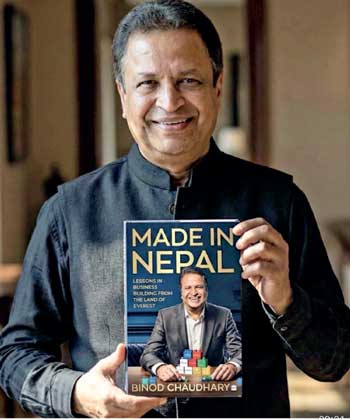 |
| Binod Chaudhary |
One particularly striking episode from Nepal’s period of unrest captures the unpredictability of operating in fragile environments. Chaudhary recounts a tense moment when armed men approached him during a recent political crisis. Having previously dealt with Maoist insurgents in Nepal and militant groups in India, he initially feared the worst. When one of the men asked, “Are you Binod Chaudhary?”, he braced himself for danger—only to discover that they were members of his own security detail, dispatched to ensure his protection. The incident, at once unsettling and revealing, underscores the psychological demands of leadership in unstable contexts.
Where Made in Nepal distinguishes itself from many founder memoirs is its emphasis on institutionalisation. Chaudhary repeatedly underscores the importance of professional management, governance structures, and succession planning. He cautions against overreliance on founder charisma, arguing that sustainable growth demands systems that outlast personalities. In this respect, the book reads less like a celebration of individual brilliance and more like a considered case for organisational maturity.
A broader economic subtext runs throughout the narrative. Chaudhary situates his journey within Nepal’s development trajectory, suggesting that private enterprise can act as a stabilising force in fragile economies. Business, in his telling, is not solely about shareholder returns but about employment generation, capability building, and national confidence. While the tone occasionally reflects patriotic advocacy, it remains grounded in lived experience rather than abstract rhetoric.
Particularly relevant for Sri Lankan readers are Chaudhary’s bold investments in neighbouring markets during challenging periods. His strategic acquisitions and partnerships in Sri Lanka—across banking, real estate, and hospitality—demonstrate a long-term belief in the country’s resilience and potential. At times when investor sentiment was cautious, his continued engagement reflected both commercial conviction and regional solidarity. These investments reinforce his broader philosophy: disciplined enterprise can create value even amid economic uncertainty, while simultaneously contributing to employment and industrial capacity.
The narrative is direct and unembellished. Chaudhary favours clarity over flourish, recounting negotiations, market entries, and expansion decisions with pragmatic precision and decisiveness. Some readers may find the tone more instructive than emotive; yet it is precisely this candour that strengthens the book’s credibility. Lessons on diversification, cross-border scaling, change management, and brand building emerge organically from lived experience rather than being presented as retrospective theory. At moments, the discipline and institutional focus echo the “good to great” philosophy associated with Jim Collins—particularly the emphasis on systems, leadership humility, and enduring organisational excellence.
One of the book’s most significant contributions lies in its exploration of global ambition from a peripheral base. Chaudhary challenges the assumption that emerging-market firms must first saturate domestic markets before venturing abroad. In smaller economies, he argues, internationalisation is not optional but essential; scale must be pursued externally when domestic ceilings are limited.
At a time when supply chains are being recalibrated and geopolitical shifts are reshaping global trade, Made in Nepal serves as a reminder that competitive advantage can be constructed in unlikely places. The “Land of Everest” operates as both metaphor and backdrop—a landscape where endurance is embedded in culture.
For business leaders in larger economies, the book offers perspective. For entrepreneurs in emerging markets, it provides encouragement grounded in precedent. For policymakers, it underscores a recurring lesson: enabling enterprise may be one of the most reliable pathways to national resilience. The narrative also pays generous tribute to mentors, friends, and family, reinforcing the importance of support systems behind entrepreneurial success.
Chaudhary does not portray himself as infallible. Failures and miscalculations appear alongside achievements, strengthening the book’s central message that setbacks are integral to scale. Ultimately, Made in Nepal is less a victory lap than a call to expand the map of global business possibility—and to recognise that ambition, when combined with hard work, discipline, resilience, and courage, can transcend even the most formidable constraints. It is a rewarding read for those committed to nation-building, offering corporate adventure, practical philosophy, and enduring leadership lessons—particularly for young leaders in emerging economies determined to transform adversity into opportunity. In that sense, it echoes the enduring realism of Niccolò Machiavelli: fortune favours those prepared to shape it.



