Wednesday Oct 21, 2026
Wednesday Oct 21, 2026
Tuesday, 7 July 2026 05:04 - - {{hitsCtrl.values.hits}}
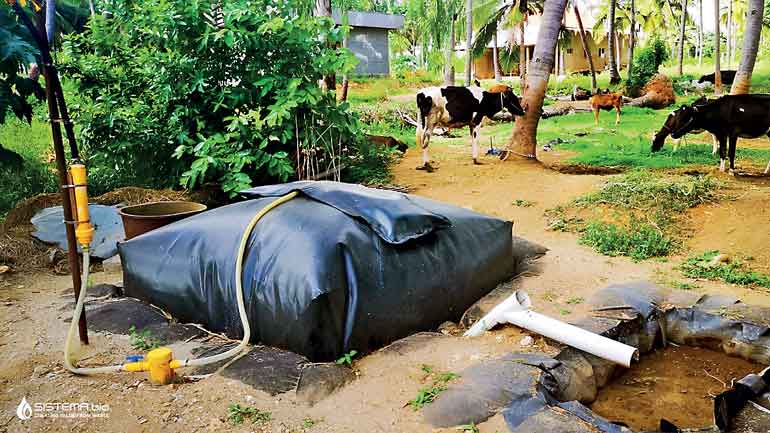
 A single number should change the way Sri Lanka looks at cow dung: Rs. 252,000. That is the annual saving a dairy household of five to six people, with three to four cows and two acres of land, could retain by replacing part of its LPG and chemical fertiliser use through a properly installed biodigester, according to a Solidaridad–Nucleus Foundation pilot model. It is not a national average, and it should not be treated as one. But it raises a national question: why should rural families keep sending scarce cash out of the village for fuel and nutrients when part of both can be produced at the farm gate?
On several visits I undertook last year to rural households in Sri Lanka, I was reminded how many national problems can gather in one small kitchen: smoke from the stove, a half-used LPG cylinder, a fertiliser bill on the table, and a cowshed where manure had become a sanitation problem rather than a resource.
These may appear to belong to different stories. In reality, they are part of the same national challenge. Sri Lanka’s struggle for energy security, food security, nutrient security and environmental recovery is often discussed in separate rooms by separate ministries. Yet on thousands of farms, these issues come together every morning before breakfast.
The most visible sign is the cooking fire. Sri Lanka remains deeply anchored to biomass. Elledge, Everett and Nandasena study on biomass stove use found that over 78% of Sri Lankan households burned wood in biomass stoves; the figure was about 84% in rural areas and 96% in estate communities, while even urban firewood use exceeded 34% (Elledge, Everett and Nandasena, 2012). Pallegedara and Kumara later noted that 70.3% of Sri Lankan households still depended on firewood for cooking (Pallegedara and Kumara, 2022).
A farmer worries about the next fertiliser purchase because imported nutrients are expensive. A dairy household keeps cattle, but manure lies in heaps, releasing odour, methane and flies. A woman cooks with firewood because LPG is either too costly, too uncertain, or saved for special meals. Meanwhile, the nation spends scarce foreign exchange on fuel, fertiliser and milk products, while local soils lose life and farmers lose confidence. This is not a crisis of one sector. It is a crisis of design.
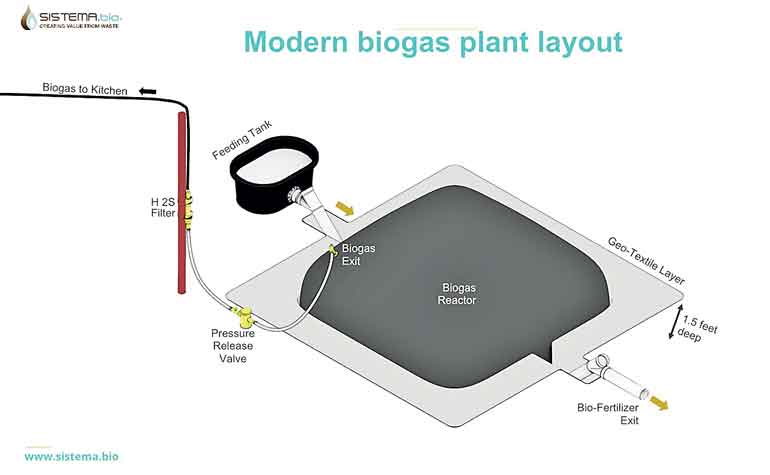
A biodigester is not a miracle machine. Its strength lies in being practical. Cow dung and water go into an airtight reactor. Microorganisms break down the organic matter in the absence of oxygen and produce biogas, which can be piped to a stove. The remaining slurry becomes a nutrient-rich organic fertiliser that can be returned to crops, fodder plots and home gardens. The second output is just as important. FAO’s review Bioslurry = Brown Gold notes that bioslurry has the potential to improve soil fertility and soil structure when used properly
A country still waiting for ships
Sri Lanka knows better than most countries the cost of import dependence. In 2025, total merchandise imports rose to $21.5 billion, the second-highest level on record after 2018, according to the Central Bank of Sri Lanka’s Annual Economic Review 2025. Fuel remained the largest item in the import basket, costing about $4 billion, even though lower petroleum and coal prices reduced the bill from $4.4 billion in 2024.
The pressure does not stop at fuel. Central Bank trade classifications show that Sri Lanka also spent heavily on dairy products, fertiliser, agricultural inputs and chemical products in 2025. The direction is clear: Sri Lanka’s farm and food systems remain tied to imported energy, nutrients, and dairy ingredients.
The farm is feeling the heat
The pressure is not only economic. Sri Lankan farms are already living with climate risk. A 2024 study on Sri Lanka’s climate and disaster-risk ecosystem, published through WeAdapt and InsuResilience, identifies rising temperatures, water scarcity, erratic rainfall, pests and diseases, soil degradation and extreme weather as primary risks to food systems. Farmers also face indirect pressures such as market volatility, supply-chain disruptions and the rising cost of living.
Climate stress does not arrive alone. It comes with higher input costs, uncertain yields, falling soil organic matter, greater irrigation demand and weaker farm incomes. A farmer facing dry spells needs better soil structure, better moisture retention and balanced crop nutrition. Yet when imported fertiliser becomes expensive, the farmer is pushed into a trap: the land needs more care just when the household has less cash to provide it.
This argument must not be confused with a return to Sri Lanka’s abrupt organic-only experiment of 2021. That policy left a deep scar on farmers and on public trust. Bio-slurry from biodigesters is not a substitute for scientific fertiliser policy, soil testing or balanced crop nutrition. Its value lies in reducing part of the dependence on imported nutrients, improving soil organic matter, and helping farmers use chemical fertilisers more efficiently. The lesson from Sri Lanka’s fertiliser crisis is not that farmers should be denied mineral nutrients; it is that the country needs a more resilient nutrient system.
The link between energy and agriculture becomes painfully clear when LPG prices rise or cylinders are difficult to refill. Families do not stop cooking. They fall back on the fuel they know: firewood. But firewood is not free. It is paid for through women’s time, labour and lungs. This burden is strongly gendered. In most rural households, women remain responsible for cooking and much of the daily care economy. the rural energy question is not separate from women’s health, farm productivity or household dignity. The cooking fire is where national import dependence becomes personal
When LPG fails, women pay the price
The link between energy and agriculture becomes painfully clear when LPG prices rise or cylinders are difficult to refill. Families do not stop cooking. They fall back on the fuel they know: firewood. But firewood is not free. It is paid for through women’s time, labour and lungs.
This burden is strongly gendered. In most rural households, women remain responsible for cooking and much of the daily care economy. Pallegedara and Kumara (2022), studying Sri Lankan micro-data, found that firewood burning for cooking influences respiratory health and healthcare utilisation. Their study links firewood use to respiratory-health burdens and higher use of healthcare services.
A small biodigester pilot baseline conducted by Solidaridad and Nucleus Foundation in 2025 gives this reality a human scale. In the surveyed dairy and mixed-farming households, all respondents reported firewood as the dominant cooking fuel. Eighty per cent said firewood collection was a burden, citing long distances, heavy loads and snake-bite risks. Many households also used one or two LPG cylinders a month, suggesting that rural families often combine firewood and LPG rather than fully shifting to clean cooking. The same baseline found that most farmers spent Rs. 25,000 to Rs. 40,000 per month on fertiliser, with average monthly fertiliser expenditure around Rs. 28,000. These findings are indicative, not nationally representative, but they show where the pressure sits in daily life.
This is why the rural energy question is not separate from women’s health, farm productivity or household dignity. The cooking fire is where national import dependence becomes personal.
A quiet technology with national relevance
A biodigester is not a miracle machine. Its strength lies in being practical. Cow dung and water go into an airtight reactor. Microorganisms break down the organic matter in the absence of oxygen and produce biogas, which can be piped to a stove. The remaining slurry becomes a nutrient-rich organic fertiliser that can be returned to crops, fodder plots and home gardens.
The International Energy Agency describes biogas as a mixture of methane, carbon dioxide and small quantities of other gases produced through anaerobic digestion of organic matter in an oxygen-free environment (IEA, 2020). In simpler terms, a biodigester turns farm waste into usable energy.
The second output is just as important. FAO’s review Bioslurry = Brown Gold notes that bioslurry has the potential to improve soil fertility and soil structure when used properly (FAO, 2013). For Sri Lanka, this is valuable not because it replaces all fertiliser, but because it returns part of the nutrient cycle to the farm gate.
The case for biodigesters should begin with three words: availability, accessibility and affordability. The raw material is already there. The Solidaridad–Nucleus pilot baseline found households owning cows, buffaloes, goats and poultry, with average daily dung production estimated at around 80 to 100 kg. That is enough to support household-scale or clustered energy solutions, depending on farm size, animal management and local design. The energy is local. Unlike LPG, biogas does not depend on foreign exchange, shipping lanes or international oil prices. The nutrient stream is local too. Bio-slurry does not remove the need for sound fertiliser planning, but it can reduce pressure on imported fertilisers, improve soil organic matter and support fodder production
For many readers, the word “biogas” may bring back memories of old village plants that worked briefly and then fell into disuse. Sri Lanka›s earlier biogas efforts often failed because digesters were treated as one-time installations with no maintenance network, were incorrectly sized for household needs, or relied on subsidies that led to poor quality control. What has changed? Modern programs link digesters to ongoing service contracts, use standardised designs with quality certification, and increasingly rely on carbon finance rather than state subsidies creating market discipline.
Modern biodigesters may be prefabricated or locally built, household-scale or community-scale, simple or digitally monitored. The technology choice matters less than the service model. A digester that is sold and forgotten is a risk. A digester that is installed, monitored and supported becomes rural infrastructure.
Availability, accessibility and affordability
The case for biodigesters should begin with three words: availability, accessibility and affordability.
The raw material is already there. The Solidaridad–Nucleus pilot baseline found households owning cows, buffaloes, goats and poultry, with average daily dung production estimated at around 80 to 100 kg. That is enough to support household-scale or clustered energy solutions, depending on farm size, animal management and local design.
The energy is local. Unlike LPG, biogas does not depend on foreign exchange, shipping lanes or international oil prices. The nutrient stream is local too. Bio-slurry does not remove the need for sound fertiliser planning, but it can reduce pressure on imported fertilisers, improve soil organic matter and support fodder production.
Accessibility depends on delivery design. Biodigesters should not be pushed as one-off equipment sales. They should be linked to dairy companies, farmer organisations, women’s groups, local technicians, village-level service providers, banks, carbon project developers and public extension systems. In rural areas, technology spreads when people see it working in a neighbour’s home and know whom to call when something goes wrong.
Affordability is the third test. A biodigester may be financially attractive over time, but the upfront cost can still be too high for a small farmer. That is where public incentives, concessional finance, climate finance and carbon revenue can help. The household should not be asked to bear the full cost alone when the benefits are national.
Lessons from the region
Sri Lanka does not have to start from zero. Bangladesh offers a useful regional lesson. The Infrastructure Development Company Limited’s national biogas and bio-fertiliser programme has financed more than 56,500 biogas plants. IDCOL reports that these plants save about 54,200 tons of firewood a year, worth $4.27 million, and reduce chemical fertiliser use by 48,000 tons, worth $10.67 million, by producing 335,000 tons of organic fertiliser annually (IDCOL, Biogas and Bio-fertiliser Programme).
For Sri Lanka, the lesson is not that Bangladesh’s model can be copied mechanically. The lesson is that biodigesters can ease the cooking-fuel burden and the fertiliser burden at the same time when technology, finance, service and farmer support are organised together.
What the farmer gains, what the country saves
The Solidaridad–Nucleus pilot model suggests that a family of five to six people, with three to four cows and two acres of land, could save about Rs. 252,000 a year through avoided LPG purchase and reduced chemical fertiliser use. The same model suggests bio-slurry could replace 70% to 80% of chemical fertiliser use under specific farm assumptions. These are not national averages; they are indicative estimates that need testing across crops, soils and regions.
Biodigesters will not solve every problem in Sri Lanka’s agriculture or energy economy. They will not replace national fertiliser planning, dairy sector reform, watershed management or renewable electricity. But they can do something rare: solve several small but costly problems at the same time, in the same household, with one practical intervention. Sri Lanka does not need another imported dependency disguised as modernisation. It needs technologies that convert local resources into local resilience
Even with that caution, the arithmetic is worth examining. If 50,000 dairy households retained Rs. 200,000 to Rs. 250,000 each year through lower fuel and fertiliser spending, Rs. 10 billion to Rs. 12.5 billion would remain in rural economies. At 100,000 households, the figure would rise to Rs. 20 billion to Rs. 25 billion. This is not a precise foreign-exchange saving, because not every rupee saved maps directly to an avoided import. But the direction is clear: every avoided LPG refill, every reduced bag of imported fertiliser and every improvement in local milk productivity chips away at import dependence.
The wider developmental gains are equally important. Cleaner kitchens reduce smoke exposure. Women save time. Manure is managed better. Odour and flies decline. Bio-slurry returns nutrients to the soil. Fodder quality can improve. Dairy productivity may increase when farmers reinvest savings into feed, animal care and farm management.
The carbon market can carry part or the full upfront cost
Carbon finance can help turn biodigesters from a good idea into a scalable programme. The logic is straightforward. A biodigester can reduce emissions by capturing methane from unmanaged manure and by replacing firewood, LPG or other fuels. If these reductions are measured conservatively, verified independently and registered under credible standards, they can generate carbon credits.
If designed well, this carbon revenue could make biodigesters free, or nearly free, for Sri Lankan dairy households at the point of delivery, with the future value of verified carbon credits used upfront to pay for the equipment, installation and after-service.
Contd.on page 16...
(The author is the Managing Director of Solidaridad Asia and a founding member of Solidaridad’s global senior management team. An economist by training, he serves on the organisation’s Global Executive Board, providing strategic leadership in program development, financial stewardship, and governance. Since establishing Solidaridad’s presence in Asia in 2007, he has grown it into a regional sustainability powerhouse, with a multidisciplinary team of over 650 professionals operating from 26 offices across nine Asian countries. He has led extensive research on sustainable development and policy, with a strong focus on the nexus of environmental sustainability, climate action, and socioeconomic equity)
The Gold Standard methodology for animal manure management and biogas use recognises projects that recover and use methane from manure and agricultural wastes that would otherwise decay anaerobically and emit methane (Gold Standard, 2022). This means household and farm biodigesters can qualify for carbon finance if they meet strict rules on baseline setting, monitoring, safeguards and verification.
Sri Lanka already has a route to such a market. Japan and Sri Lanka signed a Memorandum of Cooperation on the Joint Crediting Mechanism in October 2022. Japan’s Ministry of the Environment described Sri Lanka as Japan’s 23rd JCM partner country. The JCM is designed to promote low-carbon technologies and allow verified emission reductions to contribute to climate goals while avoiding double counting (Ministry of the Environment Japan, 2022; Ministry of Foreign Affairs Japan, 2026).
Similar Article 6 arrangements could be explored with other countries, including the Netherlands, if Sri Lanka provides a clear, investable and transparent policy framework.
The policy bargain: remove duties, share carbon wisely
Two policy choices can make or break this opportunity.
The first is customs duty. Biodigesters, gas pipes, valves, filters, cookstoves, meters and related components should not be treated as ordinary imports. They are rural climate infrastructure. If the intended beneficiaries are small farmers, customs duties and para-tariffs should be brought to zero through a clear, time-bound policy. The fiscal revenue foregone at the border would be modest compared with the national gains from lower LPG dependence, reduced fertiliser pressure, cleaner kitchens, better manure management and climate mitigation.
The second choice is carbon benefit sharing. Sri Lanka should, of course, secure a fair share of the carbon value generated within its borders. But fairness must also reflect who carries the cost and risk. If a private investor or carbon-finance partner pays for the biodigesters upfront, covers installation and after-service, carries performance risk, and waits for verified carbon credits to be issued over time, then the project’s commercial logic depends heavily on the future carbon stream.
This is where a rigid 50:50 approach can become counterproductive. On paper, it may appear to protect the national interest. In practice, it may make the programme unattractive to investors and leave farmers with no biodigesters, no clean cooking gas, no bio-slurry, no reduction in firewood use, and no carbon revenue at all. A high share of a stalled project is not a national gain.
An 80:20 arrangement may therefore be the wiser bargain in cases where Sri Lanka does not invest public capital in the assets. Eighty per cent of the carbon value would remain with the investor and delivery structure that pays for the equipment, installation, monitoring and risk. Twenty per cent would accrue to Sri Lanka as the host country. More importantly, Sri Lanka would also receive the domestic benefits: rural clean-energy infrastructure, lower LPG dependence, reduced fertiliser pressure, better manure management, cleaner kitchens, improved soil nutrients and progress towards climate targets.
The most secure fuel may be made at home
Biodigesters will not solve every problem in Sri Lanka’s agriculture or energy economy. They will not replace national fertiliser planning, dairy sector reform, watershed management or renewable electricity. But they can do something rare: solve several small but costly problems at the same time, in the same household, with one practical intervention.
Sri Lanka does not need another imported dependency disguised as modernisation. It needs technologies that convert local resources into local resilience. A biodigester takes what a farm already has, manure, labour, livestock and land, and turns it into clean cooking gas, organic nutrients, lower costs, women’s time, carbon revenue and healthier villages.
For a country that has learned the cost of waiting for ships, the most secure fuel may be the gas made at home, behind the cowshed.




