Monday Oct 12, 2026
Monday Oct 12, 2026
Monday, 12 October 2026 03:17 - - {{hitsCtrl.values.hits}}
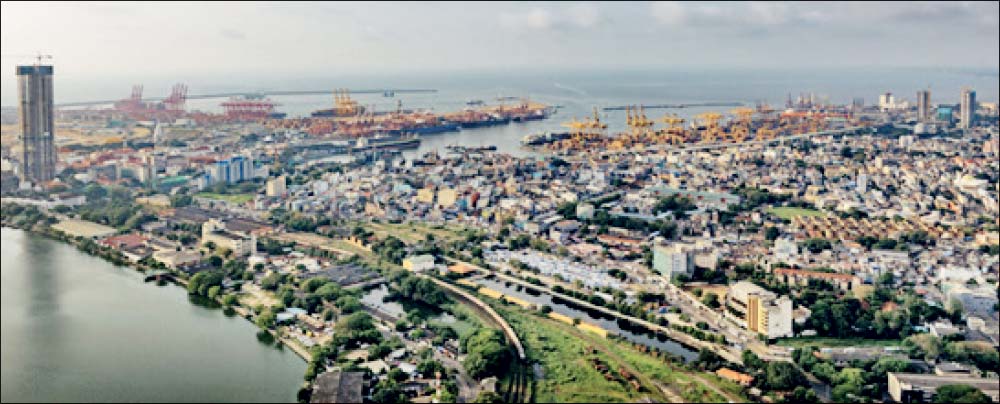
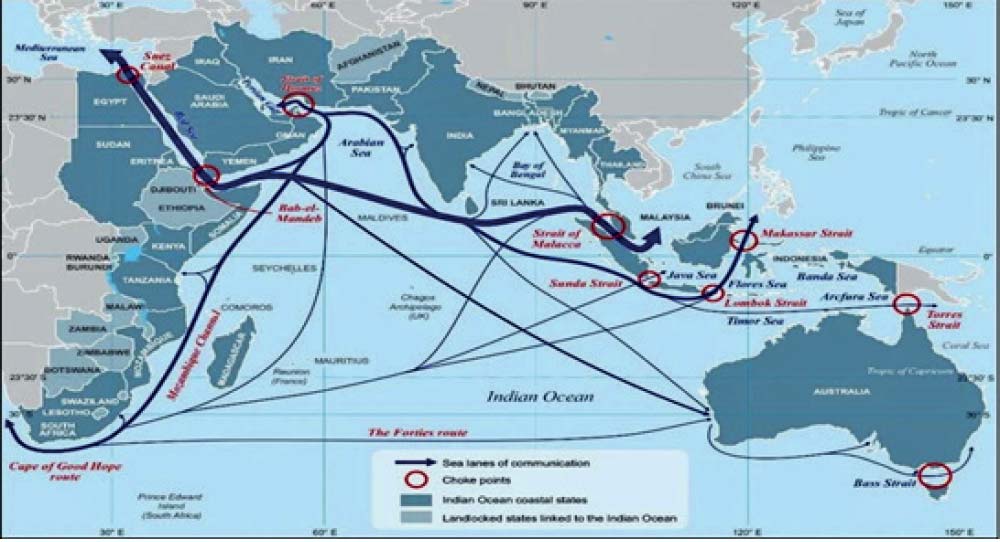
Sri Lanka’s central location along critical Indian Ocean sea lanes. Source: ResearchGate
 Sri Lanka cannot afford to remain reactive in an era of global volatility. The current combination of maritime disruption, energy realignment, climate pressures on competing hubs, and Middle Eastern capital reallocation will not last indefinitely. The country must make bold, well-governed bets across digital infrastructure, energy arbitrage, value-added logistics, and international finance before this strategic window closes
 The world’s economy is changing fast but not because anyone planned it this way. Ships can no longer safely pass through the Red Sea. The Strait of Hormuz stays tense. The US and China keep pulling further apart on trade. And climate change is hitting hard at major ports and trade hubs across Asia and the Middle East. All of this has made one old truth new again: where a country sits on the map matters a lot. Sri Lanka sits right beside one of the busiest shipping routes in the world. For decades, we treated this as just a fact nice to have, but nothing to act on. We watched the ships go by. That has to change. Sri Lanka has two big advantages: a location the whole world depends on, and rich natural resources good land, water, minerals, and coastlines. Very few small countries have both. The idea is simple: stop letting these advantages sit idle. Build real industries and real income around them, instead of just being a country that ships pass on their way to somewhere else.
The dislocation window: Why now?
Global investors, logistics companies, and tech firms are actively searching for safe, backup locations due to three major pressures:
Maritime chokepoint risk:
Rerouting around the Cape of Good Hope adds 10 to 15 days to Asia–Europe transit. Even with partial returns to Suez, war-risk premiums and schedule congestion at regional ports persist. Colombo Port has benefited passively container volumes grew by roughly 12% in early 2026 but transhipment alone misses the primary economic prize.
Redesigning supply chains:
Global manufacturers no longer rely on single shipping routes or single countries. They are permanently setting up secondary bases in safe, neutral locations to protect their business from future disruptions.
Climate and geopolitical stress on existing hubs: Rising seas and extreme weather are making it more expensive and riskier to run ports, data centers, and factories in parts of Southeast Asia and the Gulf. Flooding, storms, and heat are no longer occasional problems they’re becoming regular costs of doing business there. Sri Lanka, as a stable island, offers a natural safe alternative but only if our policies keep up and make it easy for businesses to actually move here.
Six interconnected capture opportunities
Rather than spreading resources thinly or relying on incremental policy adjustments, Sri Lanka must execute six targeted, out-of-the-box strategic positions while this realignment window remains open.
A. Digital infrastructure and regional "failover" data hub
Recent Middle East conflicts have shown how fragile global data networks are when servers and internet cables are concentrated in high-risk zones. Sri Lanka can’t realistically compete with giants like Singapore or Mumbai as a major data hub we simply don’t have the power capacity for that. But we don’t need to.
Instead, Sri Lanka should become South Asia’s primary disaster-recovery and “failover” location the ultimate insurance policy for companies needing a secure backup when geopolitical conflicts or climate disasters threaten their primary Middle Eastern or regional servers.
By leveraging major subsea cables landing on our shores (like SEA-ME-WE 6), Sri Lanka can host high-security backup data centers. Unlocking this multi-million-dollar opportunity requires fast-tracking 100% foreign ownership and pairing digital zones with dedicated renewable power contracts so operators don’t strain our national grid. This is the kind of asset that attracts the companies building out backup and edge capacity across the region, names like Equinix, STT GDC, AirTrunk, and Bridge Data Centres, all of whom have expanded aggressively into South and Southeast Asia. The government should engage these companies directly — not wait for them to come knocking, but actively court them with the cable, power, and land package already on the table.
B. Multi-fuel regional energy hub
Trincomalee must be reframed beyond conventional oil storage into a multi-fuel energy trading, bunkering, and floating LNG storage hub supplying cleaner marine fuels (LNG, green ammonia/hydrogen, and low-sulfur oil) to rerouted Indian Ocean shipping.
Recent supply chain shocks such as disruptions affecting Qatari LNG transit—serve as an eye-opener: global energy producers urgently need strategic, neutral intermediate storage locations outside the Strait of Hormuz. Sri Lanka should actively engage sovereign wealth entities like the Qatar Investment Authority (QIA) and Qatar Energy , Oman authoritires to co-invest in bonded LNG storage and Floating Storage and Regasification Units (FSRUs) at Trincomalee.
Simultaneously, the proposed India–Sri Lanka power grid interconnection should be operated as a two-way energy arbitrage asset, allowing Sri Lanka to export surplus northern wind power to India during low domestic demand cycles while importing power during peak shifts.
C. “Friend-Shoring” Supply Chain Node
Global manufacturers prefer moving supply chains to friendly, stable countries to avoid high-risk transit zones. Sri Lanka can become a safe consolidation hub for light manufacturing, garment value chains, and electronics assembly serving South Asian and Middle Eastern demand. Success requires bundling export processing zones, bonded warehousing, and rapid vessel-to-factory logistics into a single, seamless investable product.
D. Integrated Re-Export & Free Port Economy
Moving containers from ship to ship yields minimal value. As highlighted at the CIMC 2026 summit, the real prize lies in an integrated re-export economy: breaking bulk, light assembly, repackaging, and redistribution. Establishing true free-port regimes at Colombo and Hambantota with single-window customs clearance will unlock high-margin value addition.
E. Modern Airbase-Linked Aviation Clusters
Secondary aviation infrastructure most notably Mattalarepresents an underutilised strategic asset. As primary Middle Eastern and South Asian hubs face capacity constraints, Sri Lanka can establish dedicated Maintenance, Repair, and Overhaul (MRO) free zones and cold-chain air-cargo corridors for high-value perishables and pharmaceuticals.
F. Financial Investment Park: Connecting Middle East Capital to Asian Growth
Physical supply chains require financial supply chains. Middle Eastern financial powerhouses in Dubai (DIFC), Abu Dhabi (ADGM), and Riyadh sit on immense pools of capital seeking growth exposure in South Asia. Sri Lanka can bridge this capital flow by developing a dedicated Financial Investment Park / International Financial Centre (IFC)concept, anchored by Port City Colombo (CIFC):
The Enabling Architecture: What Execution Demands
Geography and position alone will yield nothing without structural readiness. Winning this transition requires four non-negotiable policy actions:
Conclusion
Sri Lanka cannot afford to remain reactive in an era of global volatility. The current combination of maritime disruption, energy realignment, climate pressures on competing hubs, and Middle Eastern capital reallocation will not last indefinitely. The country must make bold, well-governed bets across digital infrastructure, energy arbitrage, value-added logistics, and international finance before this strategic window closes.




