Friday Sep 18, 2026
Friday Sep 18, 2026
Friday, 18 September 2026 00:24 - - {{hitsCtrl.values.hits}}
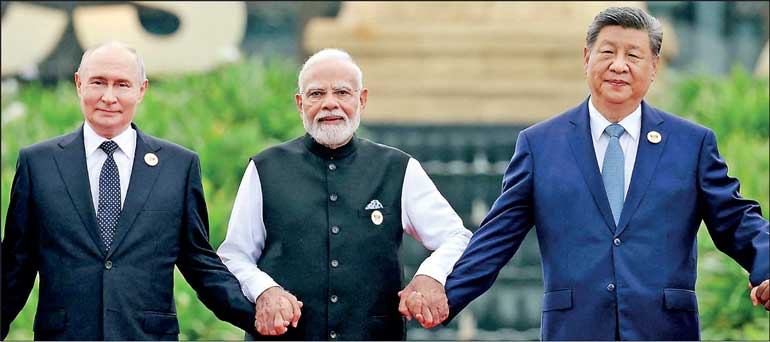
From left: Russian President Vladimir Putin, Indian Prime Minister Narendra Modi and Chinese President Xi Jinping pose for a photo at the BRICS summit in Delhi

The most important financial story to emerge from the 18th BRICS Summit in New Delhi was not the birth of a new currency. There was no new BRICS banknote. No monetary union was announced. No replacement for the US dollar suddenly appeared on the horizon.
What emerged instead was potentially more practical: a slow attempt to construct the plumbing of a more diversified global economy. Payment systems. Local currencies. Trade finance. Development finance. Digital infrastructure. Artificial intelligence. Critical minerals. Supply chains. These may sound technical. But the future of geopolitical power increasingly depends on them.
The New Delhi Declaration encouraged greater use of national currencies in trade and investment and supported work toward interoperability between BRICS payment and financial messaging systems. It also encouraged the New Development Bank to expand local-currency financing. That is not a financial revolution overnight. It is infrastructure for gradual change.
Why the dollar question matters
The dollar’s global role is not simply a matter of American prestige. It is embedded in trade invoicing, international banking, investment, reserves, commodities and payment infrastructure. That makes the dollar system extraordinarily difficult to replace. BRICS knows this. The members themselves remain deeply connected to the existing global financial system. Their economies have different monetary regimes. Their trade patterns differ. Their financial markets differ. Their capital controls differ. Their currencies have different degrees of international convertibility. A common BRICS currency would therefore be extraordinarily difficult. Payment interoperability is much more realistic.
New geography of payments
India’s UPI has become one of the world’s most prominent instant payment systems. Brazil’s Pix has achieved enormous domestic scale. Other BRICS members possess their own national systems. The idea now being explored is whether such systems can be connected. That could reduce transaction costs, accelerate settlement and potentially expand trade in national currencies.
Financial Times reporting has highlighted the growing interest in cross-border links among BRICS payment systems, while also noting the practical obstacles posed by incompatible currency systems, capital controls and trade imbalances. For businesses, that distinction matters. Geopolitical declarations are one thing. Lower transaction costs are another. If a small exporter can receive payment faster and more cheaply, the consequences are real.
What it could mean for the Global South
For many developing economies, international payments are expensive. Small businesses face currency conversion costs. Migrant workers pay fees to send money home. Importers depend on banking networks that can be disrupted by sanctions or financial restrictions. Trade finance remains inaccessible for many companies.
A more interoperable payment ecosystem could therefore have benefits beyond geopolitics. It could become development infrastructure. That is where the BRICS financial agenda becomes particularly interesting. The question is no longer simply, Can BRICS reduce dependence on the dollar? It is, Can BRICS make cross-border economic activity cheaper and more accessible for ordinary businesses and workers?
New Development Bank
The New Development Bank remains one of BRICS’ most tangible institutions. At New Delhi, leaders supported further strengthening of the bank, including expanding its membership base and increasing local-currency financing. The declaration also backed continued work on a new investment platform. This is important because infrastructure finance is one of the Global South’s largest structural challenges. Ports. Railways. Renewable energy. Water systems. Digital networks. Urban infrastructure. Climate adaptation. Health infrastructure.
These require enormous capital. Traditional development institutions remain important, but developing countries have long argued that their governance structures do not adequately reflect contemporary global realities. BRICS therefore has an opportunity to provide additional financing channels. But financing must be judged by its quality. A BRICS alternative should not reproduce debt dependency under a different flag.
Tariff problem
The summit also took place against a profound restructuring of global trade. Protectionism is returning. Tariffs are increasingly being used as geopolitical instruments. Trade restrictions are being justified through national security, industrial policy and environmental concerns. The New Delhi Declaration strongly criticised unilateral tariffs and non-tariff barriers, warning that such measures can disrupt supply chains and disproportionately affect developing economies.
For businesses in emerging markets, this is an increasingly dangerous environment. A company may have a competitive product but suddenly face a tariff. A country may invest in a manufacturing sector only to find its export market politically closed. A supply chain built over decades can be reorganised within months. The era when global trade was governed primarily by efficiency is giving way to an era where resilience and strategic autonomy increasingly matter.
Critical mineral economy
Nowhere is this more visible than in minerals. The global energy transition is increasing demand for lithium, cobalt, nickel, graphite and rare earth elements. Electric vehicles need batteries. Renewable energy requires enormous material inputs. Semiconductors and advanced technologies depend on specialised minerals. Military systems require many of the same resources. This means that the green transition is simultaneously becoming a geopolitical competition.
India’s warning at the summit against the weaponisation of critical minerals therefore has major economic significance. The challenge for BRICS is to build supply-chain resilience while ensuring that resource-rich developing countries do not remain trapped at the bottom of the value chain. Exporting raw minerals is not enough. The Global South needs processing. It needs technology. It needs manufacturing. It needs skills. It needs research. Otherwise, the next commodity cycle will simply reproduce the old pattern of dependency.
AI: New industrial revolution
The next economic transformation may be even larger. Artificial intelligence is changing productivity, manufacturing, services, logistics, finance and education. China’s Xi Jinping proposed a BRICS AI Open Source Zone and further cooperation in services and economic development.
This opens a strategic question. Will AI become another technology concentrated in a few powerful corporations and countries? Or can emerging economies develop shared infrastructure and knowledge? The Global South has an opportunity to avoid becoming merely the market for other people’s technologies. But this requires investment in education, research, computing infrastructure and electricity.AI cannot operate in the cloud without physical infrastructure. Data centres consume enormous quantities of energy. The AI economy is therefore also an energy economy.
Energy contradiction
This creates one of the most difficult BRICS dilemmas. The world needs rapid decarbonisation. But developing countries also need reliable energy for industrialisation. The New Delhi Declaration recognised the continued role of fossil fuels while addressing energy transition and sustainability, while BRICS also criticised carbon-border measures that it sees as unfair trade barriers. This is a familiar Global South argument. Countries that industrialised earlier built wealth through large-scale fossil-fuel consumption. Developing countries now face pressure to decarbonise while still struggling with poverty, energy access and industrial development. The solution cannot simply be “Developing countries must stop developing”.
The answer must be technological cooperation, climate finance, affordable energy and a just transition.
Climate finance is economic policy
For emerging markets, climate change is not an environmental side issue. It is a balance-sheet issue. A flood can destroy infrastructure. A drought can reduce agricultural output. A cyclone can damage ports. Extreme heat can reduce labour productivity. A glacier collapse can destroy roads and hydropower infrastructure. Climate adaptation therefore requires capital. And the countries most exposed to climate risks often have the least fiscal space to respond. This is where BRICS financial institutions could become important. If development finance can be directed toward climate resilience, the economic returns could be enormous.
Small economies should be watching
For countries such as Sri Lanka, the BRICS transformation should be watched carefully. Sri Lanka is not a BRICS member. But it sits in a region deeply affected by BRICS trade, investment, shipping, energy and financial networks. Its future economic strategy cannot ignore the changing architecture. The opportunity is not to choose one geopolitical camp. It is to diversify intelligently. If BRICS payment systems become more interoperable, Sri Lankan businesses could potentially benefit from easier transactions with major emerging markets. If New Development Bank financing expands, new possibilities for infrastructure and sustainable development finance may emerge. If regional supply chains diversify, Sri Lanka could seek opportunities in logistics, services, manufacturing and maritime industries. But diversification requires policy capacity. A small country cannot simply wait for geopolitical change to produce benefits. It has to prepare.
Business meaning of multipolarity
Multipolarity is often discussed as a diplomatic concept. For business, it means something more concrete. It means more markets. More currencies. More payment systems. More standards. More supply-chain corridors. More regulatory complexity. More opportunities and more risks. Companies will increasingly have to think beyond the traditional North Atlantic economic system. African markets matter. Indian markets matter. Chinese markets matter. Gulf markets matter. Latin American markets matter. Southeast Asia matters. The Global South is not one market. It is a collection of increasingly interconnected markets.
BRICS investment question
There is, however, a danger. Economic nationalism can destroy the very cooperation BRICS wants to build. If every country subsidises its own industries, restricts imports, protects strategic sectors and controls technology exports, global trade could become increasingly fragmented.
The answer is not unrestricted globalisation. Nor is it economic isolation. The answer is strategic openness. Countries need the ability to protect essential sectors while maintaining sufficient trade and investment flows to support growth. BRICS can contribute to that balance if it builds practical rules rather than simply issuing political declarations.
From summit rhetoric to economic architecture
The most important achievement of New Delhi may therefore not be a spectacular announcement. It may be the accumulation of small mechanisms. Payment interoperability. Local-currency financing. Development banking. Digital infrastructure. AI cooperation. Supply-chain resilience. Critical-mineral partnerships. Trade facilitation. Investment platforms. Each mechanism is modest. Together they could form something larger. An economic architecture that gives emerging economies more options. That is the real significance of BRICS. Not the destruction of the existing system. Diversification of the system.
Next phase
The international economy is entering a period of profound uncertainty. The old assumptions are weakening. Globalisation is being reorganised. Technology is transforming productivity. Climate change is transforming risk. Wars are transforming supply chains. Tariffs are transforming trade. AI is transforming labour. Critical minerals are transforming geopolitics. In this environment, countries cannot rely on yesterday’s economic architecture. BRICS is attempting to build alternatives. But alternatives will only matter if they work. A payment system must actually make payments easier.
A development bank must finance productive and sustainable projects .A local-currency mechanism must manage exchange-rate risks. An AI initiative must create real knowledge and capacity. A mineral partnership must produce value addition. A trade agreement must create opportunities for businesses beyond the largest corporations .This is the test.
Future will be built in the plumbing
The most consequential transformations in history often begin invisibly. Not with flags. Not with speeches. Not with summit photographs. But with systems. Railways. Ports. Telecommunications. Banking networks. Electricity grids. Digital platforms. Payment infrastructure. BRICS is now entering that territory.
The future contest is not simply about who controls the world’s largest military. It is about who can build the infrastructure through which the twenty-first-century economy moves. New Delhi showed that the emerging economies want a greater role in designing that infrastructure. Whether they can build it fairly, efficiently and inclusively remains the larger question. The BRICS story, therefore, is not really about a currency .It is about architecture. And architecture determines what kind of economy can be built inside it.
(The author is a researcher with the Law and Society Trust, global politics analyst and social documentary photographer)



