Friday Nov 20, 2026
Friday, 20 November 2026 00:25 - - {{hitsCtrl.values.hits}}
Earlier this year, I visited a temporary learning facility for children whose school had been relocated from their hill country estate after Cyclone Ditwah. What struck me was not only what they had lost, but what they were seeing for the first time. Instead of a short walk from their row house to school, the children now take a tuk-tuk down the hill into town. It is no exaggeration to say that their world view was being transformed by this experience. It reminded me that children’s futures are shaped by the opportunities in front of them – and that too often, where a child is born still decides what those opportunities are.
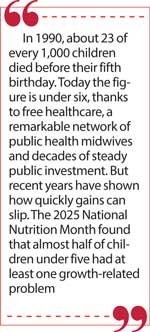
Today is World Children’s Day, and it is worth remembering how far Sri Lanka has already come in widening those opportunities. In 1990, about 23 of every 1,000 children died before their fifth birthday. Today the figure is under six, thanks to free healthcare, a remarkable network of public health midwives and decades of steady public investment.
But recent years have shown how quickly gains can slip. According to the World Bank, poverty more than doubled after 2019, from 11.3% to 24.5% in 2025. Cyclone Ditwah affected more than 275,000 children last year, and the 2025 National Nutrition Month found that almost half of children under five had at least one growth-related problem. The burden falls hardest on children on the plantations, in disaster-hit districts and children with disabilities – those already furthest from opportunity.
Every one of these children has the right to grow, learn and be safe – not someday, but now. Government cannot close these gaps alone, and neither can UNICEF. Children in Sri Lanka need business too.
And there is a window right now that will not stay open for long. Sri Lanka is reforming its education system, including a new early childhood curriculum. The first five years are when a child’s brain develops fastest and when every rupee goes furthest. Getting early learning right – trained teachers, quality preschools, children who arrive at school ready and excited to learn – may be the most important investment the country can make in its next generation. The reform is the chance to build that into the system, rather than fund around it.
The good news is that care for children runs deep in Sri Lanka. The country made education free in 1945, long before most of its neighbours, and has kept it free ever since. WHO and UNICEF data show that almost every Sri Lankan baby receives their routine vaccines in the first year of life. And when Cyclone Ditwah struck, UN figures show that nearly two in three displaced people were taken in by host families and communities rather than staying in safety centers – and more than four months later, some 150,000 people were still being hosted. Families opened their homes to other people’s children without being asked.
Sri Lankan businesses share that instinct. During the economic crisis, companies and individuals helped raise funds for children and families, and after Cyclone Ditwah, businesses gave generously to the recovery.
That generosity has mattered, and it will always be needed when disaster strikes. But much of it still goes to one school, one village or one cause close to a company’s heart – valuable but limited to the children it
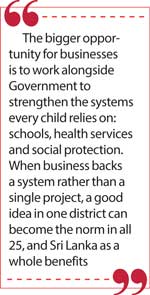
happens to reach. The bigger opportunity is to work alongside Government to strengthen the systems every child relies on: schools, health services and social protection. When business backs a system rather than a single project, a good idea in one district can become the norm in all 25, and Sri Lanka as a whole benefits.
The early years are the place to start. In Uva and Central provinces, businesses have worked with provincial authorities and UNICEF to improve preschools – funding that strengthens the public system rather than sitting alongside it. With the education reform under way, multi-year commitments like these could help the new early childhood curriculum reach every classroom, not just the fortunate ones.
It continues inside a company’s own walls. Some of the most powerful things a business can do for children sit in its own policies: parental leave beyond the legal minimum, breastfeeding spaces, childcare and flexible hours. On plantations and in apparel factories, where so many parents work, support for workers’ children is good for families and increasingly valued by export markets. Some firms are already leading – one agribusiness has appointed child protection focal points across its estates – and the Children’s Rights and Business Principles offer a practical guide for others ready to follow.
Business also brings what money alone cannot: know-how in logistics, technology, finance and data – exactly what helps services reach the children who are hardest to reach. In Sri Lanka we are exploring private-sector-led models to bring solar power to schools, clinics and water systems – solutions that make commercial sense and change children’s lives.
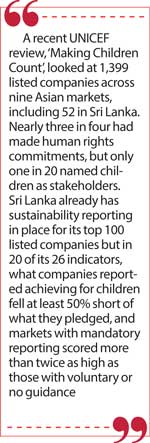
And what gets measured gets done. A recent UNICEF review, ‘Making Children Count’, looked at 1,399 listed companies across nine Asian markets, including 52 in Sri Lanka. Nearly three in four had made human rights commitments, but only one in 20 named children as stakeholders. Sri Lanka already has sustainability reporting in place for its top 100 listed companies but in 20 of its 26 indicators, what companies reported achieving for children fell at least 50% short of what they pledged, and markets with mandatory reporting scored more than twice as high as those with voluntary or no guidance. Asking them to report on how they respect children’s rights – in the workplace, in their supply chains and in their marketing – would be a low-cost way to make children visible and to turn goodwill into accountability.
This is also sound economics. Every dollar spent on childhood immunisation returns between $20 and $50 or more, and nutrition programs return more than $20. With an ageing population, where each generation of workers will be smaller than the last, Sri Lanka cannot afford for any child to fall behind. And as the country rebuilds after the economic crisis, investors are watching its people as closely as its balance sheet.
Eighty years ago next month, UNICEF was founded to help children recover from war. Sri Lanka’s children face different challenges today, but the question is the same: not whether we can afford to invest in them, but whether we can afford not to. So here is my challenge. By next World Children’s Day, let everyone of Sri Lanka’s top 100 listed companies report on what it is doing for children’s rights – not just what it has promised, but what it has delivered. Those children in their temporary classroom have already glimpsed a bigger world. Let’s make sure it is there waiting for them.
(The author is the UNICEF Representative in Sri Lanka, a role she assumed in August 2025. She has held senior leadership positions with UNICEF in Bangladesh, Sri Lanka and Mozambique, overseeing programs in complex humanitarian and development contexts, including responses to COVID-19, political unrest and refugee crises. A UK national, she previously worked with the Aga Khan Foundation and Chatham House, and has an academic background in Development Studies and International Relations)