Wednesday Sep 16, 2026
Wednesday Sep 16, 2026
Wednesday, 16 September 2026 00:20 - - {{hitsCtrl.values.hits}}
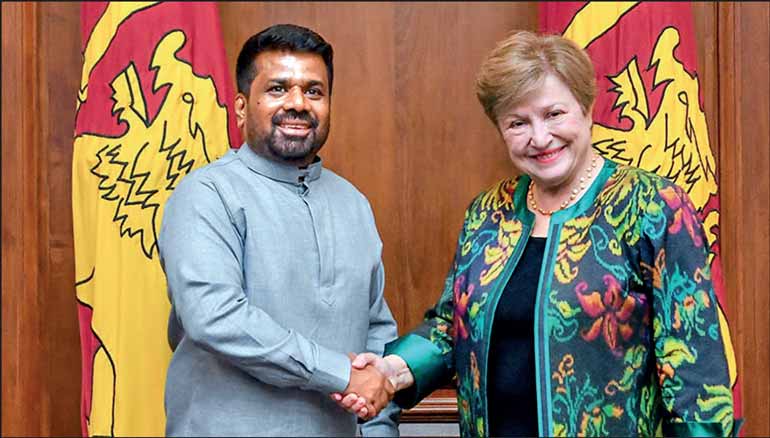
President Anura Kumara Dissanayake with IMF Managing Director Kristalina Georgieva during the latter’s visit in 2025 – File photo
 An International Monetary Fund delegation is currently in Sri Lanka to hold discussions relating to the Seventh Review of the country’s economic reform program supported by the Extended Fund Facility (EFF). The mission, which runs from 10 to 23 September, is led by Evan Papageorgiou, the IMF Mission Chief for Sri Lanka.
Successfully completing this review and continuing the IMF program as planned are important. Nevertheless, it is our considered view that Sri Lanka cannot build a sustainable economy over the long term merely by following the path prescribed by the IMF. Macroeconomic stability is an indispensable foundation, but it cannot be treated as the ultimate objective of national development.
Since the economic crisis of 2022, Sri Lanka has regained a degree of macroeconomic stability. Notable progress has been made in containing inflation, increasing Government revenue, strengthening the primary fiscal balance, rebuilding foreign reserves and restructuring public debt. These achievements should not be underestimated. However, they are not the final measures of the country’s development success. They are merely the foundations upon which the next stage of economic progress must be built.
This article therefore examines why Sri Lanka must move beyond the macroeconomic targets of the IMF program and undertake a broader economic transformation founded on production, exports and national capabilities.
What the IMF program can—and cannot—deliver
The primary purpose of an IMF program is to help a country manage a balance-of-payments crisis and restore macroeconomic stability. Its main areas of focus therefore include narrowing the gap between Government revenue and expenditure, restoring debt sustainability, safeguarding price and financial stability, rebuilding foreign reserves, strengthening public financial management and reducing vulnerabilities to corruption.
On 27 May 2026, the IMF Executive Board completed the combined Fifth and Sixth Reviews of Sri Lanka’s economic reform program. This decision provided the country with access to approximately US$695 million, bringing total disbursements under the arrangement to nearly US$2.4 billion. At the same time, the IMF projected that economic growth could slow to around 3 per cent in 2026 because of adverse conditions, including the conflict in the Middle East and the effects of the cyclone.
The crucial point is that macroeconomic stabilisation and economic transformation are not the same. Stabilisation prevents the economy from collapsing; transformation enables it to move forward.
Determining what goods and services Sri Lanka should produce, identifying the sectors in which it can compete globally, providing domestic entrepreneurs with access to technology and capital, and connecting rural production to international value chains are not the primary functions of an IMF program. These decisions are a national responsibility belonging to the Government of Sri Lanka, the business community, universities, research institutions, professionals and the people.
The IMF’s recommendations should therefore be incorporated into the national economic plan as important components. However, it would be misguided to assume that those recommendations alone should determine the country’s future direction. Sri Lanka’s development strategy should not become an extension of the IMF program. Instead, the IMF program should become one component of a much broader national development strategy designed and owned by Sri Lanka.
The real lesson of the 2022 crisis
Sri Lanka did not collapse economically merely because its debt had become too large. The country also failed, over several decades, to build a sufficiently strong production and export base capable of earning the foreign exchange required to service that debt.
Export revenue did not grow at the pace required, while the country remained heavily dependent on imports for fuel, medicine, food, machinery and industrial inputs. Consequently, the gap between import expenditure and export earnings continued to widen, creating an economic structure increasingly dependent on foreign borrowing to bridge that gap.
Foreign loans may be used to expand consumption, real estate, import-based trade and construction projects that generate inadequate revenue. Such activities may produce the appearance of economic growth for a limited period. However, they do not necessarily generate the foreign exchange required to repay the debt incurred. What happened in 2022 was the sudden exposure of this long-standing structural weakness.
The relief gained through debt restructuring is not permanent. Foreign-currency debt-servicing pressures are expected to increase again from 2028, while principal repayments will rise progressively in the years that follow. In addition, certain payments on Sri Lanka’s macro-linked bonds may vary according to the country’s nominal GDP measured in US dollars and its real economic growth during the 2025–2027 assessment period.
If the economy performs better than projected, the degree of debt relief may decline and the returns received by creditors may increase. This could affect the fiscal space available for education, healthcare, research, infrastructure and industrial expansion.
The temporary breathing space now available should therefore not be used merely to celebrate the return of stability. It must be used to build a foreign-exchange-earning economy capable of meeting its obligations when the next cycle of debt repayments intensifies.
The jigsaw puzzle of a production-based economy
The economic model best suited to Sri Lanka must be founded on production. However, building such an economy involves much more than opening a few factories, granting tax concessions or repeating the slogan, “Let us increase exports.” It must be a carefully designed and integrated national program in which every component is placed correctly—like the pieces of a jigsaw puzzle coming together to form a complete picture.
Fiscal discipline is one piece of this puzzle. A stable exchange-rate and interest-rate environment is another. Energy security, transport and logistics networks, technology, research, skilled labour, entrepreneurship, long-term industrial finance, access to export markets, quality standards and policy consistency constitute the other essential pieces. If these components are implemented separately and without coordination, the complete economic picture will never emerge.
The IMF’s recommendations must also be placed correctly within this jigsaw puzzle. A production-based economy cannot be built without fiscal discipline, debt sustainability, effective control of corruption, sound public financial management and price stability. However, assembling only these pieces will not complete the picture. Productive capacity, technological transformation, market access, industrial financing and human capital must be aligned with them.
Sri Lanka should not attempt to produce everything. It should strategically select sectors in which the country possesses a comparative advantage, existing capabilities or access to growing global demand.
These may include value-added agricultural and food products, pharmaceuticals and medical equipment, electronic components, rubber-based products, high-value apparel, boatbuilding, value addition to mineral resources, information technology, digital services and equipment required by the green-energy sector.
Attention should also be given to import substitution where it is economically justified. However, this must not become an excuse to maintain inefficient businesses indefinitely behind protective tariff walls. Incentives should be time-bound, performance-based and linked to measurable outcomes such as exports, employment creation, technology transfer and domestic value addition.
Lessons from East Asia
The economic transformation of Japan, South Korea, Taiwan, Singapore and China was not simply the automatic outcome of an entirely free market. These countries accepted market competition, but their Governments also provided a clear strategic direction.
Their transformation involved identifying priority industries, directing credit and financial facilities towards those sectors, investing in research and technology, developing a skilled workforce and helping domestic firms enter global markets. Businesses receiving state support were also expected to deliver measurable results in exports, productivity and technological advancement.
Nevertheless, the experiences of these countries cannot be copied blindly. Global trade rules, technology, automation, environmental constraints and international supply chains are very different from those that existed several decades ago.
Sri Lanka therefore needs a developmental state suited to the twenty-first century. This does not mean a state that makes every decision in place of the market. It means a state capable of identifying market failures and providing the strategic direction, infrastructure, technological foundations and institutional strength required to overcome them.
Neither a small State nor a large State—but an effective State
Sri Lanka should no longer remain trapped in outdated binary debates such as “privatisation or nationalisation?” and “a smaller Government or a larger Government?” What the country needs is an efficient, capable and results-oriented State.
Where the State engages in commercial activity, it should do so on the basis of a clearly defined national interest, professional management and measurable performance targets. Activities that can be carried out more efficiently by the private sector should be entrusted to it, while the Government must safeguard fair competition, consumer protection, environmental sustainability and national security.
A National Council for Production and Exports could be established to guide this economic transformation. Such a council should bring the relevant ministries, the Central Bank, the private sector, professional associations, universities and research institutions to the same table.
A five-year action plan should be prepared for every selected priority industry. Each plan should clearly define export-revenue and employment targets, technological and training requirements, necessary infrastructure, financing arrangements and the institutions responsible for implementation.
Progress should be independently evaluated each year. Incentives and projects that repeatedly fail to deliver their intended results should not be preserved indefinitely for political reasons. State support must cease to be regarded as an entitlement and instead become a responsibility tied directly to performance.
From stability to transformation
The current visit by the IMF delegation reminds Sri Lanka once again of the importance of fiscal discipline. Yet it also raises a far more important question: What kind of economy will Sri Lanka have become by the time the IMF program comes to an end?
If the country simply returns to its old import-and-consumption-driven economic model, the stability achieved today will amount to little more than a brief pause before the next crisis. However, if this opportunity is used to build an export-oriented production economy that integrates technology, knowledge, industry, agriculture and modern services, the IMF program can become more than a mechanism for crisis management. It can serve as a bridge towards national economic transformation.
The IMF is an essential piece in the jigsaw puzzle of a production-based economy. But it is not the complete picture.
The complete picture is a productive Sri Lanka that is capable of servicing its debt, supplying internationally competitive goods and services, creating dignified employment for its young people, and distributing the benefits of development fairly across all sections of society.
The responsibility for creating that picture does not belong to the IMF. It is entirely our own national responsibility.
(The author is Emeritus Professor of Economics, University of Colombo)




