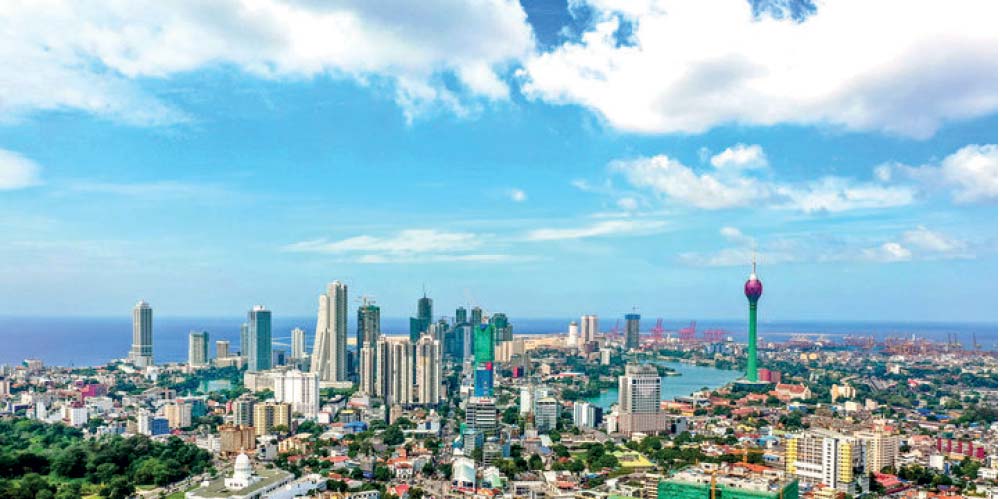
Colombo city skyline
 So far, there is no decision by the Government whether to extend the IMF life support beyond April 2027. All answers given by top policymakers have been evasive. Even President Anura Kumara Dissanayake did not give a direct answer to this issue. According to him, the Government will appoint a committee to examine the matter and make a suitable recommendation about the future of the IMF life support. Thus, for practical purposes, we should presume that Sri Lanka will be on its own after April 2027 until the Government gets into a new life support program with IMF
Keynote delivered by author at the recently concluded CMA Budget 2027 Conference
 Every banker, accountant, and senior manager in this audience knows one fundamental truth about turning around a troubled enterprise: the most dangerous moment is not the crisis itself. The most dangerous moment is the handover. When external life-support comes to an end and internal cash flows must take over, a poorly managed transition stalls the entire balance sheet.
Today, Sri Lanka stands at that exact handover point.
To understand what President Anura Kumara Dissanayake’s Budget 2027 is trying to achieve, I want you to picture a modern hybrid vehicle driven by a gasoline engine and an electric motor which supports each other to move the vehicle forward. When the gasoline engine becomes weaker, the electric motor takes over. When the battery set is weaker, the gasoline engine takes over. Since you all drive these vehicles, you are familiar with the setup. Think of it purely in terms of momentum and risk management.
For the last four years, Sri Lanka’s economy has been pulled out of default by a high-torque engine: the International Monetary Fund’s Extended Fund Facility. In the first three months of 2027—from January through March—the country completes the final stretch of that IMF program.
Then, on 1 April, the external engine switches off. For the remaining nine months of 2027, the Sri Lankan economy must run on its own internal battery—powered entirely by domestic tax revenues, our own foreign reserves, export earnings, and public capital expenditure. So far, there is no decision by the Government whether to extend the IMF life support beyond April 2027. All answers given by top policymakers have been evasive. Even President Anura Kumara Dissanayake did not give a direct answer to this issue. According to him, the Government will appoint a committee to examine the matter and make a suitable recommendation about the future of the IMF life support. Thus, for practical purposes, we should presume that Sri Lanka will be on its own after April 2027 until the Government gets into a new life support program with IMF.
Budget 2027 is designed to be the seamless transmission connecting those two phases. In an old manual car, switching power sources causes a violent jolt, or worse, the engine stalls in the middle of traffic. A modern hybrid blends power smoothly, so the passengers never feel a bump. Budget 2027 attempts to keep IMF fiscal discipline and self-running domestic growth meshed together, ensuring uninterrupted momentum from January to December.
Later today, CMA expert panels will dissect the granular details of this budget—its tax schedules, sector allocations, and compliance rules. My task this morning is to step back and set the stage by examining the formidable structural challenges sitting on the President’s desk as he plans this takeover from IMF.
|
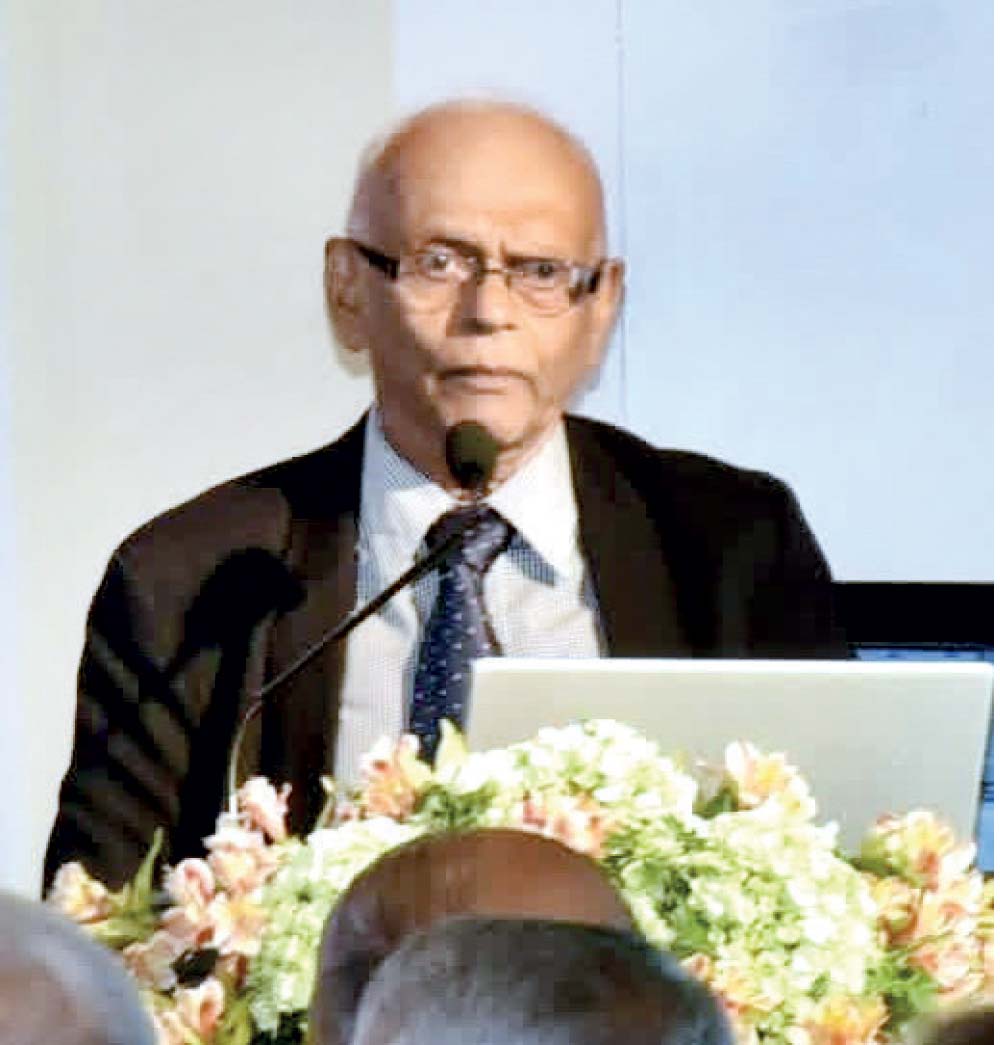
Author addressing the CMA Budget 2027 conference
|
Four immediate pressures threatening the transition
Even the best-designed transmission faces rough terrain. As Budget 2027 moves from paper to execution, it confronts four immediate pressures that threaten to knock the economy off course.
First, global geopolitical turbulence: Sri Lanka is no longer operating in a calm, predictable world economy. Escalating tariff wars, shifting supply chains, and ongoing conflict in the Middle East mean Sri Lanka cannot rely on a gentle global tailwind. Every flare-up in the Red Sea or the Persian Gulf immediately drives up its freight costs, energy bills, and import prices, while trade barriers threaten its entry to export markets.
Second, climate shocks as unbudgeted liabilities: As accountants and risk managers, you price contingent liabilities onto a balance sheet. Yet national budgets repeatedly get ambushed by extreme weather. There is no need to look far back for proof—just look at the recent unprecedented flooding right here in the city of Colombo, occurring even after just a few hours of heavy rain. When Sri Lanka’s commercial capital grinds to a halt after a brief downpour, the citizens see first-hand how fragile the country’s infrastructure is. Unpredictable floods, prolonged droughts, and agricultural disruptions are no longer rare emergencies; they are recurring fiscal shocks that wipe out harvests, spike food prices overnight, and force the Treasury into unplanned relief spending.
Third, domestic power groups and political distractions: Let us be candid about the political economy. Any administration attempting to dismantle entrenched patronage networks faces organised pushback from vested interest groups looking for friction points to destabilise the Government. Even now, look at the agitation campaigns, designed in various guises, launched by some sections in society which are not related to economics or budgetary policies. However, they manufacture political tension and consume policymakers’ valuable time and bandwidth—time that should be spent steering the economy through its most delicate transition.
Fourth, and most urgent, the ordinary citizens’ cry for relief: Economists and top policymakers quite rightly celebrate macroeconomic stabilisation—falling debt ratios, rebuilt reserves, and primary surpluses in fiscal accounts. But citizens cannot pay a grocery bill or an electricity tariff with a primary surplus. Ordinary Sri Lankans have endured four gruelling years of austerity and compressed living standards. Today, they are demanding tangible relief, followed by genuine improvements in their daily lives. Their plight is evident from the Household Income and Expenditure Survey report recently released by the Department of Census and Statistics. It says due to the acceleration of general price levels, compared with the status prior to January 2021, the real income of people has fallen by about 50% by mid-2025. This position will worsen due to the Central Bank’s inactive monetary policy to keep inflation above 8% till mid-2027. Thus, the President’s tightrope walk is clear: how do you answer the citizen’s cry for relief without opening the fiscal floodgates and crashing the economy back into crisis?
Thwarted inflation targeting and a joint Treasury–Central Bank solution
This brings me to the first major policy blind spot in our current economic framework—one that directly affects every banker and business planner in this room: Sri Lanka’s thwarted inflation targeting.
Over the past year, we have watched inflation creep back above the Central Bank’s target range. When asked why, the Central Bank’s official explanation is straightforward: this inflation is not caused by excessive money printing or runaway consumer demand. Rather, it is driven by unmanageable supply shocks—global tariffs, Middle East conflict, and domestic climate damage.
And what is the Central Bank’s current policy response? Essentially, it is acting like a lame duck—sitting passively on the sidelines, holding interest rates, and waiting for these supply-side problems to resolve themselves.
Now, let me make a personal confession to you this morning. As a former central banker, I firmly believed in monetarism, and supported the central bank’s monetary policy that was designed along those exact lines. Back then, we held the classic view that ‘inflation was always and everywhere a monetary phenomenon’.
But looking at things as an outsider today—and watching how the Central Bank’s top management has been forced to vainly defend its stand before the Committee on Public Finance (COPF)—my attention has been drawn to a different reality. Their continued explanation given to Parliamentarians that the current inflation driven by supply shocks is beyond the Central Bank’s policy apparatuses is not policy at all. It is a demonstration of policy inactivity.
In this connection, my attention turned to a compelling new book on inflation—a combined intellectual thesis harboured by a university professor and a former World Banker, political economist Mark Blyth, and former World Bank economist Nicolò Fraccaroli. Their new book titled ‘Inflation: A Guide for Users and Losers’ and published in 2025, looks at inflation and anti-inflation policies from a different perspective. Their central argument speaks directly to Sri Lanka’s predicament. They demonstrate that raising or holding interest rates when inflation is caused by supply shocks is an outdated, blunt playbook. Rate hikes cannot grow more rice after a flood, and they cannot clear shipping lanes in the Middle East.
Today, fighting Sri Lanka’s rising inflation has become a function of fiscal policy, not merely a monetary phenomenon.
Yet, Budget 2027 has failed to address this properly because it has not recognised this fundamental shift. When Parliament enacted the new Central Bank Act in 2023, the Central Bank was rightly insulated from political money printing—and let me be clear, we must never return to the era of Treasury-dictated money printing. However, in building a wall to protect independence, lawmakers created a rigid silo. The new Act makes no provision for formal operational coordination between the Central Bank and the Treasury to fight supply-side inflation.
The good news is that we do not even need to amend the Central Bank Act to fix this.
We can achieve this immediately by utilising the high-level coordinating council between the Governor of the Central Bank and the Secretary to the Treasury. By appropriately revising its Terms of Reference and mandating that this council convene every two weeks, we can create an operational bridge.
In these bi-weekly meetings, the Central Bank retains full independence over interest rates, while the Treasury commits to swift, targeted fiscal interventions—such as strategic buffer stocks, freight and energy cushions for essential goods, and rapid supply-chain fixes—the moment supply shocks threaten inflation targets. Without the Governor and the Treasury Secretary working together every fortnight, our inflation-targeting regime will remain helpless.
Pragmatism over ideology: Moving from preconditions to economic take-off
Beyond fighting immediate fires, Budget 2027 faces a deeper strategic question: once the IMF hands over the keys in April, what is Sri Lanka’s long-term blueprint for self-running prosperity?
To answer that, I want to reach back to a thinker who was our hero when we learned development economics in the 1960s: the late Walt Whitman Rostow.
For those in the room who know balance sheets better than economic history, let me briefly introduce him. W.W. Rostow was a prominent American economic historian and policy advisor—born to Russian-immigrant parents—who studied how poor, traditional nations transform into modern, prosperous economies. In 1960, he published a landmark book titled 'The Stages of Economic Growth.'
In the 1960s, Rostow’s practical, real-world insights were our guiding light. Unfortunately, over the decades that followed, his good, practical suggestions were gradually subdued and pushed aside by the obsession with complex mathematical economic modelling that became fashionable among academic economists. When economists fell in love with abstract equations, they forgot Rostow’s practical wisdom on how nations actually build momentum.
Today, I believe Rostow’s stages of growth matter more to President Anura Kumara Dissanayake than ever before. Rostow showed that an economy must pass through distinct, sequential stages:
First, setting up the preconditions for take-off—building basic infrastructure, fixing institutions, stabilising finances, and mobilising capital.
Second, directing the take-off—a decisive, concentrated burst of productive investment where growth becomes self-sustaining.
Third, consolidating the work done for take-off—spreading modern technology and efficiency across all sectors of the economy.
And finally, arriving at the age of high mass consumption—where ordinary citizens live comfortably in a world of broad-based prosperity.
Now, here is the delightful historical irony. Rostow subtitled his famous book 'A Non-Communist Manifesto.' He presented his theory explicitly as a market-driven alternative to socialist central planning.
As President Dissanayake begins Sri Lanka’s self-running phase, he should embrace Rostow’s practical growth strategy rather than clinging to rigid socialist planning. It brings to mind that famous saying attributed to ex-President J.R. Jayewardene: “When in twenties, if someone is not a socialist, he is a fool; when in his fifties, if he is still a socialist, he is still a fool.”
The wisdom in that remark is timeless: idealism is natural in youth, but governing a nation at maturity demands pragmatism. Looking at Sri Lanka through Rostow’s pragmatic lens reveals our exact danger. Everything we have done over the past three years—debt restructuring, revenue mobilisation, and anti-corruption governance—belongs strictly to Stage One: setting the preconditions for take-off.
IMF stabilisation is not the flight; it is merely preparing the runway. If Budget 2027 treats fiscal stabilisation as the final destination, Sri Lanka will sit forever on the tarmac, while our citizens grow restless waiting for the prosperity of Stage Four.
Beginning in April 2027, the President must actively direct the take-off. That means ensuring Budget 2027’s capital expenditure is not scattered across unproductive hand-outs, but laser-focused on export diversification, flood-resilient urban infrastructure, logistics, digital transformation, and unlocking affordable credit for small and medium enterprises. Only by igniting a genuine take-off can Sri Lanka consolidate its gains and deliver the broad prosperity our people are crying out for.
Budget 2027 sits at a historic crossroads. In three months, our IMF safety net folds away, and our hybrid economy shifts into self-running mode. To navigate global geopolitical storms, withstand sudden Colombo floods, look past political distractions in Anuradhapura, and answer the ordinary citizen’s cry for relief, this Budget must pass three tests: It must execute a seamless handover from external support to domestic self-reliance. It must empower the bi-weekly council between the Central Bank Governor and Treasury Secretary so fiscal policy actively fights supply-side inflation alongside monetary policy. And it must boldly transition Sri Lanka from Rostow’s preconditions into a pragmatic, self-sustaining economic take-off
Three benchmarks for today’s deliberations
Let me bring these threads together as you begin your deliberations today.
Budget 2027 sits at a historic crossroads. In three months, our IMF safety net folds away, and our hybrid economy shifts into self-running mode. To navigate global geopolitical storms, withstand sudden Colombo floods, look past political distractions in Anuradhapura, and answer the ordinary citizen’s cry for relief, this Budget must pass three tests:
It must execute a seamless handover from external support to domestic self-reliance.
It must empower the bi-weekly council between the Central Bank Governor and Treasury Secretary so fiscal policy actively fights supply-side inflation alongside monetary policy.
And it must boldly transition Sri Lanka from Rostow’s preconditions into a pragmatic, self-sustaining economic take-off.
As you move into today’s panel sessions to examine the tax numbers, the sectoral allocations, and the fiscal projections, I urge you to measure every policy against those three tests. The Government can build the transmission, and the Central Bank can watch the dashboard—but it is you, the managers, accountants, and bankers in this room, who must supply the enterprise and capital that drives Sri Lanka’s take-off forward.
(The author, a former Deputy Governor of the Central Bank of Sri Lanka, can be reached at [email protected])



