Thursday Oct 22, 2026
Thursday Oct 22, 2026
Wednesday, 14 January 2026 03:58 - - {{hitsCtrl.values.hits}}
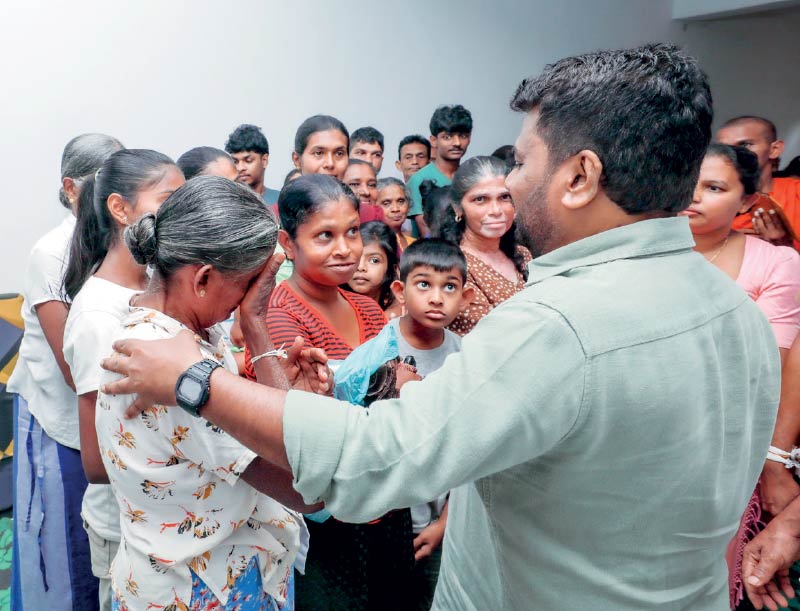
President Anura Kumara Dissanayake received a rousing welcome from the destitute, despite their untold suffering from a rehabilitation camp located at Poojapitiya temple, Kandy last week
 In disaster governance, time is not a procedural detail; it is a humanitarian imperative. Delays cost livelihoods, disrupt essential services, and deepen human suffering
 The Daily FT in a front page article last week said that a Presidential Task Force (PTF) has been appointed for rebuilding the nation through an Extraordinary Gazette in response to Cyclone Ditwah. Given the scale of damage to infrastructure, livelihoods, housing, and essential services, such a high-powered coordinating mechanism is both timely and appropriate.
This incisive article evaluates the six key interventions identified in the Gazette, assessing the President’s response to a high-magnitude disaster, proposing improvements, defining the roles of the proposed Committees, and suggesting additional interventions in the light of the global disaster experiences.
The President’s decision to establish a high-powered, multi-sectoral Task Force chaired by the Prime Minister consisting of 25 members to the national task force is appropriate given the national scale of the disaster, the need for rapid decision-making and the requirement for political authority to resolve cross-ministerial bottlenecks This approach is consistent with international practices seen after major disasters in Japan (2011), Indonesia (2004), Türkiye (2023) and New Zealand (2011), where centralised but time-bound recovery authorities were used.
Speed as a form of compassion
In disaster governance, time is not a procedural detail; it is a humanitarian imperative. Delays cost livelihoods, disrupt essential services, and deepen human suffering. The President’s prompt decision to constitute a high-powered Task Force—within days of the cyclone—demonstrates an understanding that speed itself is an act of compassion.
By placing the Task Force under the leadership of Prime Minister Harini Amarasuriya, and bringing together Cabinet Ministers, Deputy Ministers, provincial officials, and senior public servants, the President ensured that recovery efforts would not be fragmented or slowed by institutional boundaries. Instead, a unified national response was set in motion.
What distinguishes this intervention is its forward-looking vision. The mandate of the PTF goes beyond emergency relief to address the full continuum of recovery—rehabilitation, reconstruction, livelihood restoration, economic revival, and institutional strengthening. This reveals an approach grounded in long-term national rebuilding rather than short-term crisis management. This reflects a leadership philosophy that understands disasters not only as moments of loss, but also as opportunities to rebuild better, fairer, and more resilient systems.
Human-centered governance in practice
At the heart of the President’s action is a human-centered governance ethic. Cyclone Ditwah affected not abstract statistics, but families, communities, farmers, workers, and small businesses. By empowering the Task Force to establish specialised committees on housing, social infrastructure, livelihoods, finance, and public communication, the administration has recognised the complex, lived realities of affected citizens. This approach aligns with global best practices observed in countries that have successfully navigated major disasters—where centralised leadership, political authority, and professional coordination were essential to restoring public confidence and accelerating recovery.
Core issues
Post-disaster environments often suffer from overlapping mandates, duplication of efforts, and weak inter-ministerial coordination. By designating the Task Force as the central coordinating authority under the Chairpersonship of the Prime Minister, the President has introduced a unifying command structure, reducing institutional silos. This formal arrangement could be further enhanced by establishing a legally binding coordination protocol across ministries and introducing performance dashboards linked to ministry deliverable.
Immediate humanitarian needs
In instances of national calamities, delays in restoring sanitation, health care, shelter, and water systems take the backseat, escalating humanitarian crises. It is commendable that His Excellency had the audacity to give explicit prioritisation of basic needs, sanitation, and health care within the Terms of Reference ensuring people-centric recovery. This aspect can be further improved by adopting Sphere Standards and WHO emergency benchmarks and also integrating psychosocial and mental services early.
Rebuild basic infrastructure damage
The cyclone Ditwah has caused considerable damages to roads, utilities, schools, hospitals and common amenities impeding recovery and economic revival. Presidential Intervention to rebuild basic and public infrastructure enables strategic, national-level planning rather than piecemeal reconstruction. It is suggested to enforce “Build Back” and Climate-resilient standards and also introduce third party audits for large projects.
Scale up livelihood and economic assets
In any natural disaster, the most vulnerable segment is the informal workers farmers, fishers, SMEs etc and in this context the Presidential intervention on scaling up livelihoods, assets and restoring local economies aligns recovery with long-term resilience which is certainly commendable. To enhance the livelihood income during this turbulent situation, deploying cash-for-work and micro-enterprise recovery grants and partnering with the private sector for local value-chain revival are the other options.
Beyond damaged roads and broken buildings, the most enduring impact of Cyclone Ditwah has fallen silently on those with the least capacity to absorb shocks—small farmers, rural households with no stable income base, daily wage earners, and micro-industries operating at the margins of the economy. For these groups, the cyclone has not merely disrupted income; it has threatened survival.
International disaster-recovery experience is clear on one point: rebuilding livelihoods is as critical as rebuilding infrastructure. When vulnerable income streams collapse, recovery stalls, poverty deepens, and dependence on relief becomes prolonged. In this context, the emphasis placed by the President on livelihood restoration within the Task Force mandate is both timely and morally grounded.
Unlike larger enterprises, farmers and micro-industries lack buffers—insurance, savings, or access to credit. A single cyclone can wipe out crops, tools, livestock, inventories, and local markets in one stroke. If recovery efforts fail to address these losses quickly, the damage becomes structural rather than temporary. Global benchmarks from countries such as Bangladesh, Vietnam, and Indonesia demonstrate that targeted livelihood interventions—implemented early—significantly reduce long-term economic scarring and accelerate community recovery.
Weak data and information
Poor data integration undermines targeting, transparency, decision making process and speed of recovery and the Presidential intervention to include digital data and decision-support mechanisms reflects modern disaster-management thinking. This mechanism can be further improved by developing a unified post-disaster digital registry (GIS-enabled) and linking data systems with national planning and budget platforms.
Communication
Misinformation, lack of transparency, and weak stakeholder engagement erode public confidence in an environment where political rivalries play havoc to ridicule every national minded project engineered by the NPP Government, as hitherto seen. Hence, the Presidential intervention to improve communication and stakeholder engagement addresses governance legitimacy. Public trust can be further strengthened by conducting public briefings and structured engagement with civil society and affected persons and communities. The rousing welcome President received from the destitute, despite their untold suffering from a rehabilitation camp located at Poojapitiya temple, Kandy is a case in point.
Post-disaster assessment committees
This article would be incomplete, if a brief reference is not made about the significance of the eight committees established, in addition to what the Gazette Notification enumerated. Responsible for conducting rapid and detailed damage and needs assessments across sectors. It will standardise assessment methodologies, validate data from field agencies, and prioritise recovery needs. The Committee will ensure evidence-based planning, avoid duplication, and support equitable resource allocation, forming the foundation for all rehabilitation and reconstruction decisions.
When vulnerable income streams collapse, recovery stalls, poverty deepens, and dependence on relief becomes prolonged. In this context, the emphasis placed by the President on livelihood restoration within the Task Force mandate is both timely and morally grounded
Restoration of public infrastructure committee
Tasked with planning, coordinating, and monitoring the rehabilitation of transport, utilities, irrigation, health, and education infrastructure. The Committee will ensure resilience-based rebuilding, compliance with national standards, and integration of climate-adaptation measures while minimising service disruption and ensuring cost efficiency.
Restoration of Housing for Affected Communities Committee
Responsible for developing and implementing housing reconstruction strategies, including owner-driven and community-based models. The Committee will ensure safe, dignified, and culturally appropriate housing solutions, land tenure clarity, beneficiary transparency, and adherence to disaster-resilient construction standards.
Revival of local economies and livelihoods committee
Focused on restoring income sources through livelihood grants, employment programs, micro-enterprise support, and value-chain rehabilitation. The Committee will prioritise vulnerable groups, promote inclusive economic recovery, and align short-term relief with long-term economic resilience.
Restoration of Social Infrastructure Committee
Mandated to restore schools, healthcare facilities, community centers, and social protection services. The Committee will address educational continuity, public health recovery, social cohesion, and psychosocial well-being, particularly for women, children, the elderly, and persons with disabilities.
Finance and funding committee
Responsible for mobilising, coordinating, and monitoring domestic and international funding. The Committee will ensure fiscal discipline, donor coordination, transparency, and alignment with national budgetary frameworks while tracking expenditure effectiveness. Globally, countries facing fiscal stress have adopted special disaster-risk financing tools, such as: catastrophe insurance pools, contingent credit lines from multilateral institutions, and parametric disaster bonds. For Sri Lanka, integrating such instruments would reduce pressure on the national budget while ensuring rapid liquidity for recovery—an approach consistent with IMF- and World Bank-supported frameworks in post-crisis states.
International best practice emphasises sequencing and prioritisation, rather than attempting to rebuild everything simultaneously. In a post-bankruptcy context, recovery must be: needs-driven, cost-effective, and economically catalytic. The President’s focus on livelihoods, infrastructure, and local economies provides a strong base.
Countries such as Türkiye and New Zealand successfully mobilised private-sector participation and diaspora investment in post-disaster recovery. For Sri Lanka, this could include: public–private partnerships in housing and infrastructure, concessional financing for SMEs, and diaspora-backed recovery funds.
Data and information systems committee
Tasked with establishing integrated digital platforms for damage assessment, beneficiary tracking, project monitoring, and decision support. The Committee will enhance transparency, accountability, and real-time policy decision-making through interoperable data systems.
Public communication committee
Responsible for unified, timely, and accurate communication with the public and stakeholders. The Committee will counter misinformation, promote transparency, manage expectations, and ensure two-way communication with affected communities.
Global lessons
Taking a cue from the global disasters, the following additional interventions are recommended to the Presidential Task Force, if its mission is to be accomplished beyond expectation. (A)Time-Bound Recovery Authority-Define a clear sunset clause and transition plan to regular institutions.(B) Independent Oversight and Audit Mechanism-
Ensure transparency and prevent post-disaster corruption. (C) Community-Driven Recovery Platforms-Empower local authorities and communities in decision-making.(D) Climate and Disaster Risk Financing Instruments-Introduce disaster insurance, catastrophe bonds, and contingency financing. (E) National Recovery Knowledge Hub-Document lessons learned to strengthen future disaster preparedness.
A double whammy in a post-Bankruptcy economy
Cyclone Ditwah has struck Sri Lanka at a particularly vulnerable moment in its national journey. Only a few years ago, the country was navigating the painful realities of sovereign bankruptcy, fiscal consolidation, and economic restructuring. Against this backdrop, the cyclone represents not merely a natural disaster, but a compounded shock—a “double whammy” that tests both the resilience of institutions and the credibility of recovery strategies.
International experience shows that post-disaster recovery in fiscally constrained states requires more than conventional reconstruction measures. Countries such as Greece during the financial crisis, Indonesia after the 2004 tsunami, and Pakistan following repeated floods illustrate a key lesson: when disasters strike economies already under stress, recovery must be innovative, The true challenge—and opportunity—before Sri Lanka is to ensure that recovery from Cyclone Ditwah does not merely restore what was lost, but strengthens national resilience against future shocks. In a world of intensifying climate events, this means integrating disaster risk reduction, climate adaptation, and economic resilience into every rupee spent.
Cyclone Ditwah may be a double whammy, but with decisive leadership, innovative financing, and disciplined implementation, it can also become a defining moment in Sri Lanka’s recovery narrative—one that demonstrates how a nation, even after bankruptcy, can respond to crisis with foresight, unity, and resolve.
A moment that calls for recognition
Critique is a vital part of democracy—but so is acknowledgment when leadership rises to the occasion. The speed, clarity, and seriousness with which the President responded to this national emergency merit public recognition. At a moment when the country needed reassurance and direction, this decisive intervention has offered both. It reflects a genuine desire to rebuild Sri Lanka, not merely in physical terms, but in confidence, institutional strength, and collective resolve.
As recovery efforts move forward, the true measure of success will lie in outcomes. Yet it is equally important to note when the foundations are laid correctly. In this hour of calamity, the President’s action stands as a reminder that effective leadership can turn a crisis into a moment of national unity and renewal.
Conclusion
The PTF represents a sound, constitutionally appropriate, and globally consistent response to Cyclone Ditwah. With targeted improvements in accountability, data integration, community participation, and resilience financing, it can serve not only as a recovery mechanism but also as a model for future national disaster governance in Sri Lanka.
(The author is a Productivity Specialist and Management Consultant. He can be reached via email at [email protected])




