Tuesday Sep 15, 2026
Tuesday Sep 15, 2026
Tuesday, 15 September 2026 05:03 - - {{hitsCtrl.values.hits}}
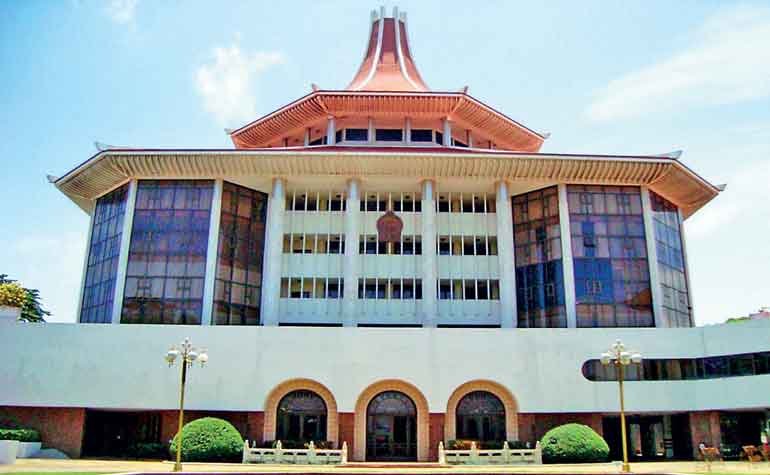
Supreme Court of Sri Lanka
 I am in solidarity with the concerns of the legal profession about ensuring the independence of the judiciary. I am simultaneously in solidarity with the simple, less than privileged citizens of our country, whether from the village, town or city, who have endured years of laws delays in land, family and marital disputes, in enterprise related issues or in criminal cases.
A national imperative – not a lawyers' issue alone
Thus, I enter this debate neither to defend nor to critique the legal profession, the Judiciary or the Government, but to examine whether retaining experienced judges, while simultaneously reforming the wider justice-delivery system and protecting judicial independence, can form part of a credible national response to the enormous backlog .This is ultimately not only a lawyers' issue. It is a citizens' issue. Every one of us has a proprietary interest in how this matter is resolved. Let me acknowledge very briefly the institutions and processes in the value chain of the justice system, before I share my research and suggestions.
Criminal, civil, forensic, medical
In a criminal matter, the process may begin with a complaint to the Police. The Government Analyst’s Department, the office of the Judicial Medical Officer, connected forensic and medical expertise, the office of the Attorney General are essential parts of the justice chain. Due to space constraints, I will not discuss these institutions, their processes and procedures, and the need for institutional, technical and process related justice sector reforms.
The Office of the Attorney General – An example of pending investigations at the SEC
On being appointed as Chairman of the Securities and Exchange Commission, in late May 2018, I observed an inventory of pending investigations into capital market offenses, as well as pending cases connected with concluded investigations. Certain investigations had commenced years before, some were incomplete due to yet unexplained self-inflicted human resource constraints, or administrative delays in inter and intra institutional evidence gathering or were pending high level review before being presented to the Commission or were pending reference to the representatives of the Attorney General's Department who were seconded to us on retainer.
Among other steps, we took a decision to triple the number of persons in the investigations department by transferring qualified chartered accountants, lawyers and others from three other divisions, where staff were certainly not burning the midnight oil. We even expanded the floor space to accommodate this, acquiring otherwise underutilised space.
I visited successive Attorneys Generals with the Director General and Heads of Legal and Enforcement and Litigation to inquire about delays in pending cases as well as delays in commencing prosecution. It is then that I came in direct contact with the consequences of administrative delays, at the apparently under resourced Office of Attorney General.
A personal historical perspective – Citizens' Commission for Judicial Reform
Beyond the above, there is also a specific reason for my interest which takes me back more than two decades. In 2004, I served on a Citizens' Commission for Judicial Reform, on the invitation of the Marga Institute. The Commission brought together around twenty senior judges and lawyers, with only two members who were not lawyers — the late Susil Siriwardena and myself. I worked particularly closely with the late Justice Dheeraratne of Kalutara, whose experience, knowledge, humility, personal grace, absence of age prejudice or domain specific superiority, generated a mutually respectfully developed substantial body of work and recommendations. But, for reasons I will not revisit here, the initiative did not develop into the sustained programme of reform that the problem required after 2005. More than two decades later, many of the same questions remain. That experience reinforces my central point- judicial reform cannot be episodic, partisan or confined to one component of the justice system.
Public interest, independence and effectiveness – Turning the search light inwards to my profession
In connection with my profession, I have written extensively and aired several podcasts on YouTube, under The Thought Leadership Forum Journal, on professionalism in practice, audit quality and ethics, including my call in 2009, during the Jubilee Anniversary celebrations of CASL, or today's CA Sri Lanka, when I urged in an essay in our Two Part Jubilee publication titled, " The Saga of an Enduring Journey" that the auditing profession should focus on “Regaining public trust and Re-earning confidence.” There is, therefore, a clear parallel with the present discussion. Institutions serving the public interest must not only be independent and effective, but must also command public confidence in their independence and effectiveness.
Two clocks running simultaneously
The backlog clock- with litigants waiting for justice today- and the reform clock, because institutional reform inevitably takes time- are two clocks running simultaneously. The sensible course is therefore not “tenure extension or institutional reform”, but “tenure extension and institutional reform.”
The 2022 Supreme Court Determination — The importance of clarity and relevance
I have examined this matter which appears to be repeatedly referred to in Parliament and elsewhere-the Supreme Court's 2022 determination on the Inland Revenue (Amendment) Bill, S.C. (S.D.) Nos. 64–71/2022.
As I now understand it, this was not a case concerning the retirement age of judges. It concerned the constitutionality of the Inland Revenue (Amendment) Bill. In considering arguments relating to judicial independence, however, the Court made a broad observation that any constitutional amendment to the retirement age or period of office affecting incumbent judges, directly or indirectly, would impinge upon judicial independence and violate Article 3, which requires a referendum. As a layman — and I repeat, as a layman rather than as a lawyer or representative of the legislature — I believe we should know not merely that a 2022 judgment is being cited, but what that judgment actually decided, what it did not decide, and why it should or should not govern the very different question now before the country.
International practice about tenure
Australia – Life tenure to 70 , but prospectively
In Australia, until 1977, federal judges had effective life tenure. Following a referendum, the Australian Constitution introduced a maximum retirement age of 70. However, the amendment was prospective, protecting incumbent judges while establishing the new rule for future appointments. Australia does not provide an answer for Sri Lanka, since the immediate stated objective of the present proposal is to retain experienced judicial capacity when the country is struggling with a substantial backlog.
Canada and New Zealand
Canada provide a very different example. Superior-court judges have a constitutionally prescribed retirement age of 75. New Zealand's retirement age for judges is 70, while its legislation provides strong protection against removal except on established grounds.
The United Kingdom
The United Kingdom offers a particularly instructive example. The Judicial Pensions and Retirement Act 1993 reduced the mandatory retirement age for most judicial office holders from 75 to 70, with the change applying substantially prospectively. Nearly three decades later, Parliament reversed the position through the Public Service Pensions and Judicial Offices Act 2022, raising the age from 70 to 75. Significantly, the 2022 increase was not confined to future appointees but also applied to serving judicial office holders.
The UK's Ministry of Justice - Consultations
Of course, I noted that the change followed a formal Ministry of Justice consultation that received more than 1,000 responses, and the Government cited the retention of judicial experience and expertise and the pressures facing courts and tribunals among its reasons.
India
India presents an especially interesting comparison. Supreme Court judges retire at 65 and High Court judges at 62. The Supreme Court retirement age was established constitutionally at 65, while the High Court retirement age was increased from 60 to 62 by constitutional amendment in 1963. Although the Indian Government stated in 2024 that it had no proposal under consideration to increase the retirement ages of Supreme Court or High Court judges, India's Supreme Court has more recently been considering enhancement of retirement ages for the district judiciary. This is relevant because it demonstrates that judicial retirement ages can be examined in the context of judicial capacity and delays rather than being regarded as immutable.
The CJ role within the Commonwealth
A review of a few Commonwealth countries reveals the following;- In the United Kingdom, Australia and Canada, there is generally no fixed number of years prescribed for service as Chief Justice of the country's highest court. Rather, the Chief Justice remains a judge until the applicable retirement age.
Sri Lanka
Why do we choose to be an outlier in comparison with comparable jurisdictions by limiting the term of the Chief Justice to a maximum of 6 years. Is it possible to design Judicial tenure, retirement age and Chief Justice leadership tenure in different ways while preserving judicial independence? Is it because the latter also involves institutional leadership, succession, concentration of authority and public confidence? The rationale of the proposal is not clear.
Britain’s quick fix to its prison crisis
During my stay in the UK in August, another aspect of the justice system was highly visible in the news, given that it was analysed every night on BBC TV throughout my 5 days in York. I gathered that, in England and Wales, the prison estate had been operating at more than 95% occupancy for over 12 years, reaching a particularly acute position in 2024. The Government introduced an emergency measure under which some eligible prisoners were released after serving 40% rather than 50% of their sentence, with the balance served in the community under probation supervision. More than 10,000 prisoners were released early under the earlier emergency scheme, according to HM Inspectorate of Probation.
Sentencing reform, supervised
release and probation
The UK's response has therefore not been confined to building more prisons. It has combined additional capacity with sentencing reform, earlier or supervised release for eligible prisoners, electronic monitoring and greater investment in probation.
The Government's January 2026 capacity analysis said that, without the new measures, prison places would have been exhausted by June 2026. It is now planning 14,000 additional places by 2031 while simultaneously reforming sentencing and community supervision.
Back home in Sri Lanka
Given our prison overcrowding and the many riots, deaths and prison breaks recently, here is yet another example of a failure at one point in the justice chain which eventually creates pressure somewhere else. Beyond simply finding more prison space, we need to examine the entire criminal-justice pipeline: which persons are remanded, how long they remain in remand, how quickly investigations are completed, how cases are prosecuted and tried, which offences genuinely require imprisonment, how sentences are administered, and how suitable offenders can be supervised and rehabilitated in the community.
Conflicts of interest – A determination on their own tenure
Interestingly, there were a few calls from non-lawyers, particularly those who have worked and walked with me, reminiscing about my stand in key situations of conflicts of interest, which were resolved procedurally and otherwise, and inquiring about my views on how Justices of the Supreme Court will make a determination on their own tenure. I thus immersed myself in research and came across this doctrine which I gathered had been discussed in certain fora while I was overseas, and which I had sadly missed. Here are my findings.
Doctrine of Necessity – Comparative
jurisprudence
The Doctrine of Necessity is apparently an old common-law exception to the general rule that a judge who is disqualified by reason of bias should not hear a case. Its purpose is not to excuse bias, but to prevent a failure of justice where there is no other competent tribunal capable of hearing the matter.
In an apparent attempt to "cure" this as it were, a request was made by the legal profession, for the matter to be heard by a "Full Bench" but that request was declined and the case proceeded before the existing five-judge bench. The fact that a wider bench was sought, but not constituted, therefore forms part of the context in which the question of necessity and judicial independence may be considered.
Canada -"But rarely applied and with great circumspection"
The Supreme Court of Canada has expressly recognised the doctrine and explained that where all members of the only competent tribunal are disqualified, they may nevertheless be required to hear the matter "by necessity." The Canadian Court emphasised, however, that the doctrine must be applied rarely and with great circumspection and only to the extent that necessity requires.
Australia - "But impartiality cannot yield to expediency or convenience"
In Ebner v Official Trustee in Bankruptcy (2000) 205 CLR 337; [2000] HCA , decided by the High Court of Australia, the Court considered both apprehended bias and the question of necessity. The Australian position is particularly useful because the Court stressed that judicial impartiality is fundamental and that the doctrine of necessity should operate only where, without it, a court cannot be constituted to hear and determine the matter. Justice Kirby, stressed that constitutional requirements of impartiality cannot yield merely to expediency or convenience.
"Not invoked if positive and substantial injustice is produced"
The Canadian Supreme Court, in its discussion of the doctrine, expressly relied upon the Australian decision, Laws v Australian Broadcasting Tribunal (1990) 170 CLR 70, where the High Court recognised that necessity could qualify an otherwise disqualifying bias where otherwise the statutory function could not be performed. But it also identified two important limitations: necessity should not be invoked where it would produce positive and substantial injustice, and, where it does apply, it applies only to the extent that necessity justifies.
"Doctrine of last resort"
The Canadian and Australian authorities indicate that it is a doctrine of last resort, not a mechanism for overriding legitimate concerns about judicial independence or public confidence.
The Doctrine of Necessity does not mean that a judge with a potential conflict is automatically entitled to hear a case. It is a narrow common-law exception designed to prevent a failure of justice where no other competent tribunal can be constituted.
A Justice Performance Dashboard
The oft quoted statistics about the 800,000 or so pending cases being confined to the Magistrate Court, may be a defence perhaps for the non-justification of an extension of tenure of Supreme Court and High Court judges. Yet it is a sad indictment of the overall justice system which has yet to perform basic routine diagnostic assessments, to determine why it is pending, and which institution and persons are responsible therefore.
Instead of merely reporting the number of cases pending before courts, a national Justice Performance Dashboard could identify whether cases are awaiting police investigation, forensic reports, medical evidence, prosecution, witnesses, court scheduling, judgment, appeal or enforcement. Only then can scarce resources be directed to the real bottleneck.
Inventorise justice sector reforms undertaken
I am aware that there have been a number of justice sector reforms, over the years, towards increasing or modernising court infrastructure, human capital and legal resources, capacity building, training and development, legislative and process reforms. But how have these resulted in tangible reform on ground?
Ethics committees and the Judicial Services Commission
Today's thoughts do not address the role of ethics committees of the Bar Association, the Judicial Services Commission and a range of other issues.
An invitation to the Thought Leadership Forum
I am hopeful that this will trigger a compelling and long-overdue public policy dialogue on Justice System Reform. I stand ready to host such an independent dialogue under the banner of my Thought Leadership Forum, bringing together a multidisciplinary panel of resource persons, free from political bias and private, vested or professional self-interest.




