Tuesday Oct 13, 2026
Tuesday Oct 13, 2026
Tuesday, 13 October 2026 00:04 - - {{hitsCtrl.values.hits}}
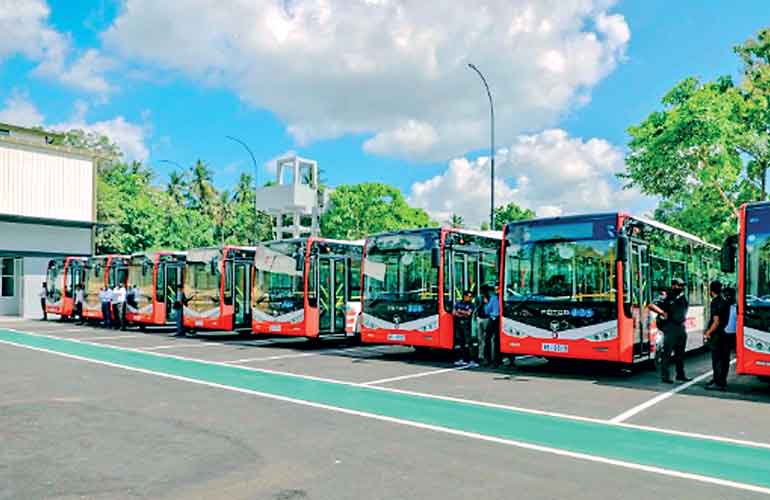
LMT Kadawatha MetroLink Depot via LinkedIn
 The launch of Lanka Metro Transit (LMT) marks a genuine milestone. Set up as a subsidiary of the Sri Lanka Transport Board and approved by Cabinet in 2025, LMT began as a modest pilot in April 2026: ten low-floor, air-conditioned buses running two routes, Makumbura–Fort and Makumbura–Kadawatha, imported under the ‘Clean Sri Lanka’ initiative. Within months, it had expanded rapidly - new depots under construction, over a hundred additional Foton buses arriving, and a plan to grow from two routes to seven, reaching well beyond Colombo’s core. For a country that has spent decades talking about mass rapid transit without much to show for it, seeing steel, depots, and dedicated fleets materialise is worth celebrating.
But the more interesting question isn’t whether LMT is a good project. It almost certainly is. The question is whether it represents something bigger than a single infrastructure upgrade - whether it could be the first move in a genuine rethink of how Sri Lankans move within its commercial capital and beyond.
Sri Lanka is not starting from zero. Few countries of its size have such extensive existing coverage: a bus network that reaches almost every corner of the island, and a rail system with real historical depth that was once used to bring commodities from across the island to the Port of Colombo. On paper, the skeleton of a strong public transport system is already there.
The problem has never really been coverage. It has been coherence. Buses, trains, and three-wheelers largely operate as separate worlds rather than one system. Congestion in Colombo continues to worsen, and research has linked inadequate transport infrastructure to a meaningful drag on national output. Reliability is inconsistent enough that most people who can afford an alternative choose one. Integration (the ability to move seamlessly from one mode to another) remains the exception rather than the rule.
The LMT will not fix any of this on its own. Its real significance will depend on what surrounds it.
Learnings from a recent visit to Vietnam
Looking at the public transport systems in the Vietnamese cities of Hanoi and Ho Chi Minh City, what strikes isn’t just a single piece of infrastructure; it is how connected different modes of transport were.
The new metro lines in both cities still have limited reach, but they are clean, frequent, and clearly built with future expansion in mind. Buses are everywhere, and while they don’t always feel modern, they run often enough that waiting for one doesn’t feel like a gamble. To ensure continuity, ride-hailing platforms have slotted in to fill the gaps. Booking a ride or a delivery is fast, prices are transparent, and it functions as a real extension of the transport system rather than a substitute for one.
Motorcycles yet remain the dominant mode of transport, and that has real costs; visible in the noise, the density of traffic, and the sheer discipline required to cross a street in central Hanoi. Certain pockets, particularly around the Old Quarter and newer commercial districts, are genuinely walkable, with short blocks and active street life that make getting around on foot pleasant rather than an afterthought. Intercity connectivity also felt considered: domestic flights between Hanoi and Ho Chi Minh City are frequent and affordable, and the highway network connecting major economic centers has visibly improved even in the last few years.
I want to be careful here. Countries like Vietnam are not a transport utopia. Congestion is real, motorcycle dependence carries safety and environmental costs, and much of the mass transit network is still years from maturity. The biggest takeaway isn’t ‘perfection’. It is the sense that every piece, imperfect as it is, seemed to be built with an eye toward how it connects to everything else.
Lesson 1: Think networks, not projects
The single biggest lesson is this: LMT cannot succeed as a standalone project. It has to be conceived as one node in a much larger network - connected to existing rail lines, the wider SLTB bus fleet, hubs like Makumbura and Kadawatha, the three-wheelers that handle first- and last-mile trips, and the BRT/LRT/MRT corridors envisioned in the longer-term Colombo Metropolitan Transport (CoMTrans) master plan published by JICA in 2014.
Encouragingly, the early signs suggest planners understand this. Makumbura and Kadawatha are being developed as multimodal terminals rather than isolated bus stops, and Borella is emerging as a central hub knitting several routes together. But a network on a map is not the same as a network a commuter actually experiences. Think of any journey as a chain: home to feeder transport, feeder to mass transit, mass transit to an interchange, and interchange to final destination.
A commuter doesn’t experience “the metro bus” in isolation. They experience the whole journey.
Therefore, a journey is only as good as its weakest link. A fleet of a hundred and seventy new buses surrounded by unreliable feeder services and chaotic interchanges will still lose passengers to private vehicles, because the failure point isn’t the bus. It now becomes everything around it.
Lesson 2: Make public transport a choice, not a necessity
Sri Lanka has long treated public transport as an essential service for those without other options; which is a legitimate and important function, but an incomplete ambition. A modern system needs to go further: it needs to attract people who own a car or a motorcycle and could drive, but make the conscious decision not to.
That shift requires taking reliability, frequency, comfort, real-time information, easy payment, and overall journey time just as seriously as affordability. This is where Vietnam’s ride-hailing applications come into play. Ride-hailing doesn’t compete with public transport; it makes the whole system more convenient and affordable, which is precisely the standard private car owners are quietly comparing everything else against.
Lesson 3: Transport infrastructure moves an economy
This is perhaps the most consequential lesson, and the one most often missed in transport debates that focus narrowly on buses and trains. Mobility determines who can reach which jobs, which universities, and which markets. A reliable 45-minute commute puts a far wider range of employment and opportunity within someone’s reach than an unpredictable two-hour journey, even if the physical distance is identical.
In this sense, transport quietly redraws a country’s economic geography. It determines which parts of a city or region can meaningfully participate in economic growth, and which remain effectively cut off despite being only a short distance away on a map. Investment in public transport is investment in labour markets, business competitiveness, and productivity; not simply in convenience.
When Cyclone Ditwah struck Sri Lanka in late November 2025, it caused the worst flooding and landslides the country had seen in over two decades. Transport infrastructure absorbed a disproportionate share of the damage. Of the World Bank’s estimated $ 4.1 billion in direct physical losses, infrastructure - roads, bridges, railways and water networks, accounted for the largest single share, at $ 1.735 billion.
Sri Lanka’s railway network was especially hard hit, with only around 478 of its 1,593 kilometers of track left operational in the aftermath, cutting off entire parts of the island from the rest for weeks. For ordinary commuters, this meant journeys that were already unpredictable became impossible. For the tourism sector, already a vital source of foreign exchange, damaged roads and severed rail links to the hill country and east coast compounded the disruption at exactly the time visitor access mattered most. The episode is a stark illustration of the argument at the heart of this piece: transport is not a convenience layered on top of the economy. It is the connective tissue the economy depends on, and when that tissue tears, the costs ripple through labour markets, businesses and export earnings alike.
Lesson 4: Develop places, not just corridors
The final lesson is about ambition. The most successful transit systems don’t just move people - they shape the places around them. Transit-oriented development treats stations and multimodal hubs not as pass-through points but as genuine economic nodes: surrounded by housing, offices, retail, and services that give people reasons to arrive, stay, and work, not just transfer.
That raises a genuinely exciting question for Sri Lanka. What could Makumbura, Kadawatha, or the country’s major railway stations become if transport planning and urban planning were treated as a single problem rather than two separate ones? I believe LMT gives Sri Lanka an opening to answer that question properly; but only if the ambition extends well beyond the tracks themselves.
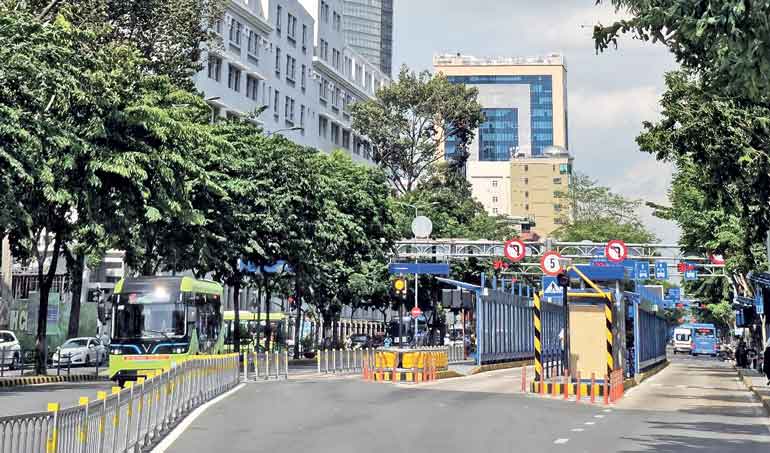
Public Transport Depot, Ho Chi Minh City
LMT: Buses are only the beginning
Perhaps the most important takeaway is not something Sri Lanka should copy from other countries. It is a different way of thinking about transport itself.
Developing countries are often tempted to measure infrastructure progress through visible assets: kilometers of road built, buses purchased, railway lines rehabilitated, or stations opened. LMT itself could easily be measured this way - by the number of buses deployed, routes opened, or passengers carried. But its real value should be judged by something much bigger: what does LMT allow people and businesses to do differently?
Can someone living outside Colombo use an LMT connection to reach a railway station and access a better-paying job without spending several hours commuting? Can Makumbura or Kadawatha become gateways through which businesses access a wider labour market? Can a passenger move from an SLTB feeder bus to LMT, rail and finally a three-wheeler without having to plan each leg as a separate journey? And when floods, fuel shortages or other disruptions occur, can an integrated network provide alternative ways of keeping people moving?
Those are ultimately questions of mobility, not buses.
And this is where LMT could become far more consequential than its initial scale suggests.
Sri Lanka does not need LMT to become another transport system operating alongside the systems it already has. It needs LMT to become the connective layer between them. Its routes and hubs could provide the backbone around which existing buses, railways, three-wheelers and eventually BRT, LRT or MRT services are progressively integrated. Common ticketing, coordinated timetables, real-time journey information, well-designed interchanges, and reliable feeder connections would arguably matter just as much as expanding the fleet itself.
That also means thinking differently about the infrastructure surrounding LMT. Makumbura, Kadawatha, and future hubs should not simply be places where passengers change buses. With the right planning, they can become economic nodes around which offices, retail, housing and services develop and extend economic activity beyond Colombo’s traditional center, while giving people access to opportunity without necessarily owning a car.
This is the larger opportunity LMT creates.
Its success should therefore not simply be that more Sri Lankans ride better buses. Success would be fewer people feeling that purchasing a private vehicle is the inevitable price of economic progress. It would mean businesses accessing larger pools of workers, regional communities becoming better connected to employment and education, transport hubs attracting investment, and Colombo gradually becoming a city where mobility does not automatically mean more vehicles on already congested roads.
When visiting countries like Vietnam, it leaves travellers with the impression of a country increasingly treating connectivity as part of its development strategy rather than merely as a transport problem.
LMT allows Sri Lanka to begin doing the same.
The new buses arriving in Sri Lanka are important. But whether LMT becomes a successful bus service or the beginning of a genuinely different mobility system will depend on everything we choose to connect to them.
(The writer is an engineer, project management professional, and energy and infrastructure development enthusiast with experience across engineering, project development, and business strategy. He can be reached at [email protected])




