Saturday Oct 10, 2026
Saturday Oct 10, 2026
Saturday, 10 October 2026 00:00 - - {{hitsCtrl.values.hits}}
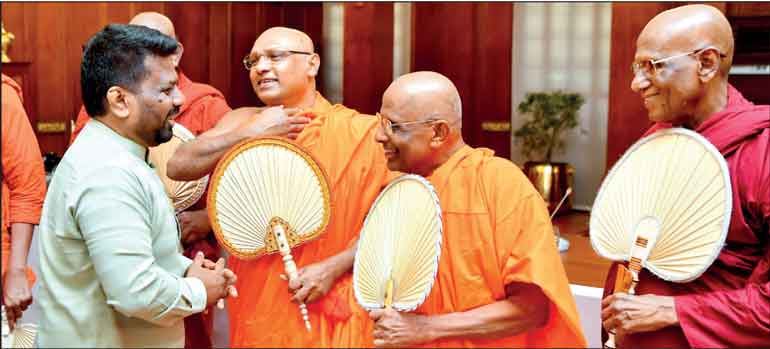
President Anura Kumara Dissanayake speaks with some of the venerable monks who attended a meeting on Thursday
 I read Sarath de Alwis’s “Ghost of Gnanasara haunts our republic” (https://www.ft.lk/columns/Ghost-of-Gnanasara-haunts-our-republic/4-798359) with respect for the author’s long experience as a journalist and his evident concern about the future of Sri Lanka. His right to question religious institutions, political establishments and historical narratives is beyond dispute. A democratic society must protect that freedom.
But freedom to question does not require us to accept every interpretation offered in its name. I believe some of the historical conclusions in the article deserve closer examination, particularly where documented history, scholarly interpretation and rhetorical assertion appear to merge.
There is no reason to deny that Buddhist institutions in Sri Lanka have experienced caste distinctions, political patronage, struggles over authority and disputes concerning property. These are legitimate subjects for historical inquiry.
The history of the Siyam Nikaya is a good example. Higher ordination was restored in 1753 through monks brought from Siam, with the support of King Kirti Sri Rajasinghe and Weliwita Saranankara. Subsequently, higher ordination within the Siyam Nikaya became restricted to Govigama candidates. This exclusion was historically significant and contributed to the emergence of the Amarapura and Ramanna fraternities.
That history should neither be concealed nor romanticised.
But neither should it be simplified. To describe the Siyam Nikaya merely as a “deliberate instrument of feudal statecraft” is an interpretation, not an uncontested historical fact. Religious revival, royal patronage, monastic reform, caste interests and political authority were intertwined. Reducing that complex historical process to political engineering risks replacing one simplified narrative with another.
The same caution applies to the British period.
The Kandyan Convention of 1815
The Kandyan Convention of 1815 unquestionably gave Buddhism a privileged constitutional position. The British undertook to protect and maintain the Buddhist religion, its rites, ministers and places of worship. That is historical fact.
British colonial policy towards Buddhism, however, was considerably more complicated than a simple bargain in which the colonial rulers protected monastic landlords in return for political obedience. British administration simultaneously protected, regulated and transformed Buddhist institutions. Questions of monastic property, succession and institutional authority increasingly became subject to colonial law and courts.
Consequently, the assertion that the British protected monastic property so that monks could “keep the populace subdued and loyal to the status quo” should be regarded as a political interpretation requiring evidence, rather than as an established historical conclusion.
There is an even more fundamental distinction that shouldnot be lost in this debate:
Buddhism is not synonymous with Sinhala-Buddhist nationalism.
There is abundant historical evidence that Buddhism became intertwined with Sinhala nationalism, particularly during the late colonial and post-colonial periods. Religious identity, ethnicity, historical memory and political mobilisation have at various times reinforced one another. This deserves serious and sometimes severe criticism.
But criticism of Sinhala-Buddhist nationalism is not the same thing as criticism of Buddhism itself.
The ethical teachings of Buddhism—Metta (loving-kindness), Karuna (compassion), Ahimsa (non-harming), truthfulness, generosity, restraint and the purification of the mind—cannot simply be reduced to an ideology of ethnic supremacy.
Indeed, Buddhist teachings provide grounds for criticising Buddhists when their conduct contradicts those principles.
A Buddhist institution can fail to live according to Buddhism. A Christian institution can fail to live according to Christianity. A political party can betray its declared principles. The failure of an institution should not automatically be treated as proof that the philosophy itself is fraudulent.
This distinction matters greatly in Sri Lanka.
We should be able to acknowledge historical discrimination committed in the name of Buddhism without condemning Buddhism itself. We should acknowledge the privileges historically enjoyed by the Sinhala majority without treating every Sinhala person as an ethnonationalist.
We should recognise the grievances of minorities without permanently defining them through victimhood. We should criticise political monks when their conduct deserves criticism without portraying the entire Sangha as a political conspiracy.
Above all, the rule of law must apply equally.
A monk is a citizen. A politician is a citizen. A journalist is a citizen. A businessman, priest, teacher or ordinary citizen is equally a citizen. No robe, office, wealth, ethnicity or religious affiliation should place anyone above the law.
But defending equality before the law does not require treating Buddhism as an obstacle to democracy.
Political order
Sri Lanka’s challenge is not to choose between Buddhism and democracy, or between Sinhala culture and pluralism. Our challenge is to construct a political order in which religious conviction and equal citizenship can coexist without one becoming a weapon against the other.
This is why I am uncomfortable with the broad use of the phrase “cosmic myth” to describe the historical foundations of Sinhala-Buddhist identity.
Every civilisation possesses narratives of origin, belonging, sacrifice and continuity. Some are historically verifiable; others are religious or cultural traditions; many contain elements of both.
The proper response is not to replace one community’s mythology with another community’s counter-mythology.
The proper response is historical literacy.
We should learn to distinguish between what is documented, what is disputed, what is scholarly interpretation and what is political rhetoric. Such discipline is particularly important in a country where careless words can deepen wounds that have already cost us enormously.
The same principle applies when invoking great thinkers. Albert Einstein’s complex attitude towards religion, for example, cannot responsibly be reduced to a convenient quotation proving either belief or unbelief. He rejected belief in a personal God while retaining a profound sense of wonder about the universe and what he regarded as the spiritual dimension of human existence.
Great thinkers should be studied, not recruited as weapons for contemporary arguments.
Sri Lanka now needs precisely this intellectual maturity.
Future of Sri Lanka
We must create a republic in which a Buddhist does not have to surrender his or her faith to be a good citizen; where a Hindu, Muslim or Christian does not have to apologise for his or her identity; and where an atheist or agnostic enjoys precisely the same citizenship as a believer.
That is not a compromise. It is the essence of equal citizenship.
The future of Sri Lanka should therefore not be a contest between competing historical or “cosmic” narratives. Nor should the answer to the excesses of religious nationalism be an equally intolerant secularism that regards religious identity itself as a problem.
We need something more difficult and more mature: a civic order capable of accommodating our differences while holding firmly to one principle—that no citizen is above the law and no citizen is below the law.
I therefore respectfully disagree with Sarath de Alwis where historical complexities appear to be transformed into sweeping conclusions about Buddhism, the Sangha and Sinhala identity. At the same time, I defend his right to make those arguments.
That is precisely the kind of Sri Lankan republic I hope we can build: one in which historical truth is pursued without hatred, religion is practiced without domination, criticism is expressed without dehumanisation, and citizenship is never determined by race, religion or political allegiance.
Our task is not to destroy one another’s histories.
It is to learn how to live together despite them.
That, ultimately, may be the most important lesson Sri Lanka can draw from its long and difficult history.




