Thursday Oct 22, 2026
Thursday Oct 22, 2026
Wednesday, 28 January 2026 00:16 - - {{hitsCtrl.values.hits}}
 Sri Lanka has reached a historic milestone in its tourism revival, recording 2.36 million tourist arrivals—the highest in recent years. This achievement reflects renewed global confidence in Sri Lanka as a destination. More importantly, it highlights the untapped potential to grow tourism numbers even further, provided the right strategic decisions are taken now.
The notion that Sri Lanka lacks hotel capacity is inaccurate. According to industry statistics, the country has over 55,000 registered hotel rooms, with an equal or larger number of rooms available in the informal sector, including villas, boutique hotels, and homestays. From luxury to budget travel, Sri Lanka is already well-equipped to accommodate a significant increase in arrivals.
Mattala: The immediate and practical solution
The most pressing bottleneck is airport capacity, particularly at Bandaranaike International Airport (BIA), Katunayake. Temporary solutions such as adding immigration counters or minor terminal adjustments may provide short-term relief, but they do not address the structural limitation.
Any major expansion at Katunayake will take considerable time and investment. Sri Lanka cannot afford to let tourism growth stall while waiting for long-term construction projects to be completed.
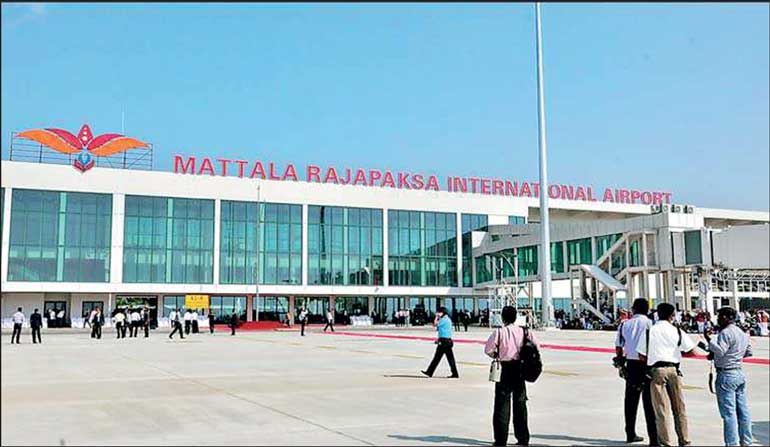
The Mattala Rajapaksa International Airport offers an immediate, ready-made solution. The infrastructure already exists, significant public funds have been invested, and operational readiness is in place. What is required is a policy shift to actively promote Mattala as a viable international gateway.
Routing international arrivals through Mattala opens direct and easy access to some of Sri Lanka’s most sought-after destinations, including:
With the Southern Expressway and connecting road networks, tourists can reach these destinations quickly and comfortably, without passing through Colombo or facing congestion at Katunayake.
Focusing on the South as an international entry point supports balanced national development. The region already benefits from strong road infrastructure and a growing hospitality base, and it has the capacity to expand further without stressing urban systems.
At the same time, Colombo can continue to serve as a commercial and financial hub, while the South evolves as a tourism, leisure, and MICE destination, as originally envisioned.
Reviving the original Southern Development vision
Activating Mattala will also accelerate long-planned developments in the South, including:
This approach ensures that public investments already made are fully utilised while generating employment and economic activity across multiple provinces.
Sri Lanka is at a defining moment in its tourism journey. The country can either allow airport limitations to restrict growth or take a bold, strategic step by decentralising international arrivals.
The solution is not temporary counters or short-term fixes.
The solution is strategic utilisation of Mattala, supported by excellent connectivity to the South, Ella, Nuwara Eliya, and the East Coast.
Sri Lanka’s tourism future will not be built by waiting—it will be built by using what we already have, wisely and decisively.
(The author is a veteran hotelier)




