Friday Nov 20, 2026
Friday Nov 20, 2026
Friday, 20 November 2026 00:20 - - {{hitsCtrl.values.hits}}
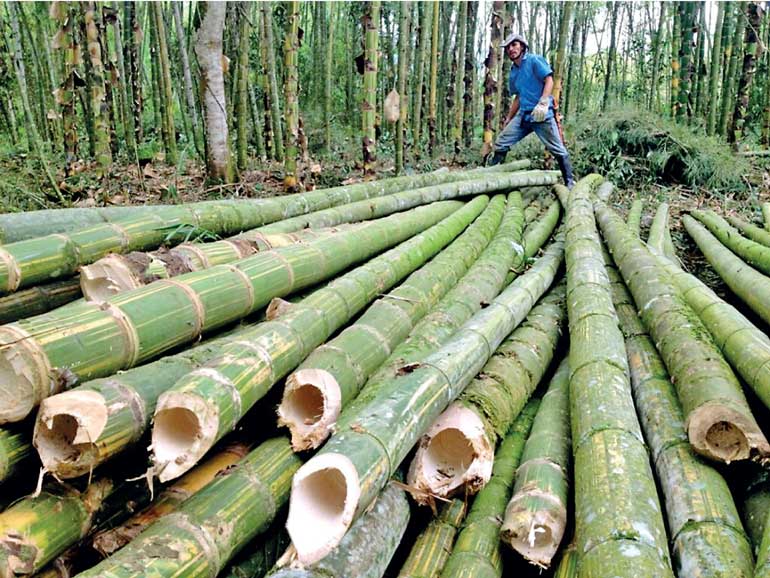

It was exhilarating to read about the light-dappled photos and architectural accounts of the bamboo pavilion designed by Architect Anjana at the recent Ruhunu Fest 2026 in Galle; one is immediately struck by how far this native resource has come. As Udugama’s article depicts, what was once dismissively labeled “the poor man’s timber” stood at the center of the exhibition as a showcase of modern structural elegance. Surrounding the pavilion were intricate bridge models crafted by architecture students from KDU, alongside modern eco-lodges utilising Cement Bamboo Frame Technology (CBFT) that slash embodied carbon emissions by up to 60 percent compared to conventional concrete construction. To the casual observer, this vibrant display of bamboo architecture feels like a sudden, spontaneous green awakening across Sri Lanka’s coastal and hospitality landscapes. But beneath the elegant structural curves and sustainable joinery lies a complex, decades-long journey of scientific perseverance, grass-roots artisan training, and—most crucially—a hard-fought legislative overhaul that systematically unblocked a century-old economic bottleneck, to return back to our indigenous heritage and masterworks.
The 116-year colonial bug
For generations, bamboo was interwoven into the very fabric of traditional Sri Lankan life. It formed the flexible framework of village wattle-and-daub homes, stabilised fragile riverbanks against seasonal monsoons, provided sturdy ‘edandas’ across rural rivulets, and served as the raw material for essential household utilities. It was local, resilient, and deeply regenerative.
Yet, in 1907, under British colonial administration, a regulatory decision was enacted that effectively froze the commercial growth of this native resource. This enactment was not just in Sri Lanka, but was forced across most of the British Colonies. Governed under rigid timber transportation laws, bamboo was subjected to severe felling and transport restrictions. What was intended as a colonial mechanism to control timber exploitation unintentionally became a system-level bug: treating a rapidly growing, self-regenerating ‘grass’ as if it were slow-growing hardwoods like teak or mahogany.
In Sri Lanka, for 116 years, this regulatory throttling restricted local producers, small-and-medium enterprises (SMEs), and builders. A rural craft worker or eco-architect looking to harvest and transport commercial bamboo was trapped in bureaucratic friction, permitted to transport only negligible quantities—often capped at just two culms per permit. Under such conditions, an industrial supply chain was
virtually impossible to build. While neighbouring and former colonial nations refactored their industrial policies to turn bamboo into a multibillion-dollar export engine, Sri Lanka’s bamboo potential remained locked behind legacy code.
Hitting ‘system upgrade’: The 2023 policy patch
Unlocking Sri Lanka’s “Green Gold” required more than architectural enthusiasm; it demanded a full-stack intervention within the halls of Parliament.
In 2023, after extensive consultative deliberations bringing together a diverse coalition—rural artisans, researchers from the Lanka Network for Bamboo and Rattan (SRINBAR), tissue-culture scientists, and officials across the Ministries of Industry, Wildlife, and Forest Conservation—the long-overdue system update was finally deployed.
Through Ministerial Consultative Committees, Parliamentarians and Policy Advocates successfully negotiated a critical regulatory amendment. The permissible limit for cutting and transporting primary commercial varieties—specifically ‘Gal Bamboo’ (Dendrocalamus asper or Giant Bamboo)—was expanded from a restrictive ‘2 units to 200 units’.
This single legislative patch represented a 100-fold increase in supply bandwidth. Overnight, it dismantled a century of artificial scarcity, allowing raw materials to flow legally and efficiently from rural groves to urban design studios and processing centers. Crucially, the policy was designed with environmental safeguards, protecting endangered flora, archaeological sites, and delicate forest ecosystems while unleashing managed, cultivated bamboo for industrial scale. (ST 16.07.23)
From tissue culture to coastal resorts
The ripple effects of this legislative breakthrough are now visible across Sri Lanka’s architectural landscape. But the structural shift relied equally on pioneering research laid down years prior by dedicated scientists.
Long before bamboo gained modern architectural appeal, researchers like Scientist Shantha Ramanayake pioneered tissue-culture propagation techniques to mass-produce giant bamboo plantlets. This downstream research blossomed into the Riverine Bamboo Project under the Mahaweli Authority of Sri Lanka, resulting in the planting of over two million tissue-cultured bamboo plants produced at laboratories in Mawatura, Kotmale.
Today, these scientific roots intersect with creative, hands-on application. At universities, architecture students are applying bamboo engineering to real-world community challenges—designing modular, low-cost bamboo pedestrian bridges to replace precarious river edandas in rural villages, ensuring school children can cross streams safely during monsoon floods.
Simultaneously, in the private sector, visionaries are redefining luxury eco-tourism. Innovators and co-founders of Una Gama, established training facilities in Akerella, Ratnapura, to upskill local workers in Cement Bamboo Frame Technology. By plastering a thin half-inch outer layer of cement over bamboo wall panels, their designs achieve structural durability and low maintenance. Spanning boutique resort units in Ahangama, bamboo restaurants at Belihuloya, and expansive beach structures demonstrate that bamboo is no longer an alternative material. Bamboo is a premier material of choice.
The 4E framework: Capturing the $100 b global bioeconomy
As Sri Lanka navigates economic recovery, bamboo represents far more than an aesthetically pleasing architectural trend—it is a strategic pillar for national sustainable industrialisation. Globally, the bamboo bioeconomy is projected to surpass $100 billion. By pairing progressive local policy with rigorous material engineering standards and progressive fiscal incentives, Sri Lanka can capture a meaningful fraction (>1%) of this global demand through a structured 4E Framework.
Economy - Moving beyond basic artisan craft to high-value engineered timber substitutes, structural beams, flooring, circular textiles, furniture, and eco-friendly packaging that replace single-use plastics and expensive imported materials.
Energy - Processing fast-growing bamboo biomass into high-caloric thermal energy, offering domestic industries a carbon-neutral alternative to imported fossil fuels and wood pellets.
Environment - Utilising bamboo’s deep root networks for erosion control along vulnerable riverbanks, while leveraging its rapid growth rate not only it acts as an extraordinary biological generator for Oxygen (O2) production, but also as one of the planet’s highest-performing carbon sinks to rehabilitate degraded agricultural lands.
Empowerment - Avoiding hyper-centralised, capital-intensive factory models to much more in favor of decentralised-smallholder plantations and regional primary processing hubs. This modular approach empowers rural villages to establish localised economic loops, creating steady regional income, energy self-reliance, and skilled green jobs.
Incentivising ecosystem services: The case for oxygen tax rebates
To accelerate this structural and technical transition, regulatory updates and engineering standards must be complemented by targeted fiscal policy. Bio-initiatives that actively produce Oxygen, stabilise fragile topsoil, preserve hydrological catchments, and sequester carbon to sustain human life perform vital public ecological functions.
In this light, Sri Lanka’s national framework could grant progressive rebates to enterprises and smallholders engaging in high-impact bio-cultivation. Extending these facilities to bio-cultivation and value-added bio-manufacturing treats growers and processors as critical ecological infrastructure—attracting regional processing hubs while directly rewarding an Oxygen positive and carbon-conscious land stewardship.
Building tomorrow’s legacy
The journey of bamboo in Sri Lanka—from traditional village utility, through a century of colonial regulation, to legislative reform and cutting-edge eco-architecture—serves as a compelling case study in how nations can revitalise forgotten resources.
When we look at the bamboo structures rising today along our coastlines and countryside, we are not merely witnessing a trend in green construction. We are seeing the tangible result of a country updating its regulatory systems, honouring its scientific pioneers, and empowering its young designers and artisans.
The houses and public spaces of tomorrow do not have to come at the expense of our natural world. By marrying ancient material wisdom with modern engineering discipline, international standardisation models, and progressive policy, Sri Lanka has proven that “the poor man’s timber” holds the key to a rich, resilient, and bio-architectural future.
(The author’s academic background includes computer science and business economics in the USA. He is formerly an engineer, and Ex-MP in Sri Lanka, and could be reached at [email protected])
Notes;
1. ST 25.10.26, Bamboo: Making the ‘poor man’s timber’ rich in eco-friendly architecture, Sunday Times Plus, https://www.sundaytimes.lk/261025/plus/bamboo-making-the-poor-mans-timber-rich-in-eco-friendly-architecture-661579.html
2. ST 16.07.23, Bamboo industry: Outdated legislations and wrong decisions, Sunday Times Plus, https://www.sundaytimes.lk/230716/plus/letters-to-the-editor-14-525206.html



