Monday Oct 12, 2026
Monday Oct 12, 2026
Thursday, 2 July 2026 01:54 - - {{hitsCtrl.values.hits}}
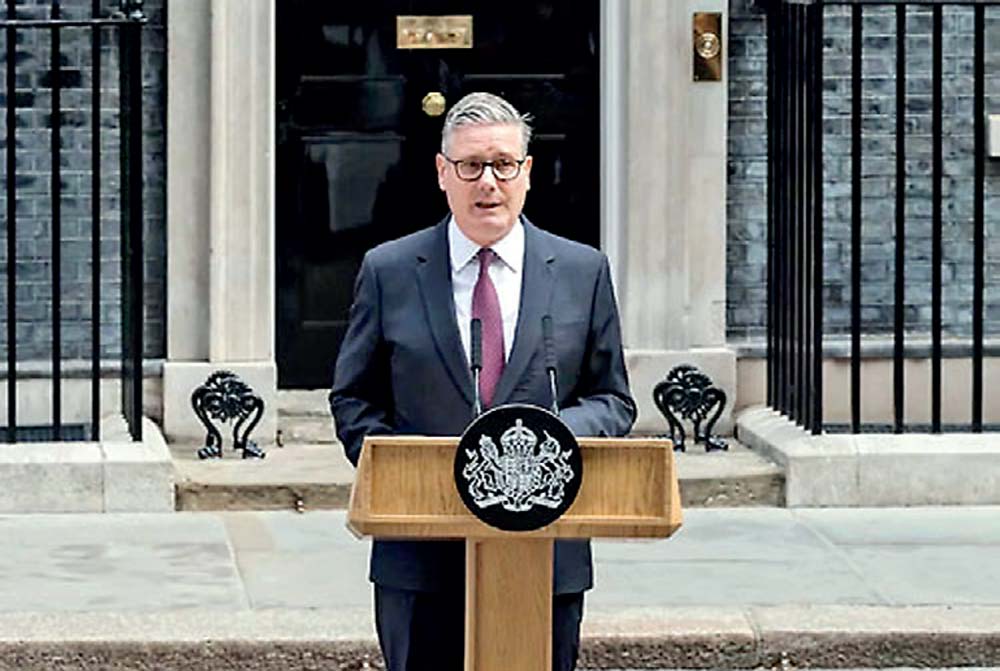
Keir Starmer: 6th British PM to quit in 10 years
The American Revolution produced an advanced political model
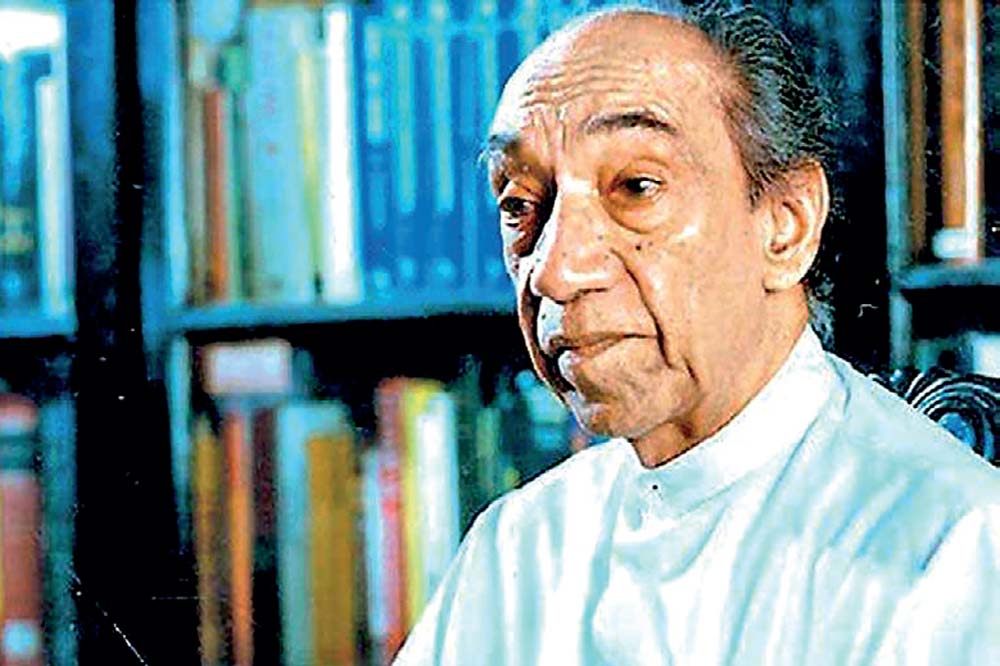
JR Jayewardene: The great political moderniser
 The elected Presidency is a better ‘lid’ than a Parliament. This is especially so in the Sri Lankan case where its North and East are neighbours of an ethnic-kinstate with 80 million people, Tamil Nadu. Those of the Lankan liberal-left who have consistently advocated both the abolition of the executive Presidency and expanded quasi-federal devolution have displayed a complete absence of responsibility and realism.
 Britain has had six Prime Ministers in 10 years. A politician who entered Parliament through a recent by-election is poised to become the Prime Minister, i.e., the political leader of Britain. If these facts do not drive home the anomalous, irrational nature of the UK political system and the comparative improvement on it that we have in Sri Lanka, nothing will.
There is a mini-series currently on Netflix about the American Revolution, the 250th anniversary of which is celebrated this month, July. Whatever the criticisms of the American political system and that of France which provided the more radical yet fraught successor to the democratic revolution in America, in neither country can anyone who wins just his home State have a direct pathway to the Presidency (except, in the US case, as a Vice-President who succeeds an assassinated President).
By contrast, in the Westminster model so dear to Ceylon’s/Sri Lanka’s left liberals, you can rule the whole country if you have won your seat and your party has won the larger number of seats in the legislature.
There is a reason for this distortion in Britain. It retains the historically anachronistic monarchy, not a democratically elected office, as the unifying symbol of the nation. The opposite is true of modern democracy exemplified by the USA and France. This is why the great liberators of Latin America, starting with Simon Bolivar, chose the model of the American Presidency rather than that of the UK.
It is not that the American presidency doesn’t require reform and rectification. Alexandria Ocasio Cortez has been among those calling for the abolition of the Electoral College and the installation of a system of purely direct national election of the President. France has precisely such a direct system. So too Sri Lanka.
Sri Lanka’s electoral system is also far more progressive than Britain’s which is the one we had until 1978, namely the first-past-the-post, ‘winner takes all’ system, which enables a victory by a narrow margin of votes and the non-representation of the losers by a narrow margin, of that seat or district. The Westminster model is a zero-sum game; Sri Lanka’s isn’t.
Unlike the ‘progressives’ of Sri Lanka, the heroic leftist revolutionaries of Latin America who were imprisoned for decades under military or civilian-military juntas which occupied the presidency, never confused dictatorship or authoritarianism with the presidential system and thought that the former sprang from the latter. They went on to run for and win the Presidency in their countries (Mujica, Lula et al), though that second cycle of left rule (Pink Tide 2) is now closing.
Even when I was indicted as the first accused of 23 persons including EPRLF founder-leader K Pathmanabha, on 14 counts under the Prevention of Terrorism Act and the Emergency regulations, for (alleged) acts committed dating from 1984 against the Jayawardene administration, we had not demanded and did not demand the restoration of either the Westminster model or the ‘closed’ economy which had preceded Jayewardene rule in 1978.
In a society which bears not only class inequity but also the residues of casteism in the social consciousness and practices, an electoral system of proportional representation is more democratic an agency than a first-past-the post model in which such archaic residues can play a decisive role. There could be a casteist Prime Minister elected from a specific locality, but it is difficult to envisage a casteist President who has to draw votes from as diverse a social spectrum as possible to win
Structure of State
Opting for a form of State is the most challenging task for a political leader or political thinker, because one is advocating a choice of the best sword and shield, the best ‘armour’ for the country, the nation, and its people.
Given the geopolitical and geostrategic realities of the island of Sri Lanka, with its composition, demographic distribution and neighbourhood, the best form of State is the 1978 Jayewardene model with its 1987 structural reform (provincial councils).
We’ve fought and won a Thirty Years War, a second Southern civil war, seen off a foreign military force on Sri Lankan soil, swiftly recovered from a tsunami, clocked an average of 5% economic growth in those years, supplemented it with social programs, and remained a functioning electoral democracy (except for a partial, i.e., Parliamentary, closure in December 1982-1988)—all under our existing political system.
Ranasinghe Premadasa and Mahinda Rajapaksa couldn’t have done any of it under a Westminster model dependent on shifting Parliamentary majorities. Sri Lanka wouldn’t have restored its sovereignty, and survived as a single unified/reunified State, i.e., one country, under any model other than the Presidential form of a Republic that we’ve had thanks to JR Jayewardene and above all the universal inspiration of the political order forged by the American Revolution 250 years ago.
As for electoral systems, JR perhaps opted for proportional representation because he was confident that the UNP would remain the country’s largest single party, but it is also true that theorists of progressive, pluralist democracy, and even radical democracy, have always recognised proportional representation as superior to, and more progressive, than the first-past-the post system.
Aristotle’s axiom
There is a more fundamental conceptual sense in which the 1978 political model (Presidency, proportional representation) as modified in 1987 (presidency plus provincial devolution) contains the rudiments of the best available political order for Sri Lanka.
Aristotle identified three broad types of State: rule by one man, which he called tyranny; rule by a few, which he named oligarchy; rule by a majority, which he designated democracy. After arguing how each type slides to its extreme and decomposes into its opposite, generating a vicious cycle, he concluded that the best State is a hybrid or mixed type, which is a fusion of the key features of all three types listed above.
Far more so than Ceylon/Sri Lanka’s 1947 Soulbury and 1972 Republican constitutions, the 1978 Republican constitution approximates the Aristotelian hybrid of the three types.
The Founding Fathers of the USA were influenced by Aristotle’s argument and the accounts by classical historians of the Republics of ancient Greece and Rome. The result was the rejection of the British model of hereditary monarchy and Parliamentary Government in favour of a democratic republic, headed by a democratically-elected Presidency and containing a bicameral legislature.
Sri Lanka’s triad—nationally-elected Presidency, legislature elected on proportional representation, devolution to elected Provincial Councils—constitutes a better system than Britain’s. Undiluted proportional representation provides the clearest mirror of public opinion and respective political strengths, while the directly elected Presidency provides the stability that can be undermined in a strictly Parliamentary system with proportional representation.
The Lankan system is superior even in the matter of devolution. The model of a purely Parliamentary system with the devolution of power to regions produces as in the British case, periodic demands for referendums on independence. An elected Presidency as the systemic apex has power which far exceeds the capacities of a Westminster model to contain and counter a political push by a regional/provincial assembly. The elected Presidency is a better ‘lid’ than a Parliament. This is especially so in the Sri Lankan case where its North and East are neighbours of an ethnic-kinstate with 80 million people, Tamil Nadu.
Those of the Lankan liberal-left who have consistently advocated both the abolition of the executive Presidency and expanded quasi-federal devolution have displayed a complete absence of responsibility and realism.
Had Sajith spent the time figuring out how to bridge the 8% between 42% and 50% he’d be President today. Going even further, if he had retained his 42% (2019) and added a mere 1% to it, moving up to 43% he would have won in 2024. Instead, the SJB, imitating Ranil, and influenced by Rajitha Senaratne and Karu Jayasuriya, lost time and energy on a campaign to abolish the Executive Presidency rather than to win it
Anomalous Lankan left
Unlike the left universally, which recognises the USA and France as having qualitatively more advanced political systems than Britain which never experienced a war of independence or completed a revolution against the feudal aristocracy and the monarchy, the Lankan left is unable to rid itself of the residues of a colonial mindset.
The political system of Britain is hardly renowned for its social, historical and cultural modernity. In turning its back on historical experiences (America’s War of Independence, the French Revolution, the Napoleonic wars against old Europe, the wartime French Resistance) and resultant political models of the USA, France, Russia, China, and Latin America, Sri Lankan left liberals are actually turning their backs on the wellsprings of political modernity.
The liberal-left or left-liberal sector produced much of the blunders in thinking on key political choices in contemporary Sri Lankan history:
 Patriotic war of national-territorial reunification vs. appeasement of Prabhakaran.
Presidency vs. Westminster model.
Proportional representation vs. first-past-the-post.
Provincial autonomy within unitary State vs. Federalism.
In a society which bears not only class inequity but also the residues of casteism in the social consciousness and practices, an electoral system of proportional representation is more democratic an agency than a first-past-the post model in which such archaic residues can play a decisive role. There could be a caste-ist Prime Minister elected from a specific locality, but it is difficult to envisage a casteist President who has to draw votes from as diverse a social spectrum as possible to win.
One would have expected the Lankan left, progressives and liberals to know better.
A republic is the most progressive political order. The Westminster model is not embedded in a republic but a monarchy, devoid of even a written constitution.
Parliamentary republics exist, with India and Sri Lanka (1972-1978) being examples. However, the great, modern republics aren’t Parliamentary but Presidential.
Countries which have a real revolution in their political history—be it ‘bourgeois-democratic’ or non-capitalist/socialist—have opted for Presidencies.
A republic is distinguished by the people being acknowledged as the source of power and sovereignty. Because the country’s leader is chosen by the votes of the whole people in aPresidential system, it is a far a better ‘political shell’ or ‘superstructure’ for a modern republic than is a parliamentary system.
The inability to grasp these basics explain why Sri Lanka’s left-liberals have failed to play their role as the consistent vanguard of modernity and modernisation. They have even been a force for conservatism.
The left-liberal cosmopolitan elite and its academics and intellectuals in particular were prejudiced and hostile precisely towards the two Sri Lankan leaders who most approximated Antonio Gramsci’s guiding criterion of the ‘national-popular’: Ranasinghe Premadasa and Mahinda Rajapaksa.
The left-liberals now support the illiberal left—the JVP-NPP Government.
Centre-right irrationality
The liberal-right/liberal centre-right/liberal-centre, i.e., the UNP, the Karu Jayasuriya-led forum and the Samagi Jana Balavegaya (SJB) are also off the rails.
The liberal centre-right stands quite firmly for the Open Economy and devolution—but neither would have been possible to implement or sustain without the Executive Presidency. Despite that axiomatic fact, the UNP under Ranil Wickremesinghe spent much political capital during the Yahapalanaya years on the ‘abolition’ project and the successor SJB wasted a few valuable years after its founding in 2020 advocating ‘19th Amendment Plus’, i.e., the abolition of the Executive Presidency.
Sajith Premadasa had scored 42% at the Presidential Election running in November 2019 against Gotabaya Rajapaksa who was surfing an anti-terrorist, post-Easter Massacre wave. Sajith’s 42% was an excellent achievement especially when one recalls that Anura Kumara Dissanayake won in 2024 with only the same percentage of the vote, 42%.
Had Sajith spent the time figuring out how to bridge the 8% between 42% and 50% he’d be President today. Going even further, if he had retained his 42% (2019) and added a mere 1% to it, moving up to 43% he would have won in 2024. Instead, the SJB, imitating Ranil, and influenced by Rajitha Senaratne and Karu Jayasuriya, lost time and energy on a campaign to abolish the Executive Presidency rather than to win it.
Any party of the liberal-democratic right, centre-right or centre, which advocates when in Opposition and wastes time when in office in trying to abolish, or actually succeeds in abolishing the Executive Presidency, will realise that it cannot proceed for long with either the open economy or devolution.
It is not that the Sri Lankan political system doesn’t require reform—but such reforms have to be a step forward, not backwards. The directly-elected Presidential system needs to remain as the overarching repository of the general will of the citizens of the island taken as a whole, but the Judiciary and Legislature have to be strengthened and checks-and-balances ensured along American lines
Jayewardene and Premadasa revolutions
JR Jayewardene was more advanced than most Ceylonese/Sri Lankan politicians. Though he was a product of the Legislative Council under British colonialism, he was the first and most prominent Parliamentarian to be able to escape from its conceptual limitations, turn towards and find inspiration in the two great democratic republics—USA and France. Thus the 1978 Constitution for which he had advocated since 1966, was modelled – though imperfectly—on the American and French political systems.
The Executive Presidency and open economy were logically linked when advocated by JR Jayewardene as a tandem in 1966. He explained its political economy in his speech to the SLAAS-F Section (Social Sciences) in December 1966, presided over by Dr. Lal Jayewardena.
JRJ was more right than wrong, more realistic than not, and certainly more correct than the liberal-left and liberal-right, when he argued 60 years ago this year, that for sustainable, rapid economic growth and modernisation the country needed “a strong and stable Executive, free from the whims and fancies of the Legislature”.
The two concepts featured in the UNP manifesto of 1977, and a mandate was obtained– which is why a referendum wasn’t needed for the changeover.
JR could not have pushed through and sustained the open economy without the Executive Presidency. This is true not only of the open economy of 1977 but of its dramatically evolved ‘Growth with Equity’ model of President Ranasinghe Premadasa (1989-1993).
President Premadasa was spot-on when he told me: “Do you think that if not for Mr Jayewardene’s Executive Presidency, our own fellows would have allowed me to implement my pro-people development programs?”
The matter is still clearer with devolution. SWRD Bandaranaike simply could not push through the pact for Regional Councils arrived at with SJV Chelvanayakam, as Prime Minister within the Westminster model. Had he been the elected President he would have. JR Jayewardene was able to push the 13th Amendment through implement it on the ground because he was the Executive President.
Large-unit devolution outside and beyond the boundary of the unitary State has long been rejected by the majority of the island’s Sinhala majority, by means of electoral backlashes which have also been swings to nationalist-populism.
Even the 13th Amendment, i.e., provincial devolution, is acceptable to the people and swathes of the Opposition only if the constitutional capacity for containment through the directly, nationally elected Executive Presidency and its proxy the governors, remain. If the Executive Presidency is abolished, devolution will go with it. If devolution is to remain, so too must the elected Executive Presidency.
Twin pillars for SJB-UNP
Sajith Premadasa and the SJB want to:
(a) Re-energise the open economy.
(b) Rebalance it in the direction of equity with rapid, pro-people programs.
(c) Revive the Provincial Councils.
If the SJB fails to recognise the comparative superiority of the 1978 Jayewardene political model of 1978 as structurally reformed by the 13th Amendment of 1987, it will be unable to fulfil these goals.
The SJB must decide which party and period it is the successor of:
(a) The ascendant developmental UNP of Presidents JR Jayewardene and Ranasinghe Premadasa (1973-1993)
(b) The declining neoliberal UNP of Ranil Wickremesinghe (1994-2026).
Sajith Premadasa, the SJB, and any SJB-UNP partnership must rest firmly upon twin pillars:
(I) The politico-constitutional model of JR Jayewardene.
(II) The socio-economic model of Ranasinghe Premadasa.
It is not that the Sri Lankan political system doesn’t require reform—but such reforms have to be a step forward, not backwards. The directly-elected Presidential system needs to remain as the overarching repository of the general will of the citizens of the island taken as a whole, but the Judiciary and Legislature have to be strengthened and checks-and-balances ensured along American lines.
https://dayanjayatilleka.webflow.io/




