Monday Sep 14, 2026
Monday Sep 14, 2026
Monday, 14 September 2026 01:18 - - {{hitsCtrl.values.hits}}
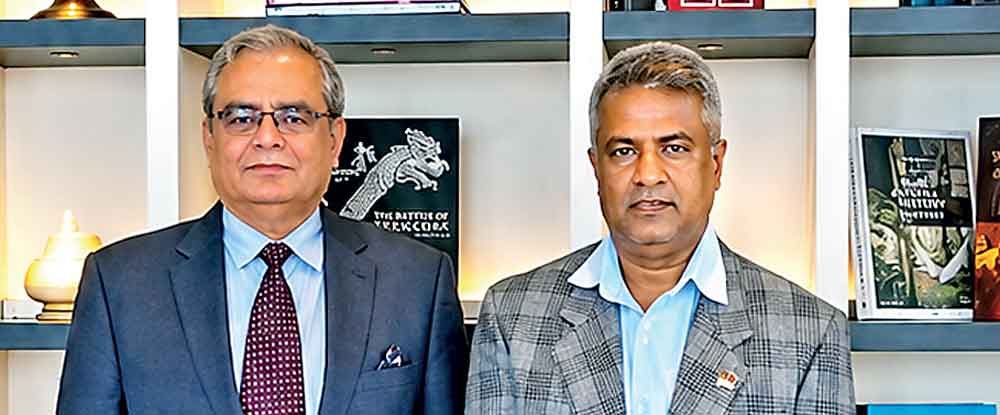
Bay of Bengal Initiative for Multi-Sectoral Technical and Economic Cooperation (BIMSTEC) Secretary General Ambassador Indramani Pandey (left) with the author Col. Nalin Herath RSP
 Sri Lanka’s strategic location in the Indian Ocean has long been described as one of its greatest national assets. Yet geography alone does not create influence. It is the ability to translate geography into policy, partnerships, economic opportunity and regional leadership that ultimately determines how a country benefits from its strategic position. A recent conversation with the Bay of Bengal Initiative for Multi-Sectoral Technical and Economic Cooperation (BIMSTEC) Secretary General Ambassador Indramani Pandey reinforced this reality and highlighted an opportunity that Sri Lanka should not overlook.
Role of BIMSTEC
During his recent visit to Colombo, I had the privilege of meeting Ambassador Pandey and discussing the evolving role of BIMSTEC and the opportunities for greater engagement with Sri Lanka. What struck me was not only his understanding of the region but also his emphasis on practical cooperation in areas that are directly relevant to Sri Lanka’s national interests.
Among the areas highlighted were maritime affairs and the blue economy, disaster mitigation, food security, counter-terrorism, anti-money laundering and combating human trafficking. These are not isolated subjects. Together, they represent some of the most important dimensions of regional security, economic resilience and sustainable development in the Bay of Bengal and the wider Indian Ocean. For Sri Lanka, maritime affairs should naturally occupy a central position in this agenda.
Sri Lanka sits close to one of the world’s most important maritime trade routes. Its ports, shipping services, logistics capabilities, fisheries, offshore resources and wider blue-economy potential provide opportunities that extend well beyond traditional port operations. BIMSTEC, therefore, offers a platform through which Sri Lanka can engage neighbouring countries on maritime connectivity, port development, shipping, marine environmental protection, disaster response, maritime security and the sustainable utilisation of ocean resources. This is particularly timely given the growing importance of the Indian Ocean to global trade and geopolitics.
My conversation with Ambassador Pandey took place shortly after the launch of the Ceylon Chamber of Shipping (CCS) at the Colombo International Maritime Conference. The Chamber was launched during the conference organised by the Colombo Shippers’ Academy, founded by Rohan Masakorala. The launch was officiated by FMC Chairperson Laura DiBella and the Minister of Ports and Aviation.
The timing was significant. Sri Lanka needs stronger institutions that can bring together Government, the private sector, academia, professionals and international partners around maritime issues. A chamber dedicated to shipping and maritime affairs can become an important platform for such engagement.
Ambassador Pandey expressed interest in closer engagement with the Ceylon Chamber of Shipping in the future and indicated that he would like to explore such cooperation during his next visit to Sri Lanka in November. This presents an opportunity that should be developed into something substantive rather than allowing it to remain another diplomatic interaction. A structured BIMSTEC–Sri Lanka maritime dialogue, for example, could bring together policymakers, shipping and logistics professionals, academics and regional experts to examine practical areas of cooperation. It could focus on maritime connectivity, port-led development, blue-economy opportunities, maritime safety and security, disaster preparedness and the development of human capital. But our conversation went beyond maritime affairs. We also discussed the importance of think tanks in shaping national policy.
I explained to Ambassador Pandey my continuing efforts to promote a stronger think-tank culture in Sri Lanka. Given my own background in the military, national security and policy research, I have increasingly come to believe that Sri Lanka needs institutions that can bridge the gap between political decision-making and academic research, institutions capable of producing practical, evidence-based policy recommendations.
Think thanks important tool for influencing policymakers
Ambassador Pandey’s response was particularly encouraging. He emphasised that think tanks can be an important tool for influencing policymakers and helping governments implement sound policies. That observation deserves greater attention in Sri Lanka. We have no shortage of intelligent people, experienced professionals, academics or former policymakers. What we lack is a sufficiently developed ecosystem that systematically brings this expertise together and converts it into policy options. A healthy democracy needs political institutions, but it also needs institutions that can independently examine complex national and international issues, challenge conventional thinking and offer policymakers alternatives. Think tanks can perform precisely this function.
They can study geopolitical developments before they become crises. They can examine the economic implications of international agreements. They can develop options for maritime strategy, national security, energy security and food security. They can assess emerging technologies and their implications for national competitiveness. They can bring international experts into domestic policy debates and, equally importantly, provide Sri Lankan policymakers with access to international policy networks.
My recent visit to the Pune International Centre (PIC) in India offered a particularly interesting perspective on this issue. I had visited PIC in 2023, when it operated from a comparatively modest office. Returning there recently for a conference organised by the Pune International Centre and the Centre for China Analysis and Strategy (CCAS), I was struck by how significantly the institution had developed. It now has a substantial physical presence and infrastructure capable of hosting major international conferences, policy discussions and intellectual exchanges. In many ways, its facilities and activities reminded me of a university environment dedicated to policy research and strategic thinking. Naturally, I wanted to understand how such an institution had developed.
One of the things I learned was that the Government had provided approximately seven acres of land, while significant support for the development of the centre had come from the business community in Pune. This is an important lesson for Sri Lanka.
India’s business community has increasingly recognised that supporting knowledge institutions is not simply philanthropy. A strong think-tank ecosystem can contribute to a better business environment, stronger economic policy, improved international engagement and greater national competitiveness. The private sector ultimately operates within the policies created by governments. Therefore, businesses have a legitimate interest in supporting institutions that improve the quality of public policy. Sri Lanka’s business community could learn from this model.
Our companies invest heavily in infrastructure, technology, human resources and corporate social responsibility. There is also a strong case for investing in knowledge infrastructure, institutions that examine the country’s future and help develop solutions to complex national challenges. This becomes even more important when we consider the challenges facing Sri Lanka. The country cannot approach maritime affairs, regional connectivity, national security, food security, disaster resilience, financial crime or human trafficking as completely separate issues. They increasingly intersect.
For example, maritime security is connected to organised crime, human trafficking, illegal fishing and financial networks. Disaster resilience is connected to ports, logistics, food supply chains and national economic security. The blue economy is connected to environmental sustainability, investment, technology and regional cooperation. This interconnectedness is precisely why policy requires institutions capable of thinking across traditional administrative boundaries. BIMSTEC provides an excellent regional platform for this kind of thinking. Sri Lanka should therefore look beyond participating in BIMSTEC meetings and signing declarations. We should seek to become an active contributor to the organisation’s intellectual and policy agenda.
Sri Lankan universities, think tanks, chambers, professional bodies and Government institutions could work together to develop research and policy initiatives linked to BIMSTEC priorities. The Ceylon Chamber of Shipping could potentially contribute particularly strongly to this effort by providing a private-sector and maritime perspective to regional discussions. Such engagement would also strengthen Sri Lanka’s soft power. Countries do not build influence only through military capability or economic size. They build influence through ideas, institutions, expertise and the ability to convene others. Sri Lanka has the intellectual resources to do this. What is required is a greater institutional commitment.
Broader thought
My meeting with Ambassador Pandey therefore left me with a broader thought: Sri Lanka’s engagement with BIMSTEC should not be viewed simply through the lens of foreign policy. It should be treated as part of a wider national strategy involving maritime development, economic cooperation, regional security, knowledge creation and policy innovation.
The opportunity is there. BIMSTEC is increasingly relevant to the strategic and economic future of the Bay of Bengal region. Sri Lanka, with its unique geographical position and maritime heritage, has every reason to play a more active role. But to do so effectively, we need more than diplomatic participation.
We need ideas.
We need institutions capable of developing those ideas.
And, most importantly, we need policymakers willing to listen to them.
The conversation with Ambassador Pandey was encouraging because it demonstrated that there is international recognition of the importance of such engagement. His interest in closer cooperation with the Ceylon Chamber of Shipping and his intention to continue the dialogue during his next visit in November provide a useful starting point. The next step should be to turn that conversation into action. Sri Lanka should build stronger bridges between BIMSTEC, the maritime sector, the private sector, universities and think tanks. If we can do that, we will not merely participate in the changing regional order, we can contribute to shaping it.
For a country positioned at the heart of the Indian Ocean, that should be an ambition worth pursuing.
(The author is the Secretary General of the Ceylon Chamber of Shipping, former Director General of the Institute of National Security Studies (INSS), and former Spokesman of the Ministry of Defence. He is also a Non-Resident Fellow at the London Dialogue. His areas of expertise include international relations, geopolitics, maritime affairs, national security, economic policy, and strategic governance. He is a consultant at JIT Group)




