Saturday Oct 03, 2026
Saturday Oct 03, 2026
Friday, 15 May 2026 05:26 - - {{hitsCtrl.values.hits}}
 policymakers and multilateral agencies across the world will need to treat energy strategy as a core pillar of economic governance, with austerity measures integrated as a permanent feature, not a crisis-time afterthought. This includes transparent communication with citizens about why conservation and targeted cuts are necessary, alongside investment in resilient supply
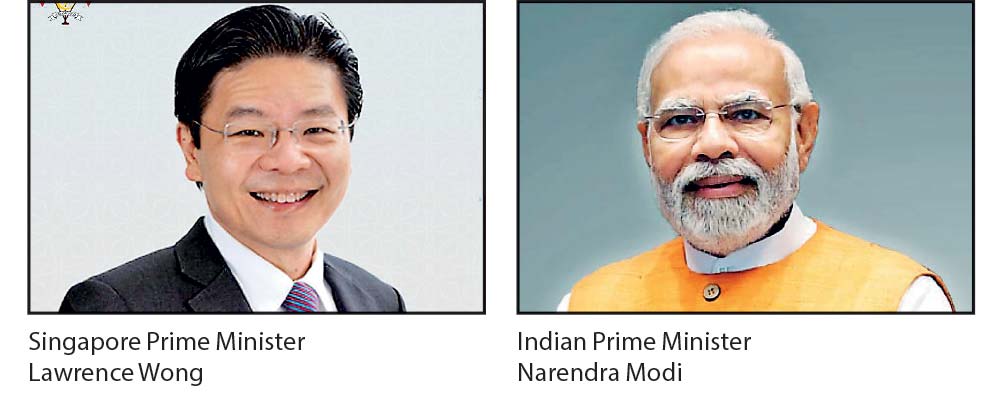
 Recent national addresses by Singapore Prime Minister Lawrence Wong and Indian Prime Minister Narendra Modi reflected a growing global reality: the world is entering a prolonged period of uncertainty where economic resilience, geopolitical stability, and national security are increasingly interconnected.
While the speeches touched on different national priorities, a common thread emerged clearly — global risks are intensifying, and governments can no longer afford to underestimate the strategic importance of energy security.For decades, global markets operated on the assumption that energy would remain reasonably accessible, affordable, and predictable. That assumption is now under pressure. Wars, shipping disruptions, sanctions, cyber threats, climate-related disasters, and strategic competition among major powers have transformed energy from a commercial commodity into a geopolitical instrument.
 Weaponising energy
The Russia–Ukraine conflict demonstrated how rapidly energy can be weaponised, with the capacity to destabilise entire economies. Europe experienced severe inflationary shocks, industries came under pressure from surging input costs, and central banks were forced into aggressive monetary tightening to contain the fallout. Similarly, ongoing tensions in the Middle East continue to remind the world that even a brief disruption to critical oil shipping lanes can trigger immediate volatility across global financial markets.Today, energy is no longer merely an economic commodity. It has become a central pillar of national sovereignty, investor confidence, food security, and broader social stability.
Austerity measures
This new reality forces a difficult but unavoidable conclusion: alongside energy diversification, nations must also embrace austerity measures. The era of readily available cheap energy masked inefficiencies in public spending, consumption patterns, and industrial design. Going forward, governments will need to impose disciplined reductions on non-essential energy usage, reconsider costly subsidies, and prioritise essential sectors over populist expenditures. Austerity in energy terms means hardening national budgets against volatility — reducing waste, mandating efficiency standards, and accepting that some economic comforts of the past may no longer be sustainable without severe strategic risk.Singapore’s leadership has consistently emphasised vulnerability management. As a highly connected global trade and financial hub with limited natural resources, Singapore understands that geopolitical shocks can rapidly spill into supply chains, currency markets, and inflation. Its strategy has therefore focused on diversification, resilience, long-term planning, and trusted international partnerships — while also signaling to citizens and businesses that energy conservation is a non-negotiable civic duty. India, meanwhile, faces a different but equally complex challenge. As one of the world’s fastest-growing major economies, India’s energy demand will rise dramatically over the next decade. Sustaining growth while protecting affordability for over a billion people requires a delicate balance between traditional energy security and renewable transformation. For India, austerity does not mean stagnation, but rather a rigorous prioritisation of energy investments over less critical expenditure, along with demand-side management that curbs unnecessary consumption without derailing development. Prime Minister Modi’s repeated emphasis on self-reliance, infrastructure expansion, renewable energy, and strategic positioning reflects an understanding that future global influence will partly depend on control over energy systems, critical minerals, and supply chains. The broader global lesson is clear. Nations that fail to secure stable and diversified energy sources will face greater economic volatility and political vulnerability. Equally, nations that refuse to adopt disciplined energy austerity — cutting waste, rationalising subsidies, and enforcing conservation — will find that no amount of supply-side investment can fully protect them from crisis. Financial markets react sharply to energy uncertainty because energy affects everything — manufacturing, transport, logistics, food production, aviation, shipping, and household consumption. A spike in energy prices immediately feeds inflation, weakens consumer confidence, pressures currencies, and complicates fiscal management. Austerity measures — such as targeted consumption caps, efficiency mandates, and the gradual removal of regressive energy subsidies — can help dampen demand spikes and reduce exposure to global price shocks. This is why governments increasingly view energy reserves, grid resilience, LNG access, renewable capacity, and strategic partnerships as matters of national defense rather than purely economic planning. Austerity complements these efforts by addressing the demand side of the equation: a nation that uses energy prudently is inherently more secure than one that depends on ever-increasing supply. The transition to renewable energy will certainly reshape the future. However, the transition itself carries risks. The world still depends heavily on fossil fuels, while clean energy infrastructure requires massive investments, technological adaptation, and stable access to minerals and battery supply chains. In this transition period, instability may increase rather than decline. This makes austerity even more critical: governments must impose temporary sacrifices on consumption to free up capital for long-term energy infrastructure, avoiding the temptation to borrow or print money to soften immediate pain to people .
Sri Lanka’schallenges
For developing economies like Sri Lanka, the implications are especially important. Energy insecurity can quickly trigger inflation, currency depreciation, industrial slowdown, and public frustration. The economic crisis Sri Lanka experienced showed how external shocks, foreign exchange shortages, and energy dependence can collectively destabilise an entire nation. What Sri Lanka also demonstrated prior to 2022 is that without prior austerity — without having reduced non-essential energy demand and without having enforced fiscal discipline — the eventual crash becomes far more brutal on the people .
Conclusion
Going forward, policymakers and multilateral agencies across the world will need to treat energy strategy as a core pillar of economic governance, with austerity measures integrated as a permanent feature, not a crisis-time afterthought. This includes transparent communication with citizens about why conservation and targeted cuts are necessary, alongside investment in resilient supply. Ultimately, in my view the global economy may not be shaped only by military strength or financial power, but by which nations can guarantee reliable, affordable, and sustainable energy to their people and industries — and which nations have the political courage to impose the necessary demand-side discipline to make that guarantee credible. In the final analysis is is now clear that energy may well become the defining factor that determines whether markets remain calm, economies stay resilient, and societies preserve stability in an increasingly US - China-Russia-India dominated world.
References
The Economic Times
https://economictimes.indiatimes.com/news/india/key-highlights-of-pm-modis-speech-in-lok-sabha-west-asia-crisis-poses-new-challenges-for-india/articleshow/129747305.cms
The Times of India
https://timesofindia.indiatimes.com/toi-plus/politics/why-modi-called-west-asia-crisis-worrisome/articleshow/129752582.cms
The Straits Times
https://www.straitstimes.com/singapore/support-of-trusted-regional-partners-key-to-securing-energy-needs-pm-wong
https://www.instagram.com/reel/DXx5x3lACWr/?igsh=MW5pYWMyZ2M5Mndqbw==



