Friday Nov 06, 2026
Friday Nov 06, 2026
Friday, 6 November 2026 00:24 - - {{hitsCtrl.values.hits}}
 PROF. Senaka Bandaranayake, in the preface to his book 'The
University of the Future,' wrote this opening line: To the researcher and the academic in the developing world, the eagerness to contribute to institution and nation building, in whatever modest a way, often becomes almost as exciting and challenging as the dedication to study, investigation, experiment and discovery.
I understand the value of that write-up, having been part of the national university system for over four decades. I may say we sacrificed a lot of potential research time to the former trying and crying. The University of the Future is yet to come, and our engagement with the nation and for the nation is still tenuous at best! Another statement I remember is a line from the address to the Malaysian Academy of Sciences by Prof Douglas Osheroff – 1996 Nobel Laureate in Physics. I saw the liquid doing something unusual; that told me right away that some sort of ordering was going on in the liquid, and I wrote it in my lab book that night. It was 2.40 in the morning, by the way. I had discovered the BCS transition in liquid helium-3. That was how it was done. This research was done in a highly supportive environment, though it may not have been obvious at the time. An open lab at 2.40 a.m. The researcher’s freedom is understood, and given all the support, not the nation but the world changes.
An event on a day in a Month in 2026. It wasn’t exactly exciting when you got a call from your Head of the Department saying the ‘audit’ was right here with her, asking for a piece of equipment bought around 2013 and wanting to confirm that the exact piece is there, recorded in the books, and present in the lab. I knew about the instrument because we were interested in vehicle fuel consumption, and these were level gauges and associated components. The audit interest was because the purchase was made with public money, and the sole purpose was to verify that the physical assets were still present. The next couple of hours were spent on telephone calls, running around to find the lab owners (the researcher really has no ownership of the lab), and ensuring that, before one leaves, what needs to be seen is shown. I should say that was done, and whether that time and energy elevated the institution to a new level, I am sure it did not. Now that tells a story and is definitely food for thought on why we make no progress. Let me elaborate more on that. The story is exciting, though in reality quite depressing.
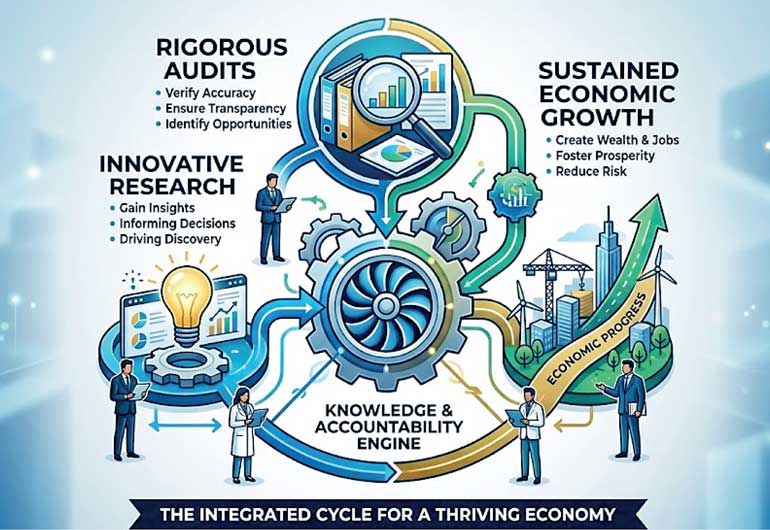
We never check, nor are we interested in, the return on investment of public money for research. If the assets and final report are present, and an evaluation report has been duly filed with some boxes appropriately ticked, that is identified, reported, and concluded as research completed and money spent and accounted for. In this manner, whether you spend 0.1% of your GDP on R&D or 2% of GDP on R&D is irrelevant. The State has no plan for the output, so meaningful outcomes never arise. Since no one sees tangible economic benefits, no one tries to allocate more rupees to research. An unproductive annual cycle of standard allocation and substandard progress continues. The administration is engaged in a meaningless pursuit of verification.
When the call came, the auditors were in the building, waiting to be taken to show the public-financed assets; one had to move fast, too. When I received the call, I was at a different meeting outside. The assets in question were related to a project funded in 2013 or thereabouts. The research student is now happily and productively based in Australia, having been invited from Sri Lanka on a PhD scholarship (funded by an Australian university through grant money from a Foundation in the USA). The decision to award the scholarship came after a half-hour Skype (yes, at the time the only VOIP system in use) call the student had with the Australian research group. Because of his master’s work (again supervised by me and in the department) and ongoing research, he had the knowledge and computational skills to fill a gap that existed in the research team in Australia. My next step was to call Australia immediately and, fortunately, I connected, as the research student who completed an equipment handover to the lab before departing quickly. Fortunately, Earth’s rotation kept my research student up at the time, down under. If audits don’t find what they’re looking for, they file an observation, and I must spend a good portion of my time writing explanations, since their filings are sacred. Of course, the auditors were genuinely doing their assigned duty. My grouse is that they should do this task differently. They should assess what outputs materialised and whether the knowledge created moved to the next level. Essentially, they should check for a decent ROI on the knowledge assets created through research funding and help overcome obstacles to realising that ROI. This does not happen – our audit mindset is in apprehending rogues, and all are presumed in that category unless shown otherwise. I blame leadership for not understanding this and for failing to transform the audit process into one of development enablement. Again, the lesson to be taken is why results were not made use of – we were looking at life cycle assessments of biofuels both technically and socially. Whatever skills we developed, I am sure Australia used them quite profitably. We bake the cake for someone to savor the taste. That is why I say the current auditing method should change to address issues and find solutions for researchers. Researchers in Sri Lanka face many issues today, and at times you wonder why you want to do research. Times have changed, but the issues have just scaled up.
An interesting fact about this piece of instrumentation is that it had to be fixed into the vehicle’s fuel tank, which means it would be moving out of the laboratory to which the asset has been allocated. The system refused to fix the unit to a vehicle, as the custodian is worried about an item moving outside the laboratory and not being returned to the cupboard. With such a unit, the piece of equipment will not return to a cupboard. Of course, he worried that when he retires, his retirement benefits will not be available because of a mismatch in the asset list. Believe you get how the story ended – this part of the research never happened. You also learn why researchers are ready to depart at the drop of a hat. George Bernard Shaw once remarked on the Ceylonese originality. Time has passed since then. Today, the creative spirit has been siphoned off. We keep working, keeping an accounting of each cent of the King’s money (I use the term King’s money because the Audit process is a relic of those times) without really understanding the value and intended function of an investment in research. Our audit must embrace development auditing – seeing why the intended result did not happen and seeking rectification of such to ensure that the next expenditure has more chances of productive delivery.
(The author is Senior Professor in Chemical and Process Engineering, Department of Chemical and Process Engineering, Faculty of Engineering, University of Moratuwa)



