Monday Nov 16, 2026
Monday Nov 16, 2026
Monday, 16 November 2026 03:48 - - {{hitsCtrl.values.hits}}

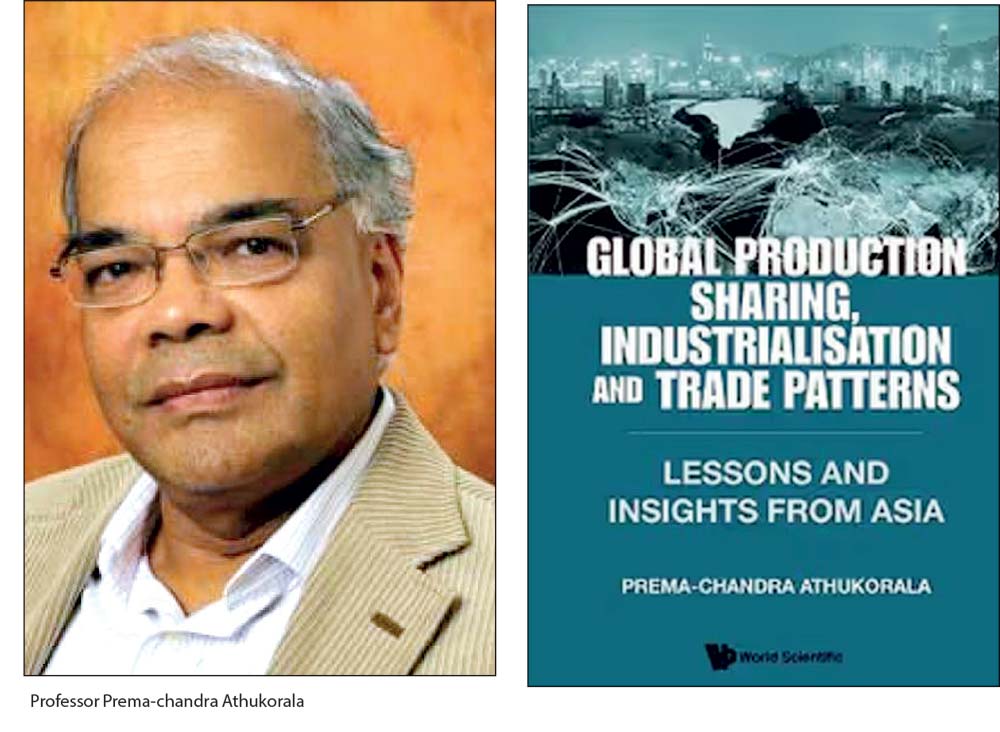
 Drawing on rich historical evidence, Athukorala shows that the island has missed many opportunities, apart from its resilient garment and apparel industry which Athukorala says has benefitted from the transfer of technology and management skills
 Even in retirement, an academic continues his journey
Professor Prema-chandra Athukorala, the Sri Lankan-born economist honoured by the Australian Government as a Member of the Order of Australia (AM) in 2026, has brought together his lifelong research on global production sharing, drawing on the experiences of some of Asia’s leading economies.
In this new book, he devotes two important chapters to his country of birth, Sri Lanka. He recently retired as Professor of Economics at the Australian National University, which he fondly calls his "intellectual home", and the university has named him Professor Emeritus. Yet an academic of his standing rarely leaves intellectual life behind. From our past conversations, I know that he remains actively involved in research and doctoral supervision. When recently asked to write a foreword for a publication, he could not do so immediately because he was busy editing a student’s doctoral thesis.
Athukorala continues to make Sri Lanka proud and stands alongside the island’s internationally renowned economists, such as Dr. Gamani Corea and Dr. Lal Jayawardena. His contribution to the field is clear: Google Scholar records well over 14,000 citations of his work, an achievement matched by very few contemporary economists.
Global production sharing networks or manufacturing value chains?
Athukorala’s latest book, Global Production Sharing, Industrialisation and Trade Patterns: Lessons and Insights from Asia, is published by World Scientific Publishing in Singapore. It contains 14 chapters, and the author acknowledges several co-authors who helped prepare the study.
The title uses "global production sharing", a term coined by management guru Peter Drucker in 1985 to explain that modern manufactured goods are no longer products of a single nation but "products of the world".
Athukorala focuses more specifically on the Global Manufacturing Value Chain (GMVC), as the book examines the physical manufacturing and assembly stages within these global networks. This focus makes the subject easier for ordinary readers to understand. It is also important because manufacturing has helped developing nations create industrial jobs, build wealth, and achieve prosperity. However, with the rise of artificial intelligence and advanced technology, a global services chain is also emerging. We may hope that, in his future work, Athukorala broadens his focus to a "global value chain plus" framework to cover these new digital developments.
Smiling Curve
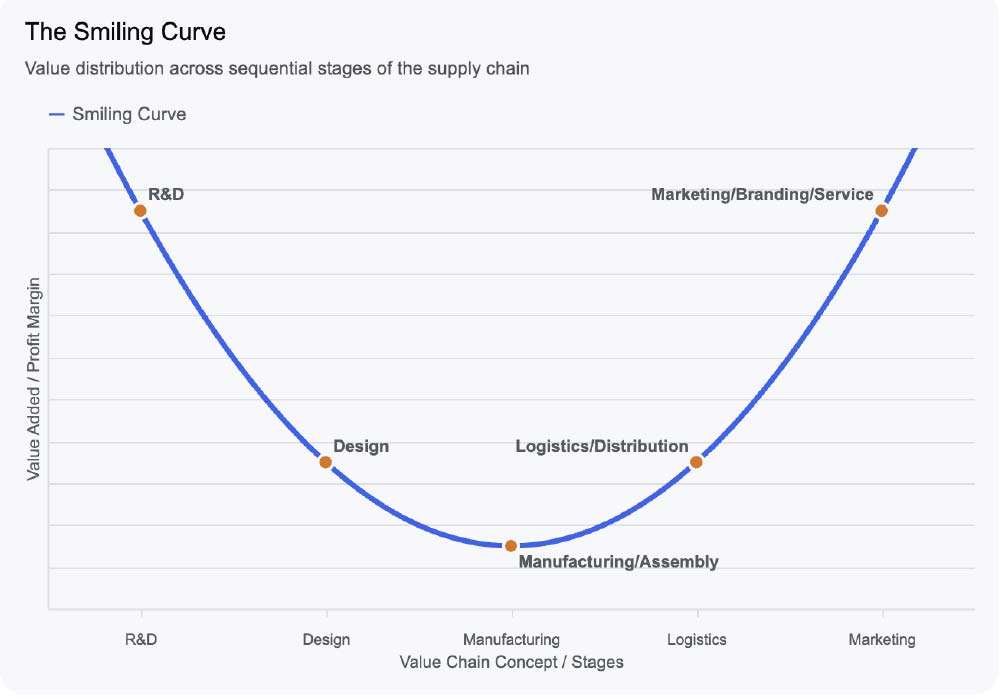
Finding a place in the Global Manufacturing Value Chain (GMVC) is a complex task for any nation. It requires firm commitment from top policymakers, consistent long-term policies, quick action to solve problems, continued public support, and the ability to withstand external shocks caused by unpredictable global leaders. Success ultimately depends on the vision and leadership of the country’s top politicians. To illustrate this challenging journey, Athukorala introduces the "Smiling Curve", a concept originally proposed by Stan Shih, the founder of Taiwan’s Acer Corporation.
The Smiling Curve is a simple visual tool shaped like a smile. Economists use it to show how much value (or economic profit) is added at each stage of making a product. For developing nations, the discouraging feature is that value addition falls to its lowest level in the middle stage before rising again to complete the smile.
The process starts at the top left with concept development and research and development (R&D), where value addition is highest. The curve slopes downwards as a country moves to product branding and design to meet market needs. It reaches its lowest point during physical manufacturing and assembly. This can discourage newcomers because the immediate financial rewards seem low.
However, the curve rises again as a country masters the stages on the right-hand side: distribution, marketing, final sales, and after-sales services. Every country must work its way along the curve to reach these more profitable stages. As Athukorala stresses, there is no shortcut to success. Nations must work hard and remain committed to climbing from the lowest point to the peak. Among the Asian nations reviewed in the book, Singapore, China, Malaysia, and Thailand stand out as clear winners, while newer entrants such as Indonesia, India, the Philippines, and Vietnam are moving rapidly towards success.
Sri Lanka’s missed opportunities except in the garment sector
But what about Sri Lanka? Drawing on rich historical evidence, Athukorala shows that the island has missed many opportunities, apart from its resilient garment and apparel industry which Athukorala says has benefitted from the transfer of technology and management skills.
Although the overall story is disappointing, it also offers hope to policymakers seeking a fresh start. To use the door metaphor, a newcomer with a fresh approach may find it easier to open a completely closed door than one already jammed halfway. In my view, this is the starting point for Sri Lanka’s current administration which is committed to delivering a rich country and a beautiful life to people.
Although the overall story is disappointing, it also offers hope to policymakers seeking a fresh start. To use the door metaphor, a newcomer with a fresh approach may find it easier to open a completely closed door than one already jammed halfway. In my view, this is the starting point for Sri Lanka’s current administration which is committed to delivering a rich country and a beautiful life to people
China: From accommodation to discontent
In his analysis of China, a clear winner in global production sharing, Athukorala explains the country’s rapid rise as a leader in global production networks and its implications for ongoing US-China trade tensions. China is now a major global exporter whose importance cannot be ignored, even by its critics.
The punitive tariffs imposed by US administration did not emerge overnight. In the early years, US policy favoured accommodating China as a development partner. As Athukorala notes, both major political parties in Washington agreed that integrating China into the global economy brought net gains to the US through lower consumer prices, more competitive companies, and greater opportunities for multilateral production—another term for global production networking. Although the influx of cheap Chinese exports created costs at home, American leaders believed these were temporary difficulties that would fade once the economy had adjusted.
However, this favourable view of bilateral trade broke down during the 2016 US presidential election. Mainstream economists such as Jagdish Bhagwati and Alan Blinder argued that American job losses were mainly caused by domestic automation and rapid productivity growth. Populist politicians, however, labelled the problem the "China Shock".
During Donald Trump’s second administration, up to 2026, an open trade war erupted, with heated political rhetoric taking precedence over reasoned economic arguments. As the two superpowers imposed retaliatory tariffs on each other, the effects spread far beyond their borders, affecting countries across the global trading system.
Athukorala wrote this chapter just before the Trump camp suffered a heavy defeat in the US midterm elections in November 2026. Although the wider world hopes this political shift may help end the rivalry, an early settlement of the tariff war remains unlikely, given America’s longstanding commitment to putting "America First". Nevertheless, Athukorala closes the chapter on a reassuring note. He observes that other countries in global production networks specialise in distinct components, making them essential partners and helping to prevent the global trading system from collapsing.
Experiences of other Asian countries
In his case studies of Asian countries, Athukorala follows a clear structure: reviewing their history, assessing their current position, and offering concluding remarks. For ordinary readers, these conclusions bring together the book’s main lessons. Although the countries have taken different paths, their experiences offer a useful guide to development strategies.
Singapore stands out as a leading success story of the GMVC model. Its national development strategy centres on multinational enterprises (MNEs)—large companies that operate in several countries. Singapore which hosted these companies on its land has benefited greatly as these enterprises expanded their manufacturing operations into newly opened economies in Eastern Europe and Central Asia that had previously relied on central planning. These gains are particularly visible in the information and communications technology (ICT) sector.
In contrast, Indonesia’s uncertain policies and lack of consistent long-term direction have held back its economic transformation. Athukorala concludes: "Indonesia has so far failed to reap gains from the ongoing relocation production processes from China within GMVCs, particularly in the context of the US-China trade war." Although this is a harsh assessment, the same criticism applies to other developing nations that have failed to benefit from the shift of factories away from China amid global geopolitical tensions.
The Philippines has made limited progress despite joining global production networks early. Malaysia, by contrast, has been highly successful, with the Penang Export Hub playing a central role in its GMVC strategy. However, Athukorala warns that Malaysia must do more to sustain this success. It needs institutional reforms, targeted investment promotion, quick solutions to investors’ problems, world-class infrastructure, focused vocational training to develop a skilled workforce, and stronger links between multinational enterprises and local firms. Thailand has carved out a niche in the automotive industry, placing it in a strong position to enter the electric vehicle (EV) sector, which offers considerable potential for global growth.
Among the newer entrants, Vietnam has worked hard to join GMVCs by promoting foreign direct investment (FDI)—including investment by foreign companies in local factories—and strong export growth. These efforts have made Vietnam an important participant in global manufacturing. India, though a late entrant, is also making steady progress. It has developed growing automotive and electronics export sectors while moving away from the import substitution policies it followed for decades—the strategy of producing goods locally while restricting imports.
Together, these Asian experiences show that, although the approaches differ, joining global networks can put economies on a path to prosperity. Athukorala does not say so directly, but this progress may signal the beginning of the "Asian Era" that regional political leaders often speak of.
Pathetic story of Sri Lanka
Athukorala’s two chapters on Sri Lanka are among the book’s most revealing and important sections for local readers. The country sought to industrialise as a way to overcome slow growth and severe unemployment. With the major economic shift in 1977, Sri Lanka began looking outward to global markets rather than inward. Yet inconsistent policies since then have held back a lasting transformation of its industrial structure.
Sri Lanka can fairly be described as a country of missed opportunities. It has repeatedly allowed promising global openings to slip away, with little apparent concern among its political leaders. Athukorala presents extensive evidence to support this disappointing account. He also notes that Sri Lanka is not alone: many developing nations have fallen into similar policy traps in the years since World War II.
Summing up his analysis of Sri Lanka, Athukorala offers a clear warning: "In sum, the analysis of regime shifts and economic performance under State-led import substitution strategy and liberalisation reforms in this paper makes a strong case for averting backsliding in policy, continuing the market-oriented reforms agenda that was left incomplete in the late 1990s, and setting up institutional safeguards to avert further policy backsliding."
Although Sri Lanka’s apparel sector benefited from technology transfer and the drive towards offshore investment in major importing countries in the 1970s and 1980s, the industry is now at a crossroads. Importing countries are increasingly looking to onshoring or nearshoring—bringing production home or closer to home—to reduce delays and costs through advanced automation and engineering technology. In this situation, although Athukorala does not spell it out in his chapter, Sri Lanka should develop its garment industry along GMVC principles.
Rather than producing a whole garment, the country could focus on particular parts of the global value chain. This would require specialising in components and activities in which Sri Lanka has competitive and comparative advantages. One area that comes to mind is garment design using advanced AI and design technologies. In my view, Sri Lankans’ strong learning skills could help them master these technologies.
This is an important, non-partisan recommendation that Sri Lanka’s current administration should follow in both letter and spirit. To open the door to lasting prosperity, the country’s leaders must avoid short-sighted policy reversals, commit to long-term structural reforms, and establish legal and institutional safeguards to protect the economy from future political shifts.
Athukorala offers a bold and clear analysis of the economic challenges facing these Asian countries. His book not only explains past failures but also points to the steps they need to take next. It is a timely and valuable guide for developing nations, especially Sri Lanka, seeking lasting prosperity for their people. Athukorala has laid out the roadmap; it is now up to Sri Lanka’s policymakers to read it and act on its lessons
Recommendation to Sri Lanka’s policymakers
Athukorala offers a bold and clear analysis of the economic challenges facing these Asian countries. His book not only explains past failures but also points to the steps they need to take next. It is a timely and valuable guide for developing nations, especially Sri Lanka, seeking lasting prosperity for their people. Athukorala has laid out the roadmap; it is now up to Sri Lanka’s policymakers to read it and act on its lessons.
(The author, a former Deputy Governor of the Central Bank of Sri Lanka, can be reached at [email protected])




