Monday Aug 31, 2026
Monday Aug 31, 2026
Thursday, 9 April 2026 00:27 - - {{hitsCtrl.values.hits}}
 On the very day that Artemis II’s SLS Block 1 roar carried four astronauts beyond the pale of Earth’s gravity – the first crewed lunar mission in more than half a century – another sort of blast thundered across the plains of West Asia: the relentless barrage of missiles, munitions and warmongering rhetoric that mark the US-Israeli war on Iran and the Islamic Republic’s reply.
It was as if humanity stood with one foot on the lunar highlands and with the other in the ruinous earthbound dust of its own making. For now, we see through a glass: darkly...
In the serenely majestic choreography of space flight, we find the best of us. Cooperation across borders and boundaries, the first woman and the first non-American (a Canadian) in this mission’s crew. And with them, the quiet poetry of exploration that makes us, as author James Michener once wrote, “a pilgrim species, born to wonder”.
Yet, back on the Earth, the drums of war have drowned out that thunder with reports of bridges and buildings struck down, medical centres hit, and experts in the subject of militarised conflicts warning that some attacks “may amount to war crimes”.
Such is the paradox of Homo sapiens: the same creature that dreams of lunar vistas to be conquered by more than the sanctified imagination – of Asimov, Bradbury and our own Clarke – but also crafts the machinery of diabolical destruction, as Trump, Netanyahu and a new Ayatollah are doing.
We have blast off
In the early hours of 1 April, NASA ’s Artemis II space mission lifted off – a testament to what collective human ingenuity can accomplish. After more than five decades since Apollo’s last footsteps on the Moon, four astronauts now trace a celestial path around earth’s only natural satellite on a ten-day journey (today, Thursday 9, is Day 8 – almost the end of the mission.)
This is not merely a technical feat... it is a cultural act – a reminder that even in our war-torn and fractured world, often perhaps the press of a button away from self-annihilation in some madmen’s fantasies, we can still look upward and agree on something larger than ourselves.
Ironic that two or three nation states are fighting each other to the bloody brutal death in a spate of modern-day holy-wars... and taking thousands of innocent lives with them into the heavenly hereafter (or hellish nothingness) – in the name of gods who don’t agree on points of theology.
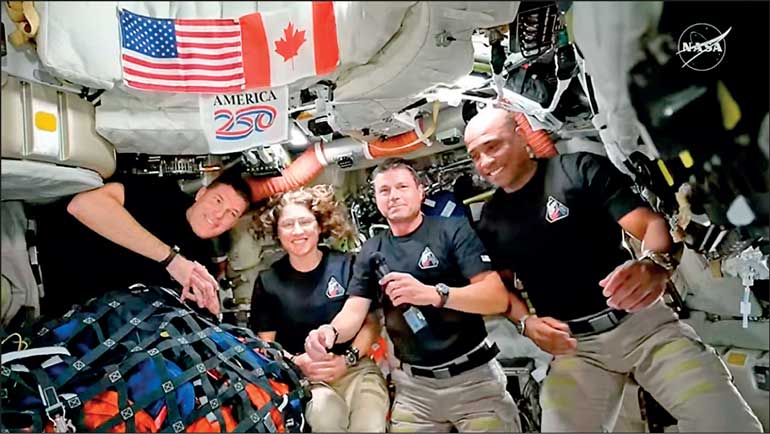
Meanwhile Victor Glover, Christina Koch, Jeremy Hansen and Reid Wiseman represent more than their nationalities, philosophies or religions. They embody the belief that the human spirit is not defined solely by its battles but also by its capacity to transcend them. The mission’s European Service Module – a collaboration between the National Aeronautics and Space Administration and the European Space Agency – underscores the incontrovertible truth that ambition still invites partnership.
This particular lunar voyage, coming as it does concurrently and simultaneously with militarised crusades on the home planet, is perhaps a special type of secular pilgrimage. It appeals to the ‘via positiva’ – the theological notion that we can know the divine through acts of creation, wonder and beauty; and now, breath-taking endeavour.
When the Orion capsule arcs against the black velvet canopy of space, we glimpse not merely the Moon, but also what we might yet become: a species capable of extending curiosity beyond the cradle of the planet where all our hopes and fears – and ambitions – are born... and die.
Yet, while Artemis II circles the Moon, our geopolitical orbit is anything but serene. What began in late February with coordinated US-Israeli strikes on Iranian targets – dubbed Operation Lion’s Roar – has evolved into a full-blown conflict that now spans a time space of over a month. The fighting has seen repeated bombardments of infrastructure, bridges, school buildings, hospitals and other sites, which in many cases – sadly, shockingly – are those that serve the Islamic Republic’s civilian needs.
And here it is that the theological element trips in. The Christian scriptures speak of the lust of the eyes and the pride of life – meaning, ironically, that the same impulses that drive us to explore the heavens can, in their shadow, justify devastation on earth. US President Donald Trump’s recent declarations that the American-led attacks were “nearing completion”. Yet, even as he trumpeted this triumphalistically, war crimes experts – including scholars from Harvard, Yale and Stanford universities – cautioned that some of the US-Israeli strikes “may amount to war crimes” especially when civilian infrastructure is deliberately targeted.
Iran, for its part, not only vowed – but also executed – a series of retaliatory attacks on strategically important infrastructure in Gulf countries friendly to American interests. And the rhetoric from Washington, Tel Aviv and Tehran – where ‘People of the Book’ (at least to all intents and purposes) rule the roost, visibly so in many instances – reads like an invocation of Armageddon than the practised diplomacy one might expect from leaders subscribing to one of the three leading monotheistic faiths.
While four astronauts set their sights on stellar objects, the Four Horsemen of the Apocalypse unleashed by the short-sighted administrators on earth underscore that the human cost of war is not an abstraction as much as the breath-taking bottom-lines of the Moon mission is a cause for admiration.
Bridges crumble, research centres are damaged, families are displaced or evacuated, and the spectre of death looms large over the desert – birthplace of three world-shaping Abrahamic faiths.
Dual citizenship
Saint Augustine, in his ‘City of God’, described two cities: one earthly and one heavenly, forever intertwined, yet in tension with each other. In Artemis II, we see a reflection of the heavenly city – our highest aspirations. In the present (and dare we say, perennial) Middle East conflict, we are forced to confront the earthly city – the sometimes inhuman realities of power, fear and panic, and survival (even thrival) through conquest and domination.
The tragedy is not just in the violence itself, but in how quickly it can eclipse our better angels. A mission that should unify global audiences – reminding us that we are all citizens of one fragile planet – becomes instead the often ignored or overlooked background to the unending news of fresh bombardments and geopolitical brinkmanship.
And yet, even here hope and faith and courage persist. Because we can tell two stories at once, belonging to both cities at the same time. We can marvel at human achievement – the wizard engineering that despatches four souls to skim the lunar surface – and we can mourn the human failure that allows children on earth to grow up amidst the echoes of ever-increasing explosions.
We can call for accountability – an adherence to international law and the protection of civilians – without dismissing the brilliance of human creativity. We can insist that diplomacy be pursued among friendly states with as much vigour as military might is brandished in the face of geopolitical opponents. We can recognise that the human spirit is not monolithic but deeply dichotomous: capable of both the sublime and the ridiculously primitive.
Ashes to the fall of moon dust
So what do we do with this paradox?
First, we celebrate Artemis II – not as an idyllic escape from Earth’s troubles, but as an inspiration to address and hopefully resolve them. Let the Moon mission remind us that cooperation yields dividends far greater than competition produces fallout that divides and destroys.
Second, we must demand of the worldly powers that there be clarity of purpose and proportionality in war. Leaders should be pressed to articulate not only military objectives but also explore pathways to peace – a peace that upholds human dignity and minimises human suffering.
Third, the global community – from civil society in nation states adjacent to the theatres of war, to regional powers – must double down on diplomacy. If the best of us can build spacecraft that carry our representatives safely into the inky black void, surely we can construct frameworks that protect life on the ground.
Finally, we must refuse the tyranny of binary thinking. To appreciate the wonder of lunar exploration is not to ignore the trauma of those trapped in the tragedy of war. Rather, it is to insist that our gaze be wide enough to capture and contain both cities.
The next small steps
Let us pray – or, if you prefer, let us prayerfully hope, or simply hope – that the next giant leap for humankind is not just on to another celestial body but into another ethic of coexistence in our earthly home. Let the poetry of spaceflight become a metaphor of – and a model for – peace. Not the absence of conflict; but the presence of justice, gentle wisdom over cruel knowledge, and a renewed sense of shared purpose as a species.
As we look to the Moon, let us also look to the minds and hearts of those who lead us, and ask: ‘What will it take for us to not only walk – one day again soon perhaps – on lunar soil with pride, but also on earthly terrain in a coveted spirit of peace?’
For if we can circumnavigate the lunar orb, we can surely circle back to our better, brighter more bountiful selves.
(The author is the Editor-at-large of LMD, and has a Master’s Degree in Theology, and a Post-graduate Diploma in Politics and Governance)




