 For more than a century, Sri Lanka's plantation economy has been built around tea, rubber and coconut. These crops have contributed enormously to export earnings, employment, rural communities and the international identity of the country. Their contribution, and the dedication of generations of plantation managers and workers who sustained them, should never be underestimated.
But agriculture does not operate under permanent conditions.
Labour availability is changing, production costs are rising and climate patterns are becoming less predictable. International markets increasingly reward quality, sustainability, traceability and environmental responsibility. Plantation companies must meanwhile continue to generate acceptable returns from one of the country's most valuable and finite resources - land.
This raises a question more fundamental than asking which crop Sri Lanka should plant next:
Are we obtaining the best sustainable economic, environmental and social value from every hectare of plantation land?
That question takes us beyond conventional Crop Management towards Land Value Management.
From crop management to land value management
Plantation management has understandably been organised around crops. If an area is under tea, the normal management question is how to improve tea productivity, reduce costs and increase profitability. That remains entirely appropriate for productive tea land.
But what happens when a field remains persistently uneconomic despite reasonable management intervention? Should scarce labour, capital and management resources continue to be committed indefinitely simply because the land has historically been under that crop?
Land Value Management begins with a broader question:
What is the greatest sustainable value this particular hectare can create?
Sometimes the answer will unquestionably remain tea. Some underperforming tea can be rehabilitated and restored to economic viability. But there may also be land where low productivity, high labour requirements and production costs make long-term continuation under tea increasingly difficult to justify.
This becomes particularly relevant when labour is scarce. Tea requires continuous and timely harvesting. Where sufficient labour is unavailable, harvesting rounds become difficult to maintain and available crop may not be fully recovered. At the same time, maintaining persistently low-yielding fields consumes part of that already scarce workforce.
The issue therefore is not simply a shortage of workers. It is also how effectively available labour, capital and management attention are allocated across the land.
Begin with the economics, not with coffee
A practical exercise undertaken within a Regional Plantation Company (RPC) in Sri Lanka illustrates this approach.
Instead of beginning by searching for land on which to plant coffee, the exercise began by evaluating the economic sustainability of the existing tea land.
The tea extent was broadly differentiated into three categories: economically viable tea; underperforming tea that could reasonably be restored to economic viability; and land where continuation under tea could no longer be economically justified on a sustainable basis.
The exercise therefore did not begin by asking, "Where can we plant coffee?"
It began by asking, "Where should tea remain tea, where can tea be restored to viability, and where should another land use be considered?"
Only after that economic diagnosis did the search for an alternative crop begin.
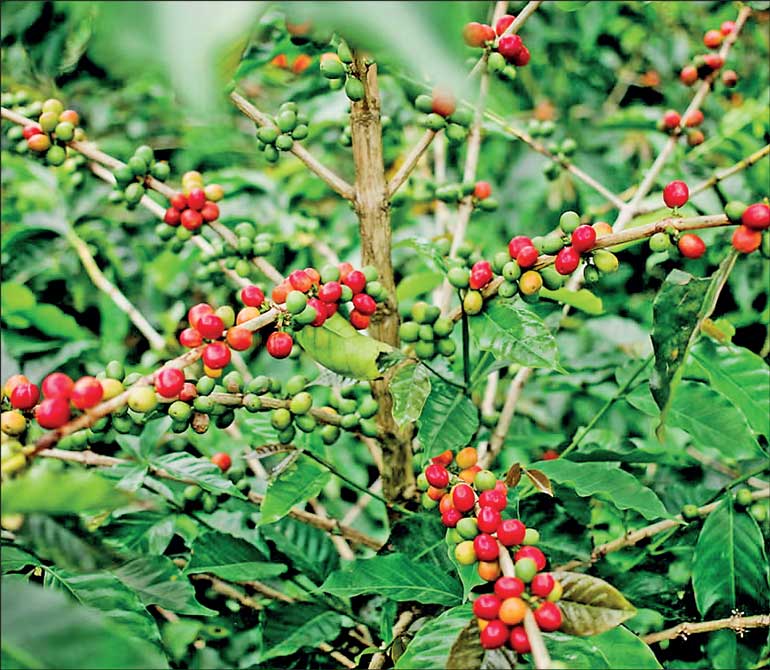
Any alternative needed to offer the potential for greater value per hectare, a reasonably attractive return on investment, lower labour dependence and a credible long-term market. Arabica coffee emerged as one crop worthy of serious consideration.
But uneconomic tea land does not automatically become coffee land. Economic evaluation is only the first filter. The second must be scientific suitability - including elevation, temperature, rainfall, soil characteristics, drainage, slope, shade, water availability and other relevant agronomic conditions.
Only where economic underperformance and scientific suitability coincide should coffee proceed to commercial evaluation.
The methodology is therefore:
Economic diagnosis -> Agronomic suitability -> Investment and market evaluation.
This is fundamentally different from diversification for its own sake.
Coffee should not replace successful tea. It should be considered where tea can no longer create sufficient sustainable value and where the land is scientifically suitable for coffee.
Sri Lanka is not starting from a blank experimental base
Sri Lanka already possesses an important scientific foundation in Arabica coffee.
A 2024 study by researchers from Wayamba University of Sri Lanka and the Department of Export Agriculture evaluated four Arabica varieties - Lakparakum, S9, HTD and Catimor. The research used material from the Department's germplasm collection and forms part of coffee crop-improvement work extending back to the early 1990s.
Of particular interest is Lakparakum. The researchers reported strong reproductive characteristics, including the highest number of flowers per node among the varieties studied, identifying this as favourable for flower and fruit production and therefore yield potential.
This should not be converted into an unsupported claim of a particular commercial yield per hectare. What it demonstrates is that Sri Lanka possesses locally evaluated Arabica material and an existing scientific foundation upon which commercial development can be built.
The country therefore does not need to begin from a blank experimental base. What is required is rigorous site-specific agronomic and commercial evaluation.
Climate change is reshaping the geography of Arabica
There is another reason why this discussion is timely.
Arabica is particularly climate-sensitive. International research published in PLOS ONE has examined how climate change could alter the geography of suitable Arabica production. Research indicates that climates better suited to Arabica could migrate upward by approximately 500 metres in some environments. Other research based on a large database of known Arabica locations found that many traditional lower-elevation coffee-growing areas could lose suitability while some higher-elevation areas and new regions could become more suitable.
Readers interested in this changing global landscape may wish to refer directly to the published PLOS ONE research on Arabica suitability and climate change.
This should not be interpreted to mean that climate change is an advantage for Sri Lanka. Nor does the research prove that the world will face a predetermined shortage of Arabica.
Its significance is more fundamental:
The geography of Arabica production is changing
A March 2026 RaboResearch assessment estimates that the proportion of current Arabica-growing areas classified as climatically unsuitable could increase from around 8% to 20% by 2050, while also pointing to the possibility of buyers diversifying sourcing relationships as supply conditions change.
If parts of today's traditional Arabica landscape become increasingly difficult to cultivate while global demand remains substantial, production will have to adapt. Existing origins will respond through improved varieties and agronomy, but different elevations and new production areas may also become increasingly important.
For Sri Lanka, therefore, the opportunity is not based on predicting a coffee shortage. It lies in recognising that suitable high-elevation agricultural land could become strategically more valuable within a changing global Arabica landscape.
Compete on value, not volume
Establishing a new coffee origin takes time. It requires suitable land, appropriate varieties, agronomic knowledge, processing facilities, trained people, quality control, cupping capability, traceability and relationships with buyers. Reputation itself takes years to establish.
Sri Lanka is unlikely to compete with the world's largest coffee-producing countries on volume, nor does it need to.
A more appropriate ambition would be to develop a significant proportion of Sri Lankan Arabica as premium coffee, while progressively developing selected origins and lots capable of achieving specialty-coffee standards.
Not every kilogram can or should be called specialty coffee. Specialty quality must be created deliberately - from variety selection, soil and shade management through selective harvesting, processing, fermentation, drying, grading, storage, cupping and traceability.
The objective should therefore not simply be maximum kilograms per hectare. It should be optimum sustainable value per hectare.
Yield, cup quality, selling price, production cost, labour requirement and long-term resilience must be considered together.
A better balance between land and labour
This approach could also help address one of the plantation industry's most difficult structural challenges.
Where labour is scarce, maintaining every hectare under a highly labour-intensive crop may no longer represent the most effective use of the available workforce.
If persistently uneconomic tea land is progressively released from tea - only where an economically and agronomically superior alternative exists - available labour can be concentrated more effectively on productive tea areas.
This need not weaken tea. It could strengthen the remaining tea operation by allowing productive fields to receive the harvesting frequency and agronomic attention they deserve, while suitable uneconomic land creates a different income stream under a less labour-dependent crop.
The objective is not simply labour reduction. It is a better balance between land, labour, capital and income.
Crop Management asks:
How can we produce more from the crop already occupying this land?
Land Value Management asks:
What is the greatest sustainable value this land can create?
Sometimes both questions produce the same answer. Sometimes they may not.
Towards a future-ready plantation model
The opportunity extends beyond the coffee bean itself.
International agriculture is increasingly moving towards climate-smart and regenerative production, biodiversity protection, carbon management, traceability and circular use of agricultural resources.
Coffee can fit naturally within such a system. Shade trees, soil improvement, biodiversity, water management, carbon sequestration and productive use of processing by-products can become components of a broader agricultural landscape. Coffee can therefore connect crop production with agroforestry, traceability and circular-bioeconomy opportunities.
The plantation of the future may consequently need to be viewed not simply as a collection of individual crops, but as an integrated land-value system.
An opportunity worth examining now
Sri Lanka need not conclude today that coffee will become its next major export crop. But neither should the opportunity be approached as though the country must begin again with a few small experimental plots and wait many more years before considering meaningful commercial development.
Sri Lanka already has locally evaluated Arabica material, institutional research and practical cultivation experience. This does not justify indiscriminate expansion. It does, however, provide a stronger foundation from which to make informed commercial decisions.
Where land is structurally uneconomic under its existing crop, scientifically suitable for Arabica and commercially viable, development should be sufficiently meaningful to establish production, processing capability, quality systems and market relationships. Small isolated plots can provide useful observations, but alone they cannot establish the complete value chain required to build a competitive coffee origin.
There is also a question of timing.
The greater risk may not be in examining the opportunity, but in failing to examine it.
Establishing a recognised coffee origin takes years. If Sri Lanka waits until every uncertainty has disappeared, other emerging origins may use that same period to establish production, processing capability, buyer relationships and market identity.
The prudent approach is therefore neither indiscriminate expansion nor prolonged experimentation. It is scientifically selected, commercially meaningful and progressively managed development.
Protect and strengthen productive tea. Determine which underperforming tea can be restored to viability. Identify land that remains structurally uneconomic. Assess that land scientifically for alternative uses. Where conditions are suitable, evaluate Arabica commercially and develop appropriate extents using locally evaluated planting material, while building processing and quality capability alongside production.
Premium coffee can provide a strong commercial base, with selected specialty origins creating greater value and identity.
In simple terms:
The right crop on the right land, supported by the right science, producing the right quality for the right market.
Sri Lanka's plantation industry possesses generations of agricultural knowledge. The challenge is not to discard that heritage, but to allow the management model to evolve as labour availability, climate, markets and economics change.
The question therefore is not whether coffee should replace tea.
The question is whether every hectare of plantation land is being given the opportunity to create its greatest sustainable value.
Sometimes the answer will be tea. Sometimes it may be another crop. And on carefully selected highland land, the answer may increasingly be Arabica coffee.
Coffee may not be the destination. It could be one of the drivers that helps move Sri Lanka's plantation industry from Crop Management towards Land Value Management - and towards a more resilient, higher-value and future-ready plantation economy.
(The author is a plantation professional with over four decades of experience in Sri Lanka's plantation industry, including senior leadership in plantation management. He writes from his practical experience and his interest in the future transformation of Sri Lanka's plantation sector. He could be reached via email [email protected])
Research References
Dissanayake, H.M.S.Y., Dissanayake, D.G.H.M.K. & Gunathilaka, H.A.W.S. (2024). Varietal Characterisation of Arabica Coffee (Coffea arabica L.) Varieties; Lakparakum, S9, HTD, and Catimor in the Vegetative and Reproductive Phase. Proceedings of the 22nd Agricultural Research Symposium.
Bunn, C. et al. (2015). Multiclass Classification of Agro-Ecological Zones for Arabica Coffee: An Improved Understanding of the Impacts of Climate Change. PLOS ONE 10(10): e0140490.
Ovalle-Rivera, O., Läderach, P. et al. (2015). Projected Shifts in Coffea arabica Suitability among Major Global Producing Regions Due to Climate Change. PLOS ONE.
RaboResearch Food & Agribusiness (20 March 2026). Climate change redefines suitability and resilience in global arabica coffee production.



