Friday Sep 18, 2026
Friday Sep 18, 2026
Thursday, 17 September 2026 00:00 - - {{hitsCtrl.values.hits}}
Have ‘primaries’ for 2029 begun?
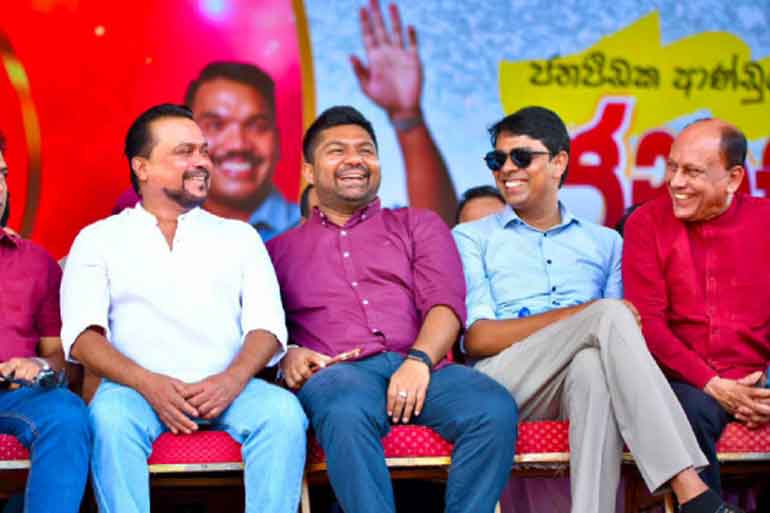
Successful event generates high spirits, camaraderie
The SLPP’s Anuradhapura rally is occasion for my conclusion that the arc of the AKD Presidency and JVP-NPP rule has begun its parabolic descent. This does not mean a linear trajectory from Anuradhapura 2026 to the President’s House 2029 for Namal Rajapaksa—a scenario which is possible, but far from preordained
 My caption this week is an obvious echo of Winston Churchill’s characterisation at a nodal point in WWII, that it was not yet ‘the beginning of the end’, but only ‘the end of the beginning’. Later in the war, he announced the beginning of the end.
There is usually an interregnum between the two, but sometimes the transition is short, and at others, the end of the beginning marks the beginning of the end.
‘Why Prabhakaran Will Lose’ was the title of an article by me (then in my late-40s) which appeared prominently in the pages of The Sunday Island, Colombo, dated October 17th 2004. At a time when the political, academic and civic intelligentsia was wedded to the thesis of an ‘unwinnable war’, the title risked damage to my intellectual reputation and credibility by going beyond an assertion of ‘Why Prabhakaran Won’t Win’—which would mean a hurting stalemate—to a definitive ‘will lose’. My unambiguous prediction was made the year before Mahinda Rajapaksa secured his party’s Presidential candidacy, won the Presidency, and appointed Gotabaya Rajapaksa and Sarath Fonseka as Secretary/Defence and Army chief respectively. None of these were safely predictable.
Though occasioned by Karuna’s rebellion and the intra-LTTE mini civil war in the East, with Karuna already on the backfoot, my prognosis was grounded far more in the comparative study of successful asymmetric wars; Prabhakaran’s sustained transgression of their characteristic features and norms; and the axiom of Vietnam’s General Giap that “if you override the objective laws of development of a phenomenon, those objective laws will override you”.
Similarly, the SLPP’s Anuradhapura rally is occasion for my conclusion that the arc of the AKD Presidency and JVP-NPP rule has begun its parabolic descent. This does not mean a linear trajectory from Anuradhapura 2026 to the President’s House 2029 for Namal Rajapaksa—a scenario which is possible, but far from preordained.
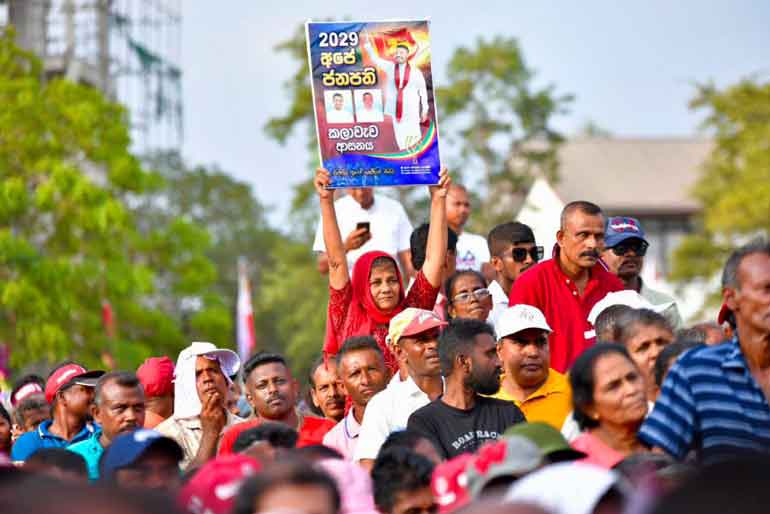
Real-time social media coverage and TV newscasts showed that the Anuradhapura rally of the SLPP and partners, with Mahinda Rajapaksa on stage, was discernibly larger than the ruling party’s public meetings in Polonnaruwa and Anuradhapura (the next day), featuring President Anura Dissanayake.
Anuradhapura was a more organic mass mobilisation. The SLPP rally was energised by a cocktail of strong emotions—overweening affection and respect for Mahinda Rajapaksa, combative loyalty to the incarcerated Namal Rajapaksa, open declaration of a determination to ensure Namal’s election as President in 2029, renewed collective hope at that prospect, defiant resistance to the ruling JVP-NPP and reawakened bitter memories of JVP barbarism in the locality. (Especially poignant was the recollection of the JVP’s murder in 1987 in the Anuradhapura bazaar, of Nandana Marasinghe, a hero of the JVP’s April 1971 uprising). The mood was more upbeat and applause from the audience was far more spontaneous, animated, enthusiastic and frequent at SLPP/Anuradhapura.
With a rampaging national ‘crisis of affordability’ (to borrow New York Mayor Mamdani’s famous phrase), the AKD-NPP bloc will hardly win a two-front battle in the heartland with the SJB and SLPP. The SJB will savage it on economics and governance; the SLPP will do so on economics and nationalism. Because of its small but raucous old allies, the SLPP may forfeit minority votes that Namal could win back, but that won’t save the JVP-NPP since some of its minority votes will go to Sajith and the SJB
It is not that the Anuradhapura discourse didn’t have a downside. There was an occasional infusion of ultranationalism—though not (yet) open chauvinism or racism—coming more from the SLPP’s old allies rather than the SLPP itself. It was also a pity—or sadly symbolic—that the scheduled closing speech by the SLPP’s DV Chanaka got ‘timed out’ or was somehow ‘crowded out’.
AKD’s Polonnaruwa and Anuradhapura speeches had nothing of the appeal his oratory had in 2024. The thrill was gone. All he had was a surly negativism, a truculently articulated commitment to ‘lawfare’ (amounting to a McCarthyite witch-hunt) against the Rajapaksa family. No credible, constructive hope for an improved life was communicated. His appeal has been funnelled-down to reassuring and remotivating the JVP-NPP hardcore. The combative cockiness of AKD and other JVP-NPP leaders, is hollow.
Moral low ground
AKD has embarked on a highly polarising two-pronged project. The dynamic of polarisation that cannot possibly work in his favour; it can only undermine him and his Government, shrinking its space.
The first prong is the witch-hunt which as AKD has indicated may well encompass every member of the Rajapaksa family, “the big boss or boss’ son it doesn’t matter”. The public perception is of a move which is intentionally though indirectly aimed at Mahinda.
Anura and the JVP-NPP do not seem to understand that the legitimacy enjoyed by Mahinda is long, deep and unassailable because his achievement in winning in three years a 30-year war and restoring peace and territorial unity, is historic. That historic legitimacy sheds a penumbra of sympathy in the mass mind, on his son Namal and spouse Shiranthi.
Mahinda’s legitimacy in the mass-mind, is that of a living legend, rooted in the Mahavamsa matrix of real and mythicised history. Targeting Mahinda’s emotional and physical wellbeing by targeting his family, depletes governmental legitimacy and popularity.
AKD is indirectly targeting a man and directly targeting the family of that man whose popularity and legitimacy he will never begin to approximate. It is a battle he may win in the post-22A courts but can never win in the hearts and minds of the people.
The mechanism of jailing people before they are convicted of a crime also raises questions of natural justice. This is more so when it comes to a family that shared deadly risks when its patriarch was leading the country in a titanic war against the world’s worst terrorism. The family could have chosen to spend the war safely overseas in East Asia/Eurasia, but didn’t.
The Rajapaksa family was punished for its cavalier conduct and unmindful excesses in Government by the electorate which voted them out twice – and overthrew one of them with the most angularities.
They now seem to be ‘soft targets’ which the JVP was notorious for, e.g., Vijaya Kumaratunga. Public memory will recall the barbaric lethal targeting of relatives and whole families by the JVP in the late 1980s. This time the vengeful targeting of families isn’t lethal but legal.
Mahinda’s legitimacy in the mass-mind, is that of a living legend, rooted in the Mahavamsa matrix of real and mythicised history. Targeting Mahinda’s emotional and physical wellbeing by targeting his family, depletes governmental legitimacy and popularity
The second prong of Anura’s lawfare is the ‘Inquisition’ against the top-brass of the war-winning military; a military perceived as having played the role of liberators of the island’s vast majority.
Thus, Anura’s double-barrelled campaign is against two targets—the family of Mahinda Rajapaksa, the living national patriarch, and the victorious military high command. These two targets are components of the war-winning ‘power-bloc’, and taken together constitute a single composite target. Such a sweeping witch-hunt of the political and military victors in a historic national war would be riskily destabilising in any post-war society.
Moreover, AKD’s polarising ‘lawfare’ takes place while the ground the Government stands on is being eroded by the heart-rending economic suffering of “the working poor” as journalist Methmalie Dissanayake has put it in an exceptional piece of social reportage.
Tri-polar game
The deeper reason which makes Anuradhapura 2026 the end of the beginning and the beginning of the end of AKD-JVP-NPP rule, is systemic. The game has just changed. A bipolar game—JVP-NPP vs. SJB, Anura vs. Sajith—just became tripolar. Namal’s Presidential campaign has been pretty much launched, and the SLPP has revived as a fighting party willing to take the battle to the Government. Even if he remains jailed, ‘Release Namal!’ will be a mobilising slogan in the 2029 campaign in the heartland.
The post-Anuradhapura tri-polarity will damage the Government for two major reasons:
As foreign experts have pointed out, the debt repayment really starts biting in 2028 and will probably be compounded by the requirements of an unavoidable IMF program when the current one ends in 2027.
AKD-JVP-NPP will be besieged on two fronts, the centrist/centre-right, and nationalist-populist/statist-populist. The SJB and SLPP will each take a ‘limb’ in its jaws and pull the NPP’s 2024 socio-electoral bloc apart. (The NPP just lost the Eppawela Multi-Purpose Cooperative Society election to the SJB-led Opposition).
With a rampaging national ‘crisis of affordability’ (to borrow New York Mayor Mamdani’s famous phrase), the AKD-NPP bloc will hardly win a two-front battle in the heartland with the SJB and SLPP. The SJB will savage it on economics and governance; the SLPP will do so on economics and nationalism. Because of its small but raucous old allies, the SLPP may forfeit minority votes that Namal could win back, but that won’t save the JVP-NPP since some of its minority votes will go to Sajith and the SJB.
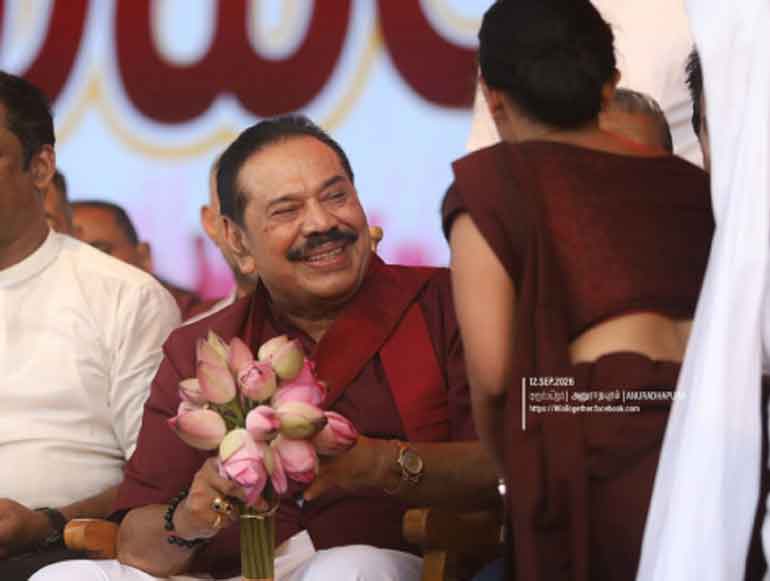
Patriarch returns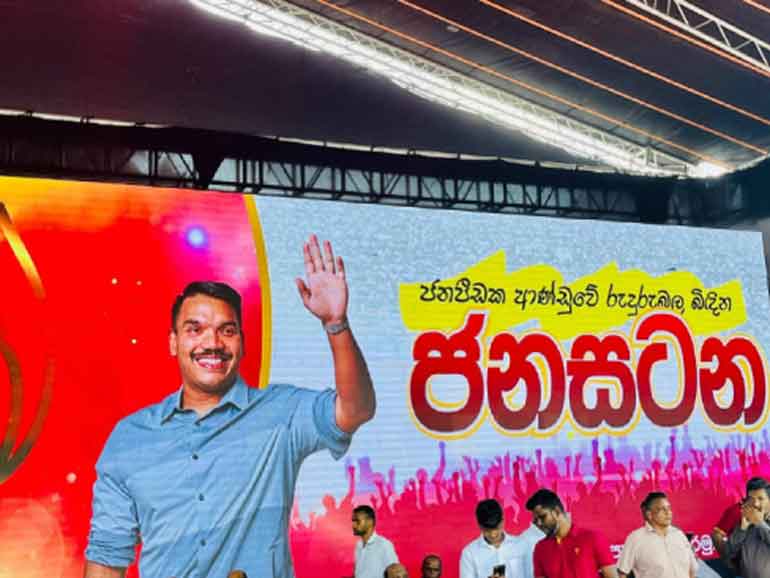
If unfairly imprisoned, could ‘Release Namal!’ motivate voters in 2029?
Strictly theoretically, 2029 should be something of a slam-dunk for Sajith, because the unprecedented growth of poverty and inequality should provide a socioeconomic majority for him if he deploys the franchise he holds exclusively, i.e., that of the developmentalist-populist paradigm of his father President Premadasa. Today’s political narrative is also about ‘Fathers and Sons’
The same methodology that prompted me to assert ‘Why Prabhakaran Will Lose’ back in October 2004, helps me envisage the end of the incumbent administration. The great Asian leader and philosopher Mao Zedong’s 50th death anniversary fell this month. When the mighty, industrialised Japanese army invaded China, Mao applied his dialectical mastery of contradictions to military science and wrote the famous text ‘Problems of Strategy in the Anti-Japanese War’, predicting that the Chinese Communist and nationalist forces on the defensive, would, with the passage of time, prevail over the preponderant Japanese forces on the offensive. He explained how the contradictions in the Japanese project would unfold, grow, weakening that dominant invasive force, while the underdog resistance would grow due to objective conditions.
So also, with the AKD-JVP-NPP rulers and the Opposition. What is currently primary will become secondary, and what is currently secondary will become primary.
Mao Zedong and General Giap, geniuses of asymmetric conflict, perceived three stages of development: (a) strategic defensive (b) contention or equilibrium (c) strategic counteroffensive. With the SLPP’s fierce fightback in Anuradhapura, the overall political struggle shifted from the Opposition on the strategic defensive and the Govt on the strategic offensive, to the second stage: the Opposition in a mode of contention, and a resultant equilibrium between Government and Opposition in public perception and opinion.
Sajith and SJB
It is illogical to accurately condemn the 22nd Amendment as an attempt by the executive to coopt the judiciary, while simultaneously staying non-committal on NR, on the presumption that a transparently fair trial is structurally possible post-22A, especially for a Rajapaksa rival of the rulers.
Silence is also unwise because AKD will inevitably attempt to entrench his incumbency by using ‘lawfare’ against Sajith and other non-SLPP Opposition candidates too.
That said, the SLPP’s revival is certain to spur the SJB from trot to canter.
Strictly theoretically, 2029 should be something of a slam-dunk for Sajith, because the unprecedented growth of poverty and inequality should provide a socioeconomic majority for him if he deploys the franchise he holds exclusively, i.e., that of the developmentalist-populist paradigm of his father President Premadasa. Today’s political narrative is also about ‘Fathers and Sons’.
The game has just changed. A bipolar game—JVP-NPP vs. SJB, Anura vs. Sajith—just became tripolar. Namal’s Presidential campaign has been pretty much launched, and the SLPP has revived as a fighting party willing to take the battle to the Government. Even if he remains jailed, ‘Release Namal!’ will be a mobilising slogan in the 2029 campaign in the heartland
But that’s only theoretically. The reality is that Sajith Premadasa is a social democratic centrist who leads a party which is not. The SJB is a centre-right party with a rightist caucus. Having been under Ranil Wickremesinghe’s leadership, it has no experience of a party and politics chosen by popular vote to lead the country. It therefore lacks the political instincts and reflexes to fight and win. It rejects attempts to change or induct new elements, and inhabits its centre-right cocoon with the only idea buzzing around being an SJB-UNP bloc with a ‘rightist’ ideological identity. An SJB-UNP bloc isn’t intrinsically bad, but is colossally inadequate—as surgically argued by Kusum Wijetilleke, SJB Working Committee member and Advisor on Political Economy to Sajith Premadasa. Wijetilleke has written what I consider the best think-piece I have read in the local press this year so far. (https://www.ft.lk/columns/Centre-right-Wrong-about-everything/4-797138)
Any SJB-UNP convergence can decisively attract votes only if such a convergence takes place on the basis of a shift to progressive centrism/social democracy and the revival of President Premadasa’s pro-people development paradigm.
If not, the sheer fatigue of protracted (decades-long) defeat will have the effect on the SJB and UNP that interminable attrition eventually has on all living things: atrophy. Sticking in its stagnant zone of defunct neoliberal, market-fundamentalist economics makes it problematic for the SJB or an SJB-UNP bloc to defeat the AKD-JVP-NPP bloc. Why so? Because AKD is driving Ranil Wickremesinghe-Mangala Samaraweera-Malik Samarawickrema economics and foreign policy to the next level. The SJB has no problem with that; only with mismanagement and the pace of privatisation (Sri Lankan airlines).
You cannot fight a battle effectively if you share the same ideological-paradigmatic space as the enemy. Sajith Premadasa certainly doesn’t share AKD’s views on the economy, but the SJB’s lead economist Dr. Harsha de Silva plays softball.
In the remake of The Magnificent Seven with Denzel Washington (I preferred the 1960 original with Yul Brynner), Ethan Hawke, playing a burnt-out ace marksman and former officer in the defeated Confederate Army, tries to train the hopelessly inaccurate townsfolk in rifle shooting. In frustrated irritation, he yells at one point “you’ve got to hate what you’re shooting at!” – and demonstrates by unerringly shooting the straw heads off the line of scarecrows erected for target practice. So long as it stays a centre-right party espousing and thereby tacitly endorsing a neoliberal right-wing economic agenda, the SJB can’t ‘hate’ what the AKD-JVP-NPP is doing in economics. By contrast, the SLPP as a party with a rather more ‘Statist’ Rajapaksa ideology, takes a greater distance from the ruling bloc, and therefore can naturally, instinctively, hit the electoral adversary harder.
The SJB is the largest single Opposition force on the ground. Riffing on Mao again, while the MR-NR headed SLPP has just become the ‘leading force’ in the Opposition outside Parliament, the SJB remains the ‘main force’ of the Opposition in general. Therefore, the failure of the SJB to shift to progressive centrism (e.g., the US Democrats) would be a major political tragedy. The SJB is the closest we come to a moderate, pluralist-centrist formation. Sajith is the closest we come to a social democratic inclination, with the ability to deliver an actual poverty-reduction program. Dysfunctionality of the politico-ideological centre in any society, removes an obstacle to the growth of extremes, and accelerates polarisation (often with an ethnoreligious note) in a context of debt-driven economic crisis, povertisation/pauperisation and ‘multidimensional vulnerability’.
2024 moment is over
The JVP-NPP won in 2024 because the two main democratic parties were in severe crisis:
The SLPP lost, crashed and splintered because it had shifted from Mahinda Rajapaksa’s pragmatic-progressivism to Gotabaya’s Far Right ideology, banned imports of agrochemicals overnight, was overthrown by the people, and fissured by clinging to President Ranil Wickremesinghe (the ‘Gas Cylinder’) while Namal Rajapaksa fought bravely to return the party to its roots.
The SJB which had initiated the Galle Face struggle with a militant march to the Presidential Secretariat and a speech by Sajith challenging Gotabaya, failed to serve as a Premadasa-ist populist Opposition when Ranil’s harsh austerity policy was massively alienating people. SJB’s Harsha and Eran urged—and cheered—“painful” reforms. Sajith failed to veto them and override their line.
AKD and the JVP-NPP moved into the breach opened by the SLPP and SJB.
Anuradhapura September 2026 marks the beginning of the end of AKD-JVP-NPP rule because the very basis of the 2024 victory of that bloc has been upended; the very condition that provided for the victory has been abolished.
With Namal’s imprisonment, Mahinda’s symbolic reappearance and the Anuradhapura fightback, the SLPP is rejuvenated. The SJB is reactivated. The two democratic pillars have re-emerged. The JVP-NPP’s space has structurally shrunk. The 2024 ‘moment’ is over.
(https://dayanjayatilleka.webflow.io/)



