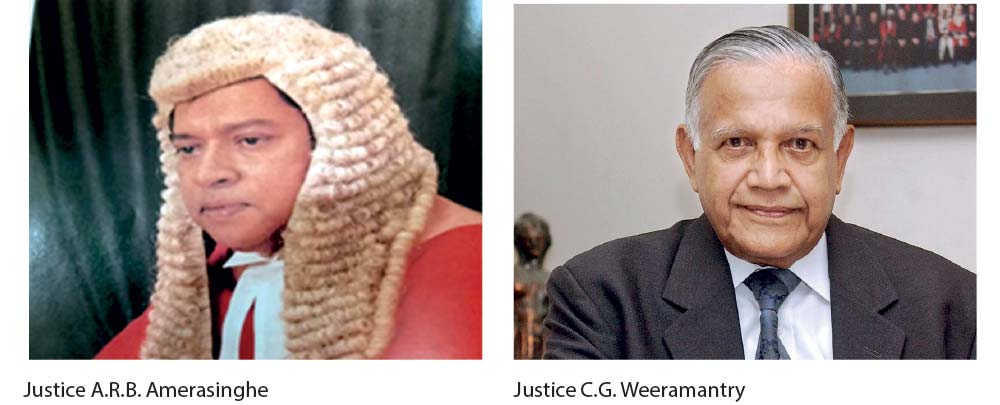
 We are guardians and not owners: the wisdom of King Devanampiya Tissa, the principles articulated by Justice C.G. Weeramantry and the landmark reasoning of Justice A.R.B. Amerasinghe convey a common message. Our ancestors did not build reservoirs, canals, monasteries and sacred monuments merely for their own generation. They created a civilisation to be preserved and passed on
The wisdom of Justices A.R.B. Amerasinghe and C.G. Weeramantry directing decisions affecting the sacred city of Anuradhapura
 Anuradhapura is replete with historical marvels; some of the marvels identified by the generations of yesteryear require national and public attention to protect and preserve them for the generations yet unborn.
One of those marvels is the Kalawewa National Park in Kekirawa, a sanctuary for elephants, particularly tuskers, which are rare in the country. In the dry season, the water levels of the reservoirs recede, revealing green grasslands that attract elephants. The Kala Wewa and Balalu Wewa reservoirs, built in the 5th century, are central to the park's ecosystem. The massive Kumbuk trees that line the park are a habitat for numerous birds, both resident and migratory.
Another marvel is the Yoda Ela, an 87 km (54 mi) long single-banking water canal constructed in 459 AD, carrying excess water from the Kala Wewa reservoir in Anuradhapura to the Tissa Wewa reservoir. The Yoda Ela is acclaimed for its low gradient of 6 inches per mile which, even with modern-day survey equipment, would be a difficult feat to achieve with such accuracy.
Then there is the ‘Biso Kotuwa’, an ancient Sri Lankan hydraulic valve pit system used to regulate water pressure and flow in the large reservoirs, preventing embankment damage and ensuring controlled irrigation. Such systems are found in sites like Polonnaruwa, Sigiriya and Anuradhapura, and comprise a vertical valve chamber built inside or beside a reservoir sluice. The pressure-dissipating mechanism reduces destructive water velocity before release and was constructed using precisely cut stone blocks, often without mortar. The system is considered to be one of the most advanced ancient hydraulic inventions.
Two respected judges, Justice Amerasinghe and Justice Weeramantry, in judgments delivered independently in two different cases, emphasised that Anuradhapura is not simply an archaeological city or a destination for tourism; it represents one of the world's remarkable ancient hydraulic civilisations, where water management, agriculture, religious heritage, engineering and environmental conservation were developed as one integrated system.
Anuradhapura's ancient reservoirs, canals, waterways, catchment areas, forests, elephants, Buddhist monuments and archaeological remains form an interconnected national heritage.
In a landmark judgment issued in the Eppawela Phosphate case of 2000 (Bulankulama and others vs Freeport-McMoRan and others), Justice Amerasinghe, with two other learned Justices of the Supreme Court in agreement, stated without ambiguity that any development that affects this heritage must be considered not merely as an exercise in planning, economics or tourism, but as a matter of national responsibility, environmental protection and the rule of law.
Government is the temporary custodian and cannot distribute State land
In this landmark judgment, Justice Amerasinghe examined the proposed phosphate mining project in the Anuradhapura District.
The Court considered the potential consequences for the ancient irrigation systems of Rajarata, the water and soil conservation ecosystems, underground aquifers and agricultural lands, the archaeological and cultural heritage and the livelihoods of local communities.
One particularly important observation concerned the inadequacy of existing legal protection for the cultural-heritage landscape.
Justice Amerasinghe drew attention to the fact that there was no adequate provision for protecting a cultural-heritage landscape such as the Yoda Wewa, as distinct from an individual archaeological monument.
Justice Amerasinghe went on to say that protecting an individual dagoba or monument is not necessarily sufficient if the surrounding ancient irrigation system, landscape, waterways and archaeological setting are damaged.
The judgment also emphasised the precautionary approach towards sustainable development and the principle that environmental damage must be borne by those responsible for causing it. The judgment deemed that if no plans are publicly available, there is no way to assess the damage that could possibly be caused by the project; in these circumstances, a project is not to be proceeded with.
Justice Amerasinghe's judgment says that Sri Lanka's law cannot be circumvented by secret agreements or by some type of understanding arrived at by two parties to the contract.
The judgment went on to say that the authority that will determine whether a project is suitable for the country in respect of its heritage, civilisation, environment, etc., is the authority that has been delegated such powers by the country's sovereign law.
Sri Lanka's ancient water wisdom recognised internationally
In 1997, Justice C.G. Weeramantry, a former Vice-President of the International Court of Justice (ICJ), made a similar observation in a case that came up before him at the ICJ. Sri Lanka's ancient water wisdom was internationally recognised.
In the Gabčíkovo-Nagymaros Project case (Hungary vs. Slovakia), which came up before the ICJ in 1997, Justice Weeramantry referred extensively to Sri Lanka's ancient irrigation civilisation. He explained how Sri Lanka's ancient rulers developed a sophisticated system of reservoirs and canals while recognising the need to conserve nature.
The eminent judge referred to the ancient principle that not even a small quantity of rainwater should flow to the sea without benefiting the people.
Justice Weeramantry also referred to the sermon of Arahat Mahinda to King Devanampiya Tissa, explaining that animals and birds have an equal right to live and move within the land.
Justice Weeramantry's central message was that development and environmental conservation must go together. He recognised that sustainable development was not a newly invented international concept: Sri Lanka had practiced these principles for centuries.
The connection between these two eminent judges
An important point is that Justice Amerasinghe's Eppawela judgment referred to Justice Weeramantry's international jurisprudence.
Their contributions provide a powerful legal and historical foundation for the principle that development and environmental conservation must go hand in hand.
Public Trust doctrine
Justice Amerasinghe and Justice Weeramantry both outline the doctrine of ‘Public Trust’, nationally and internationally.
This doctrine carries an intergenerational responsibility: the responsibility to protect natural resources.
The two eminent judges speak of sustainable development, the need to protect the Yoda Wewa cultural landscape, the ancient irrigation wisdom, the precautionary approach to environmental damage, harmony between development and nature, including the fauna, the flora and the majestic elephants that roam the land, and the shared responsibility to protect them all for future generations.
Together, the wisdom of the honourable judges provides an important framework for examining development projects in Anuradhapura and elsewhere.
Why the present Anuradhapura development proposals require careful examination
The ancient city cannot be separated from its water civilisation. A proper assessment must consider whether proposed development could affect the archaeological remains and ancient monuments; ancient tanks, canals and irrigation channels; water catchment areas and groundwater; the historical landscape surrounding sacred monuments; the ecological balance and traditional agricultural environment; and the integrity and religious character of the sacred city.
The protection of heritage should not be confined to individual monuments while the wider historic landscape and the habitat of elephants and other animals and birds are altered.
Applicable legal protection
The following laws should be examined together: the Antiquities Ordinance No. 9 of 1940 (protection of antiquities, ancient monuments and archaeological reserves); the National Environmental Act No. 47 of 1980 (environmental approvals and assessment, where applicable); the State Lands Ordinance No. 8 of 1947 (legal administration of State land); and the Mahaweli Authority of Sri Lanka Act No. 23 of 1979 (where applicable, to designated areas and lands).
Also important are Article 27(14) of the Constitution (State responsibility to protect, preserve and improve the environment) and Article 28(f) (the duty of every person to protect nature and conserve its riches). The Eppawela judgment is particularly important when applying these laws to development proposals affecting interconnected archaeological and environmental resources.
The central question for the Government
Can a Government undertake tourism and infrastructure development in Anuradhapura without first establishing, through proper archaeological, hydrological and environmental studies, that the ancient water systems, archaeological landscape and sacred character will be protected?
The answers must be provided by the legal principles already established by our courts.
Conclusion
We are guardians and not owners: the wisdom of King Devanampiya Tissa, the principles articulated by Justice C.G. Weeramantry and the landmark reasoning of Justice A.R.B. Amerasinghe convey a common message.
Our ancestors did not build reservoirs, canals, monasteries and sacred monuments merely for their own generation. They created a civilisation to be preserved and passed on.
Anuradhapura is not simply land available for development. It is a national inheritance held in trust for generations yet unborn.
It is the Government's duty to preserve its archaeological integrity, ancient water civilisation, sacred character and historical landscape. Development must serve this heritage, not destroy or diminish it.
(The author is a Senior Attorney-at-Law who has worked with Justice A.R.B. Amerasinghe.)
Notes:
The Eppawela Supreme Court judgment, Bulankulama and others vs. Freeport-McMoRan and others: https://elaw.org/resource/sri-lanka-bulankulama-v-min-industrial-development-eppawala-case-sc-application-no-88499-fr
Justice Weeramantry's ‘International Environmental Jurisprudence and Sri Lanka's Ancient Irrigation Wisdom’



