Sunday Oct 25, 2026
Sunday Oct 25, 2026
Thursday, 10 September 2026 00:27 - - {{hitsCtrl.values.hits}}
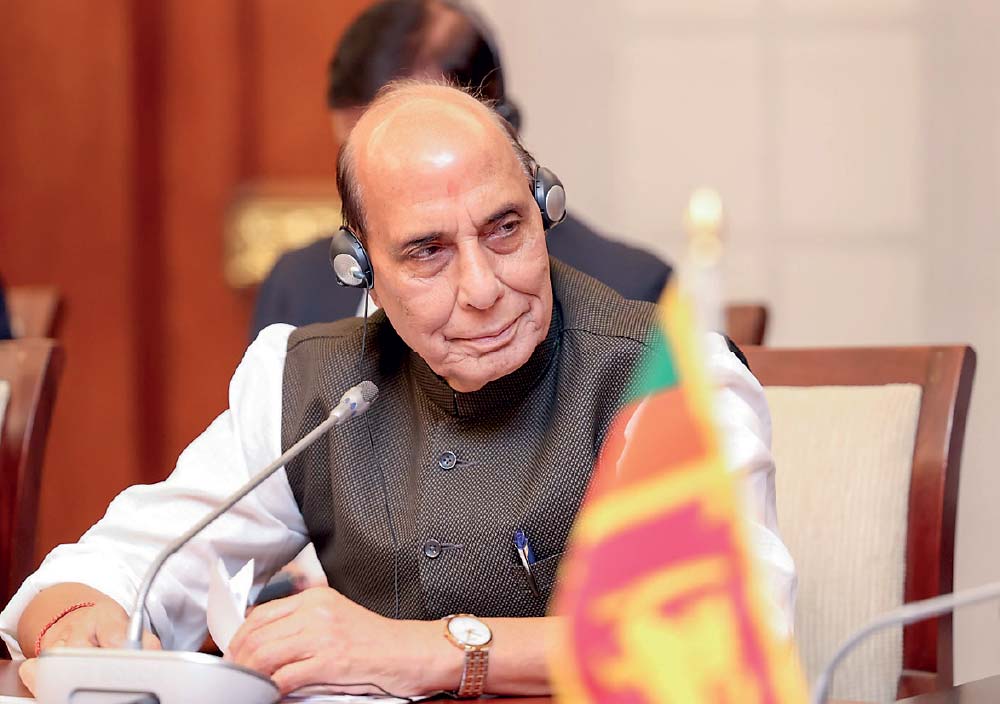
Indian Defence Minister Rajnath Singh
 Singh’s visit should be received with courtesy, used with discipline, and remembered for what it adds to Sri Lanka’s ability to stand on its own water. Take the neighbour’s hand. Keep the island’s choices
 Indian Defence Minister Rajnath Singh landed in Colombo earlier this week for a three-day official visit, the first by an Indian Defence Minister in 38 years. The last such call was by K. C. Pant in 1988. That long silence itself tells a story.
For nearly four decades, defence business between the two neighbours was handled by service chiefs, training colleges and quiet staff talks. New Delhi has now chosen to put a political minister at the centre of the relationship, and to do so immediately after a dense sequence of Indian visits and against a harder contest in the Indian Ocean.
The visit will be read, in Delhi, Beijing and Washington, as a signal. Our task in Colombo is narrower and more serious: to convert the signal into national capability without converting the island into a platform.
Not an isolated visit
Singh’s program is the latest layer in an unusually concentrated Indian engagement since President Anura Kumara Dissanayake assumed office in September 2024. Prime Minister Narendra Modi’s State Visit in April 2025 was the first by any foreign Head of Government after the new presidency. Seven documents were signed. Among them was the first comprehensive India–Sri Lanka Defence Cooperation Memorandum of Understanding, a five-year umbrella covering joint exercises, training, port calls, humanitarian assistance and disaster relief, information exchange and possible defence-industry cooperation. Either side may terminate it with three months’ notice. That exit clause is not a detail. It is the difference between a structured partnership and a treaty alliance.
What followed was a rhythm, not a one-off. The eighth Annual Defence Dialogue was held in Colombo in June 2025. The Indian Navy Chief called in September 2025. After Cyclone Ditwah, India arrived as a first responder and later announced a reconstruction package of some $ 450 million; External Affairs Minister S. Jaishankar came as Special Envoy. In January 2026 the Indian Army Chief, General Upendra Dwivedi, handed over vehicles and training aids, opened a friendship corner at the Defence Services Command and Staff College, and laid a wreath at the IPKF memorial in Battaramulla. The Indian Vice-President visited in April. Foreign Secretary Vikram Misri was in Colombo on 5 August with rupee lines of credit for railways and other priorities. Later that month, Sri Lanka’s Navy Commander, Vice-Admiral Damian Fernando, made his first overseas visit in command, to New Delhi, and met the Chief of Defence Staff, the Defence Secretary and the Navy Chief.
Singh therefore arrives not as a stranger opening a file, but as the political seal on work already in motion. He is scheduled to call on the President, who holds the defence portfolio, the Prime Minister and the Defence Secretary. The itinerary also takes in the IPKF memorial, the Defence Ministry, the parliamentary precincts, Gangaramaya Temple, a likely reception on an Indian Navy ship, the National Defence College, and the Sita Amman Kovil in Nuwara Eliya. Indian High Commissioner Santosh Jha has said relations have “never been better” in decades. The visit calendar, at least, is not an invention.
What already stands on defence floor
It is important to be precise about what already exists, so that we do not mistake institutionalisation for a sudden tilt.
Training is the deepest bond. India is the largest foreign trainer of the Sri Lankan armed forces, offering on the order of a thousand to twelve hundred vacancies a year. One naval accounting records more than two thousand Sri Lankan naval personnel passing through Indian courses over nine years. Shared classrooms produce shared language, shared drills and personal networks that outlast any single Government. Reports ahead of this visit point to three new memoranda, one likely on air-defence guns, one on cadet-corps links, and one on cooperation between the Sri Lanka Defence College and Indian defence institutions. If signed, those instruments would push the relationship into the next generation of officers, not only today’s operators.
Exercises are now routine rather than ceremonial. The twelfth edition of SLINEX, the bilateral naval exercise, was held in Colombo from 14 to 18 August 2025, with a harbour phase of professional exchanges and a sea phase of gunnery, boarding, replenishment and communications. MITRA SHAKTI, the army exercise with air elements, held its eleventh edition in Belagavi last November. A fourth bilateral diving exercise was conducted in Colombo in April 2026. The two navies and coast guards continue International Maritime Boundary Line meetings. An Indian Navy Dornier was based here for maritime surveillance from August 2022 to August 2025. A Maritime Rescue Coordination Centre was commissioned with an Indian grant of about $ 6 million. INS Vikrant and INS Udaygiri took part in the International Fleet Review marking the Sri Lanka Navy’s 75th anniversary.
None of this is trivial. None of it, by itself, is alignment. Hardware, hours at sea and staff-college seats are instruments. What they become depends on command, data and political purpose.
National security questions that matter
Three questions should govern Colombo’s handling of the next 72 hours.
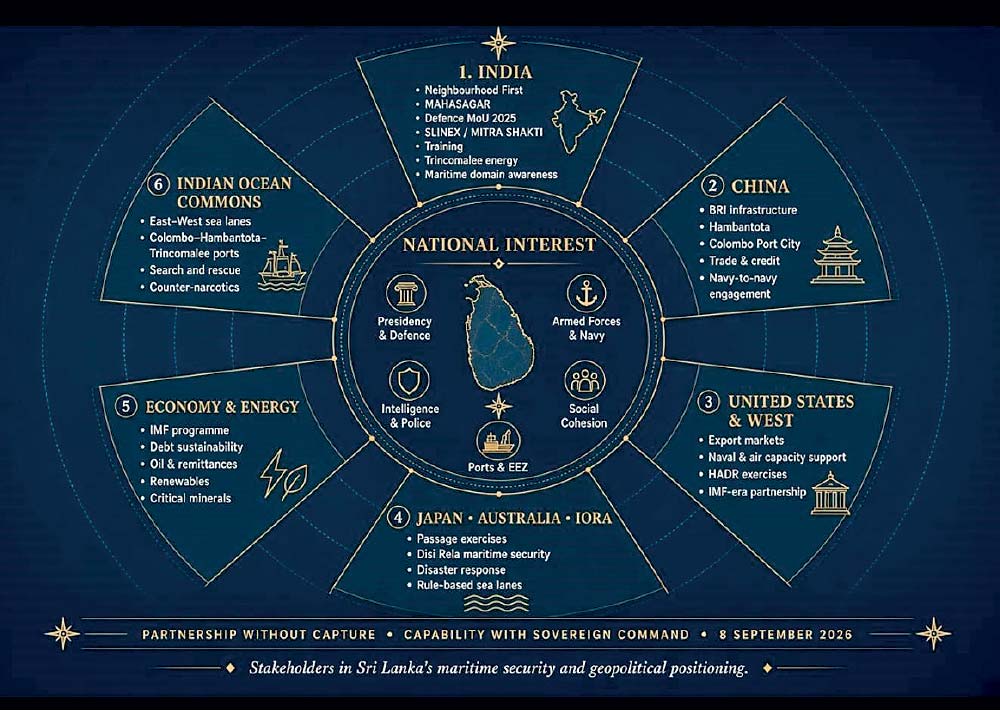
The first is maritime domain awareness. Sri Lanka’s core security geography is not a land frontier. It is the exclusive economic zone and the sea lanes that pass our shores. The live threats are narcotics, people-smuggling, illegal fishing, and the possible relocation of cyber-fraud compounds. Conventional naval war is not on this year’s operational list. Indian help with sensors, hydrography, diving, boarding drills and search-and-rescue is therefore rational. The test is who owns the picture. Shared awareness is useful. Exclusive dependence on one partner’s fusion centre is a vulnerability. Australia’s Disi Rela program against irregular maritime movement, Japanese passage exercises, and United States capacity support, cutters, aircraft, humanitarian exercises, already exist. They should remain in the mix. Maritime security should be a Sri Lankan-led coalition of convenience, not an Indian franchise.
The second is the air and coastal defence gap. Talk of Indian air-defence guns is not abstract after the 2026 conflict in West Asia reached our own waters, the sinking of the Iranian frigate IRIS Dena off Galle, and later Iranian hulls lingering near the exclusive economic zone. The Government’s public line was the correct one: no combat use of our territory, airspace or waters by any party; humanity first; sailors rescued. That posture only works if the State can see, and if necessary contest, its approaches. Accepting guns, radars or training is compatible with an independent foreign policy if command, basing and rules of engagement remain Sri Lankan. Integrating them into another country’s kill-chain would not be.
The third is internal security. Easter Sunday accountability, narcotics networks that run through ports and prisons, and communal peace are not separate from geopolitics. Partners price political risk. A State that cannot govern its harbours, its financial system and its extremist ecosystems will be offered “help” that looks like tutelage. India’s interest in counter-terror coordination and drugs overlaps with genuine Sri Lankan needs. The discipline required is the same as in any sound intelligence relationship: cooperate on targets; do not outsource the service.
The wreath at the IPKF memorial will be watched, as it was when the Indian Army Chief stood there in January. The years 1987 to 1990 remain raw in our political memory. The only stable line is professional honour to the dead, not a political rehabilitation of an intervention that divided this country.
How the region will read Colombo
India’s motive is not mysterious. Sri Lanka sits on the approaches to India’s southern seaboard. Chinese commercial and dual-use presence at Hambantota and Colombo Port City, and continuing engagement with the People’s Liberation Army Navy, is the backdrop. Pakistani naval units calling at Colombo, including a Chinese-built Hangor-class submarine earlier this year, only sharpen New Delhi’s preference for a denser security habit with us. Neighbourhood First and MAHASAGAR, Mutual and Holistic Advancement for Security and Growth Across Regions, are the language. The operational aim is that extra-regional navies do not treat Sri Lankan harbours as a default logistics base against Indian interests.
Our motive should be equally clear, and different. Geography makes India the permanent neighbour. Crisis behaviour, liquidity and fuel in 2022, the cyclone in 2025, the energy and remittance shock of 2026, has already shifted public sentiment. That is a political fact. It does not require Colombo to adopt India’s threat picture of China, or to freeze other relationships.
A workable posture is polyalignment with a spine. India is the deepest security and connectivity partner, domain awareness, disaster response, training, Trincomalee energy cooperation, grid links and rupee credit, on the condition that ports, exclusive economic zone access and intelligence fusion remain under Sri Lankan law. China remains a major economic and infrastructure partner; new exclusive strategic footholds should not be created, and debt and operational control must stay visible. The United States, Japan, Australia and Europe matter for markets, green shipping, extra training pipelines and non-traditional maritime threats. Ordinary naval diplomacy with Pakistan and others is manners, not signalling.
The Government’s stated doctrine, an independent policy that does not favour any country, and territory that will not be used against a third party, is the right public frame. This week will test whether that frame can coexist with deeper, more structured Indian defence cooperation. It can, if the new memoranda are capability contracts with exit clauses, not political alignment documents.
Take help. Keep the choice
Colombo should treat the expected instruments as a capability audit.
On air defence, welcome sensors and guns that Sri Lanka can man, maintain and switch off. Reject any arrangement that requires foreign crews, foreign rules of engagement, or data that only flows one way. In cadet corps and staff colleges, take the training and keep a parallel pipeline with other professional schools so that the officer corps is not a single-source product. On the 2025 Defence Memorandum, measure implementation by Sri Lankan readiness, hours of maritime coverage, time-to-rescue, interdiction rates in the exclusive economic zone, disaster lift, not by the number of Indian ship-days in harbour.
Joint training should emphasise humanitarian assistance, counter-narcotics, hydrography, diving and lawful boarding. Those are the missions that serve the public and do not lock us into someone else’s contingency. Scenarios that only make sense in an India–China or India–Pakistan crisis should be declined politely and firmly.
Defence talks must also be bound to the prosperity agenda. Trincomalee as an energy and industrial node, electricity interconnection, port productivity and cyclone reconstruction are where security cooperation either pays the citizen or looks like militarisation. A Defence Minister’s visit that produces only wreaths and signed paper will be read in the region as alignment. A visit that also moves energy storage, disaster systems and maritime safety will be read as statecraft.
I write as a former Police officer who spent a working lifetime on intelligence, counter-terrorism and the unglamorous work of keeping a multi-religious island in one piece. Geography gave us a seat at the table of Indian Ocean commerce and security. Institutions, energy policy, port performance and social cohesion will decide whether that seat produces prosperity, or merely more invitations to other people’s contests.
Singh’s visit should be received with courtesy, used with discipline, and remembered for what it adds to Sri Lanka’s ability to stand on its own water. Take the neighbour’s hand. Keep the island’s choices. Make sure every exercise, every gun and every training slot leaves us more able to say no the next time a great power asks to use our sea, our air or our soil.
(This analysis is offered in the interest of national security, institutional reform, and public safety)
(The author is a retired Senior Superintendent of Police. He served as Deputy Director in charge of the Counter Terrorism Desk, State Intelligence Service, and later as Intelligence Coordinator to the Inspector General of Police. He is the author of Security Beyond Enforcement: Practical Approaches for a Safer Nation)




