Thursday Oct 15, 2026
Thursday Oct 15, 2026
Thursday, 16 July 2026 03:30 - - {{hitsCtrl.values.hits}}

Leaders of American Democratic Socialism: Sanders, Mamdani, AOC
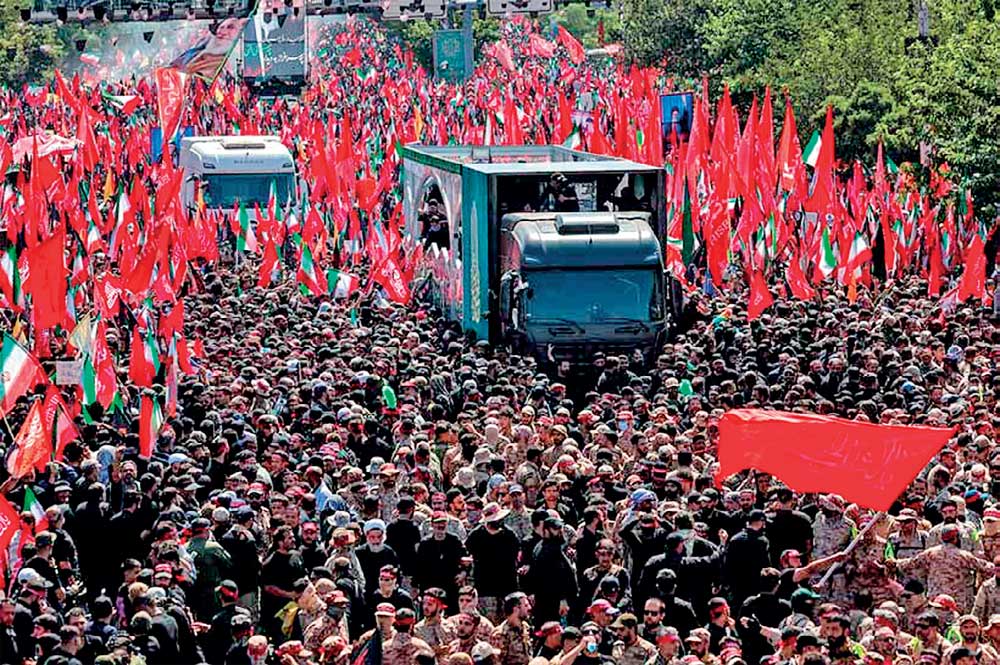
A fragment of the millions attending Ayatollah Khamenei’s funeral
 If Iranian shooting at cargo ships deserved massive US retaliation including on civilian infrastructure, what would constitute just retaliation for the massacre of 120 schoolchildren between the ages of 6 to 13 in Minab by US Cruise missile strikes on the opening day of America’s Iran war?
 Future history will record that the 250th birthday of the USA coincided with the funeral procession of Ayatollah Khamenei and his family (including his little granddaughter), murdered by an Israeli-US airstrike earlier this year. The funeral was one of the largest in modern history.
While there are those who would opt for one of these two polarities (USA/Iran) in current world politics and history, most of us belong to the majority of literate and critically thinking people of the middle-classes, especially in the global South, who admire the US for its achievements and Iran for its fortitude.
We are after all, the product of both American cultural modernity and the anti-hegemonistic, anti-imperialist struggles of the global South—and contain within ourselves the elements of, and a fusion of, both. Therefore, we can see things from both sides, sometimes from a midpoint; sometimes from above the fray; sometimes on one side but while comprehending the other—always, ultimately, searching for a synthesis or at least an equilibrium.
The generation of my father and his contemporaries was one that combined admiration for JFK with support for rising Third Worldism. India with Jawaharlal Nehru as Prime Minister and John Kenneth Galbraith as President Kennedy’s ambassador to New Delhi captured that moment in South Asia’s intellectual history. The synthesis which inspired and characterised Ceylon’s literary and policy intelligentsia was the source of this island’s ability to punch well above its weight in world affairs, obtaining recognition for Ceylon as a developmental model of modest income with high literacy and social welfare. It was also the source of Sri Lanka’s foreign policy success and strategic autonomy.
Today one of the sources of Sri Lanka’s enduring crisis is the absence of any political alternative which is informed and influenced by the progressive current of US liberal-democratic thinking in economics—Stiglitz, Krugman, Reich, Sachs, (Jim) Galbraith—and politics. There are no leaders or parties which take their inspiration from the US progressive Democrats.
American Democratic Socialism
A striking feature of the USA’s 250th birthday was the hysterical critique of ‘communism’ in President Trump’s speech. This was odd since it has been decades since the Soviet Union folded, enabling the Cold War to be won by the West. Trump wasn’t referring to China or North Korea as proliferators of a pernicious ideology. He was talking about the danger of homegrown communism. Since there is no markedly communist activity in the USA, what was Trump on about?
He made it clear that he was referring to the significant trend of support within the US Democratic Party and therefore within mainstream US politics and society for candidates of the Democratic Socialists of America (DSA), a caucus initially founded to focus on poverty issues by Michael Harrington several decades back, which had gone into decline but was revived by the Bernie Sanders campaign.
A fascinating feature of the USA at 250 is the resurgence of the very term ‘socialism’—not ‘communism’—and the ideological identity ‘socialist’, within the democratic mainstream of the most powerful capitalist nation in the history of the world. American socialism is no foreign import; it is the proud descendant of the progressive potentials of the American revolution, the American Constitution and the real struggles of American history.
In a richly dialectical development, by reviving the brand ‘socialism’ at a time of the deep recession of socialism in the global South including its tragic cave-in from the Caribbean to Chile, America is vindicating the original idea of Marx and Engels that socialism would arise from the womb of the most advanced capitalism. It shows that the USA is a site from which an advanced alternative modernity can arise, at least as idea and experiment.
The DSA unabashedly criticises capitalism and defends the term socialism, but quite rightly doesn’t advance an expressly socialist or anti-capitalist economic program. The DSA’s economic ideas and formulations as best expressed by Bernie Sanders, Zohran Mamdani and Alexandria Ocasio-Cortez can easily be accommodated within the parameters of Western/Northern European, Canadian and British social democracy at its zenith. The critique of capitalism and the cause of socialism advanced by the DSA and progressive US Democrats, is more a moral-ethical critique than a total systemic alternative to capitalism. It does however, provide deep structural reforms as alternative to the present form and model of neoliberal late-capitalism.
Mamdani’s economic program and practices in New York are centred on ‘affordability’ and are practical proof that there is a way of working within capitalism while reordering priorities and pushing social needs to the forefront in a capitalist metropolis, thereby beginning a process of the evolution of capitalism through reform, moderating and modifying its anti-social logic of maximising individual profit, and giving incremental weightage to the basic material needs of the wage-earning majority.
On the 250th anniversary of the American revolution there is something growing in the American consciousness which can be dated to the 2016 Bernie Sanders campaign, the breakthrough electoral victory of Alexandria Ocasio-Cortez and her squad of progressive women colleagues, the Black Lives Matter protest over the George Floyd killing, the occupation of elite American campuses by young people in solidarity with the people of Gaza and the Palestinian cause, the victory of Zohran Mamdani in the New York mayoral race, the No Kings demonstrations in all cities of the USA, the successful struggle against ICE killings in Minnesota, and now the DSA surge in the Democratic primaries.
President Trump’s response on the 250th anniversary of the USA’s birth through revolution and the war for Independence, was to lash out with McCarthyite viciousness against the New American Revolution underway at the grassroots.
Whoever wins the 2026 midterms and the 2028 Presidential race, the democratic socialist current will be part of America’s political landscape.
In Sri Lanka, there are no left-liberal or leftist currents which are the equivalent of the Democratic Socialists of America (DSA) which would be most relevant in a multiparty democratic republic. Instead, Sri Lanka has a left with currents which have converted to neoliberalism; or praise models which are almost defunct; or ones which don’t exist and are untested; or that which is awesome by any yardstick but unique and utterly impracticable on this island for reasons of size, scale and historically-evolved political system.
How is Trump’s intention to take-over the Strait and charge 20% for ‘guardianship’, different from Iran’s demands? Iran borders the Strait while the US is an outsider to the region. Therefore, Trump’s announced ambition amounts to piracy
Militant mourning, historic mobilisation
One reason for the USA’s relative decline in its role of world leadership is that its decision-making has come unmoored from any expertise, any in-depth historical knowledge, about its enemies or rivals.
Any expert analyst would realise what the funeral procession of the martyred Ayatollah Khamenei indicates.
Except for the deaths of Mao Zedong and Zhou Enlai, no one recalls a larger funeral for a nation’s leader. While those funerals were larger as befits China’s much vaster population, and characterised by love, sorrow and respect, the funerals of the murdered Ayatollah Khamenei and his family generated those emotions plus one more—hatred of the enemy and the collective determination to avenge these martyrs.
The collective mourning and the funeral procession transcended national borders and identities, crossing the Iranian/Persian and Arab divides as it moved into Iraq. The mourning in Karbala and Najaf in Iraq was every bit as militant as in Iran itself.
The US bombed Iran while this funeral procession was proceeding. Though it did not bomb the procession itself, it bombed some bridges and railway tracks which connect Mashhad where the funeral was due to culminate. Just days after the funeral the US bombed a water plant in Mashhad.
History will record that the US didn’t have the basic civility and decency to observe a moratorium on bombing of the country while the funeral procession and open mourning of millions at the unprovoked killing by the US and Israel of Iran’s leader and family were still proceeding.
The renewed US bombing is in retaliation for Iran’s shooting at three cargo ships attempting to cross the Strait of Hormuz without Iran’s permission. The Iranian attack neither sank these ships nor caused high casualties. However, the US ‘double-tapped’ an unarmed Iranian Navy ship already crippled by a US submarine strike and barbarically caused the death by drowning of over a hundred Iranian sailors off the waters of Sri Lanka in March 2026.
If Iranian shooting at cargo ships deserved massive US retaliation including on civilian infrastructure, what would constitute just retaliation for the massacre of 120 schoolchildren between the ages of 6 to 13 in Minab by US Cruise missile strikes on the opening day of America’s Iran war?
How is Trump’s intention to take-over the Strait and charge 20% for ‘guardianship’, different from Iran’s demands? Iran borders the Strait while the US is an outsider to the region. Therefore, Trump’s announced ambition amounts to piracy.
Discussion of US strikes on Iran for alleged violation of the MoU regarding the Strait must begin with the recollection that shipping was passing quite normally and unimpeded until US-Israel began a war of unprovoked aggression while Iran was engaged in negotiation.
To my mind, the real reason for massive US retaliation for Iran striking three ships, is that the Trump administration simply could not abide the televised scenes from the funeral of Ayatollah Khamenei—its massiveness, militancy, spirit of resistance, and sheer collective defiance in the face of the world’s ‘sole superpower’ which fancies itself as capable of dictating to the world and its peoples.
The reaction of the superpower in relative decline, to the defiance of the Iranian public despite the Epic Fury launched against it and enormous US naval and military power encircling it, was to lash out with punitive viciousness. The mourning Iranian and Iraqi Shiite multitudes was to unfurl more and much bigger red banners bearing an oath of vengeance in English, expressing their comprehensible rage against the US President who seems to view himself a Caesar and the US as Imperial Rome.
Taking the longer view of history, we see that the US has made enemies of the Shiite Muslims in Iran, Iraq, Lebanon, Yemen etc. The seeds of violent hatred that Trump and Netanyahu have sown will generate cycles of retaliatory asymmetric violence from generations of militants beyond our lifetime.
The Trump-Netanyahu axis has caused the inevitable accumulation of antagonism in the historical memory of a religio-cultural community of over 200 million, with a transnational, cross-border spread and a readiness for martyrdom. This inexhaustible wellspring provides Iran and the Shiite-led resistance in the Greater Middle East region or ‘Crescent of Crisis’ (as dubbed in the late 1970s):
 Capability for non-nuclear, conventional tactical second-strikes.
Capacity to sustain protracted asymmetric conflict.
Potential to achieve dynamic asymmetric equilibrium vis-a-vis US/Israel.
For how long can the USA, a foreign force from oceans away, and Israel, an aggressive expansionist regional minority, sustain themselves in their present modes, separately or in partnership, against a determined, motivated force more powerful than Afghanistan’s Taliban, operating on its native soil and seas?
Russia’s Foreign Minister Sergei Lavrov said a few days back that the West is using Ukraine as “a battering-ram” against Russia, seeking a “strategic defeat” of Moscow. I would add that weakening Russia may be perceived by the West as also a potential battering ram against China
Full-scale war on Russia
The recently concluded NATO summit shows every sign of UK-Europe intent on a war, backstopped by and eventually drawing in the US, aimed at defeating Russia. President Putin’s spokesperson Dmitri Peskov admitted:
“We have Russia on one side and the Kiev regime plus a number of European countries, plus the United States that is supplying millions of tons of weapons to Ukraine. What is it? It’s not an operation anymore, it’s a war. It’s a full-scale war.”
Two years before the Ukraine war, I had warned of this outcome at scholarly conferences and addresses to academies in Russia, in a political scientist’s analysis of post-Cold War dynamics and Western grand strategy. There were doubts and intellectual resistance to accepting the scenario I advanced as a probability, but Russia may now come to realise the existential imperative of waging a war that approaches its (non-nuclear) ‘absolute form’.
Russia’s Foreign Minister Sergei Lavrov said a few days back that the West is using Ukraine as “a battering-ram” against Russia, seeking a “strategic defeat” of Moscow. I would add that weakening Russia may be perceived by the West as also a potential battering ram against China.
Given that it’s a “full-scale war”, the existential question that Moscow has to ask itself is whether today’s Russian ruling elite, State, military and ideology/mindset more closely resemble or approximate the imperial Russian ruling elite, State, military and ideology/mindset which fought and lost wars in 1905 and 1914-1917, or are more like:
(I) The victorious (Soviet) Russian ruling elite, State, military and mindset that pushed back the 180,000-strong 16 armies including from the USA- UK-France- Japan that invaded Russia following the 1917 Bolshevik revolution and were defeated by 1919-1920 under Lenin, by the Red Army led by Trotsky and Tukhachevsky.
(II) The (Soviet) Russian leadership of Stalin and the Red Army commanded by Marshals Zhukov, Rokossovsky et al, who resisted the invading Nazi German army (1941), broke the back of the mighty Nazi war machine at Stalingrad, and chased the Nazi-fascist monster back to its Berlin lair causing Adolf Hitler to commit suicide.
To summarise: is the Russian State currently being confronted by NATO , i.e., imperialism, closer the Tzarist State or Soviet State, and is the Russian military closer the White Army or the Red Army? Or is the Russian power-elite and State’s ideology and mindset closer the Tzarist State while Russia’s military, engaged in fighting imperialism (Ukraine as NATO’s battering-ram) has thereby evolved more positively, i.e., closer the Red Army?
China risks the cracking of its Western ‘Wall’, leaving it open to Western forces or a pro-West Russian Government on its long border with Russia. A defeat of Russia would mean the grand-strategic encirclement of China by the West and its Eastern allies would be complete. If Russia falls, fails or flips, the continued rise of China and therefore the East will no longer be unassailable. The Eurasia Dream will end
China’s western wall
The elephant in the room of world politics today is the Dragon, i.e., China. As Stalin and Mao concurred in Moscow in 1950, Russia and China stand back-to-back; each other’s safe ‘rear base areas’.
Would it be in China’s best interest to run the risk of the possible defeat or chronic debilitation of Russia by the West?
China’s strategy against US aggression has long resided in ‘area denial’, i.e., the ability of its long-range missiles to destroy US warships in the proximate half of the Pacific. But the Iran war shows the US aircraft carrier battle groups have developed an invulnerable shield against (Iranian) missiles. Historical and strategic realism would suggest that China could supply Iran with enough advanced shore-to-ship and ground-to-air missiles to be tested against US Navy and Air Force supremacy.
China risks the cracking of its Western ‘Wall’, leaving it open to Western forces or a pro-West Russian Government on its long border with Russia. A defeat of Russia would mean the grand-strategic encirclement of China by the West and its Eastern allies would be complete.
To modify the Thucydides Trap theorem, no hegemonic power would allow the peaceful rise and eventual displacement by a competitor, unless (a) its role as a global power was no longer tenable—like post-WWII Britain and colonial Europe and (b) the successor global hegemon was on an ideological-cultural-systemic continuum, as the newer USA was to the older UK. These conditions do not apply to USA/ China.
If Russia falls, fails or flips, the continued rise of China and therefore the East will no longer be unassailable. The Eurasia Dream will end.




