Monday Oct 12, 2026
Monday Oct 12, 2026
Monday, 12 October 2026 03:34 - - {{hitsCtrl.values.hits}}

 A critical policy dilemma arises when evaluating these two goals. If financial literacy remains low across the population, there is little meaning in merely attaining a high rate of financial inclusiveness. Bringing uneducated consumers into the formal financial system without the skills to navigate it safely is akin to handing a complex vehicle to an untrained driver
 The Central Bank of Sri Lanka (CBSL) has recently intensified its policy drive toward achieving financial inclusiveness and financial literacy. These dual concepts are foundational pillars of a modern, stable economy. In the lexicon of policymakers, financial inclusiveness means ensuring that sustainable financial habits and access are extended to everyone in society, rather than to an exclusive group. Financial literacy, on the other hand, demands that individuals who engage in financial transactions do so, equipped with actual knowledge, rather than out of dangerous ignorance.
However, a critical policy dilemma arises when evaluating these two goals. If financial literacy remains low across the population, there is little meaning in merely attaining a high rate of financial inclusiveness. Bringing uneducated consumers into the formal financial system without the skills to navigate it safely is akin to handing a complex vehicle to an untrained driver.
Therefore, as a matter of economic priority, financial literacy must precede inclusiveness, or at the very least, act as its prerequisite. Without the intellectual shield of literacy, rapid inclusiveness simply exposes vulnerable populations to predatory financial engineering.
Historical precedent: The Isuru Project
This current push by CBSL is by no means the first time the apex bank has championed these twin objectives. In the 1990s, it embarked on a groundbreaking initiative targeting the poorest of the poor. This was executed through the implementation of the first-ever microfinance poverty alleviation project in the country, called the Small Farmers and the Landless Credit Project, christened in Sinhala as the Isuru Project, meaning it will bring prosperity to targeted people.
Having served as the Director of this Project from 1992 to 2000, I witnessed firsthand the transformative power of blending grassroots access with structured education. The initiative was a collaborative, multi-agency effort funded by International Fund for Agricultural Development, Canadian International Development Agency, Sri Lanka Government, and its Central Bank.
The successful implementation of this vast project was guided by the profound expertise of the Central Bank’s premier microfinance expert, G. M. P. de Silva, an Executive Director of the bank, and supported dynamically by a deeply dedicated project management team at the head office and across various district branches.
The primary objective of the Isuru Project was to provide microfinance facilities to segments of the population trapped in abject poverty, with a specific, deliberate focus on empowering women. Rather than offering mere charity, the project systematically elevated the financial literacy of these women by training them in self-employment microfinance enterprises. This structural framework integrated them directly with formal banking networks via the Regional Rural Development Banks.
Through this pipeline, every participant secured access to fundamental banking facilities—specifically, regular deposit-making and borrowing mechanisms. To ensure that this newly granted access did not collapse under the weight of bad debt, the project provided rigorous, practical financial education. The women were taught how to evaluate a financial proposal, calculate the true, effective borrowing rate rather than looking only at nominal costs, invest their money wisely, and say no to deceptive investment offers.
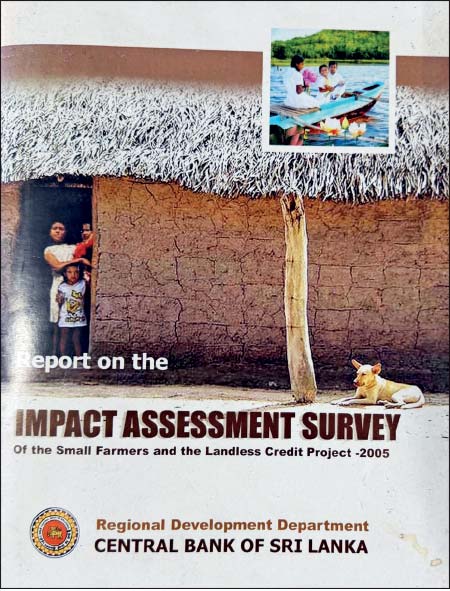
The ultimate validation of this methodology came in 1998, when the Project Completion Report prepared by donors officially concluded that the Isuru Project had comprehensively attained its objectives, proving that financial literacy could be successfully taught to even the most marginalised socio-economic groups. Later in 2005, a project impact assessment survey conducted by survey specialist Sharmini de Alwis too made the same conclusion.
|
Central bankers are living in utopias, believing their communications can do miracles
|
True meaning of financial empowerment
Through the structured framework of the Isuru Project, women who previously subsisted in deep poverty transformed into bankable, savvy investors capable of managing risks and guiding others within their communities.
A defining feature of the project was its pricing mechanism. The lending interest rates within the project were strictly aligned with prevailing market interest rates to prevent the underserving from using project facilities.
This pricing model once prompted a telling interaction. A senior commercial banker, viewing the project through a traditional institutional lens, questioned the participating women as to why they willingly accepted these relatively high market-linked interest rates instead of demanding heavily subsidised, below-market credit.
I recall that the response from the women was swift, sharp, and structurally profound. They explained that they did not mind the transparent cost of loans, provided they could borrow the money exactly when it was needed, without being subjected to time-consuming, cumbersome, bureaucratic paperwork.
For a famer, the usefulness of a loan is entirely dependent on time. If he needs to purchase fertiliser, the loan proceeds must be physically available before the cultivation season commences, not weeks after the rains have arrived. To these newly literate borrowers, the administrative speed and the elimination of red tape outweighed a marginal difference in interest rates.
This remains the ultimate definition of full-scale financial literacy and inclusiveness: a consumer base that understands the time-value of money, evaluates transactional efficiency over mere nominal costs, and utilises formal banking structures to drive real economic productivity.
Modern predatory traps and the literacy deficit
Today, the economic landscape faces renewed challenges that underscore why the CBSL’s current campaign is so vital. Widespread reports indicate that vulnerable groups across the island are continually being systematically exploited by crafty, deceptive schemers.
These modern financial predators utilise highly sophisticated pyramid schemes to trap the unwary. Among these are speculative schemes involving the purchase of future timber assets—such as buying trees promised to be harvested for profit in 25 years—alongside an array of digital and analog “quick money-making” multi-level marketing proposals. Given this landscape of structural deception, CBSL’s renewed focus on regulatory oversight and public awareness is highly creditable and necessary.
Yet, despite these institutional efforts, tragic cases continue to emerge where ignorant loan-seekers are severely exploited by informal money lenders. This ongoing crisis persists because they still lack the fundamental analytical skills required to evaluate a lending proposal. They remain blind to hidden fees, predatory compounding mechanisms, and collateral traps.
Financial safety information and consumer-protection frameworks must be communicated through grassroots, accessible media that demystify the legal complexities of collateral, compound interest, and borrowing risks before vulnerable families are pressured into surrendering their fundamental security
The case of exploitation: A modern warning
This is one such case which I have come across.
Alice (not her real name), a middle-aged mother of two daughters aged 13 and 15, was forced to assume full responsibility for supporting her family after a sudden series of misfortunes. Her husband, a mobile fish trader on a motorbike, was disabled by a terminal illness. The trade had passed down through his family: his late father had sold fish by carrying a pingo load from house to house, and after his death, Alice’s husband took over the business, purchasing fish directly from sea-going fishers. When he was confined to sickbed, Alice stepped into the role of breadwinner, carrying fish in a reed basket on her head and selling it door to door. A further crisis followed when the roof of the family home collapsed.
With no savings and no realistic access to a short-term loan from a formal bank, she turned to a moneylender who appeared courteous and willing to lend her Rs. 400,000 immediately, secured against the land on which her house stood. The loan carried a 24-month term and a monthly interest rate of 4%, requiring Rs. 16,000 each month in interest alone, before any repayment of principal. For a low-income woman whose daily earnings from fish trading barely covered family’s food bill, this obligation created an impossible financial burden. With no viable alternative and facing the immediate insecurity of a collapsed roof, Alice agreed to the harsh terms.
Within months, the mathematical trap embedded in the loan became visible. Her cash flow was not sufficient to meet all the financial obligations. She postponed all the family obligations and met only the moneylender’s demand for monthly payments.
The illusion of legal protection: Exploiting the ultra duplum loophole
The most insidious dimension of Alice’s predicament lies in her near-total lack of legal protection, produced by the ease with which informal lenders exploit outdated statutory frameworks. In Sri Lanka, informal credit is nominally governed by the century-old Money Lending Ordinance No. 2 of 1918. One foundational element of this framework is the ultra duplum, or in duplum, rule, which prohibits lenders from recovering interest more than the principal sum originally borrowed. Under this rule, for a principal loan of Rs. 400,000, the maximum legally recoverable accumulated interest would be capped at a further Rs. 400,000, meaning that Alice’s total legal liability should not exceed Rs. 800,000.
However, the moneylender’s contract was carefully designed to avoid violating the letter of the ultra duplum rule. Rather than depending on the indefinite accumulation of interest, the lender secured profit through asset-stripping clauses that converted collateral into the real object of extraction.
Because Alice was highly likely to default on a 4% monthly interest obligation within the 24-month loan period, the agreement made the family’s land central to the transaction. It provided that, if she failed to repay the principal and agreed interest within the stipulated period, the pledged land—valued at roughly Rs. 10,000,000—could be acquired by the lender.
Since the calculated interest did not necessarily exceed the principal during the formal life of the contract, the arrangement could appear technically compliant while remaining profoundly exploitative. This legal manoeuvre transformed a consumer-protection principle into a mechanism of dispossession, using a small emergency loan to place a generational asset worth twenty-five times the principal debt at risk.
This systemic failure is deepened by contemporary regulatory paralysis. The Government recently enacted the Microfinance and Credit Regulatory Authority Act No. 9 of 2026 to establish a stronger legal framework for supervising unregulated lenders and protecting vulnerable consumers. Yet the framework has not been fully implemented and remains functionally inert at the ground level.
Crucially, it still fails to reach financially and economically vulnerable women such as Alice. Because her loan was crafted by an informal moneylender operating through a private contract that appeared to comply mechanically with the ultra duplum ceiling, the transaction fell into a regulatory blind spot. Without operational capacity, local enforcement, and grassroots outreach, the statute cannot effectively regulate informal actors who target desperate, unbanked borrowers outside the formal microfinance sector.
Myth of inclusion
Alice’s trajectory is not an isolated instance of poor individual judgment; rather, it demonstrates how economics literacy—or its absence—can operate as a structural vector of marginalisation. ‘Economics literacy’ refers not merely to the ability to repay described in ‘economic literacy’, but to a broader understanding of how economic systems, legal frameworks, institutions, and power relations shape, constrain, and sometimes foreclose individual choice. Alice’s vulnerability is deeply intersectional, constructed at the volatile convergence of class, gender, geography, and sudden domestic crisis. As an urban, low-income woman, her initial entry into the labour market was already constrained by traditional gender roles and informal networks.
The transition of the family enterprise across three generations reflects a gendered regression in technological and economic security:
1. The first generation: The father-in-law carried fish using a traditional pingo load, relying entirely on physical labour.
2. The second generation: The husband modernised the trade by integrating a utility motorbike, expanding the geographical reach and volume of the business.
3. The third generation: Upon the husband’s illness, the enterprise did not merely transition to Alice; it regressed. Due to institutional neglect and systemic gender barriers, Alice was forced back to an even more primitive, grueling form of distribution—carrying a reed basket on her head while walking from house to house.
This regression illustrates how women in the informal economy are routinely stripped of productive capital assets, such as vehicles, and pushed into the most physically punishing and lowest-yielding forms of labour. When a catastrophic structural shock occurred—the collapse of the household roof—the absence of formal banking relationships, financial safety nets, and accessible institutional credit left Alice entirely exposed to predatory informal lenders. Such credit networks often masquerade as community support, yet they actively capitalise on the immediate survival needs of marginalised women, systematically stripping them of the few long-term assets they possess, including land.
By combining robust economics literacy, transparent and accessible central bank communication, enforceable consumer-protection regulation, and community-based intersectional solidarity, Sri Lanka can move away from a system that feeds on desperation and toward one that safeguards collective dignity, asset security, and economic justice for vulnerable women
Blind spots in Central Bank communication
Alice’s entrapment highlights a profound failure of institutional communication and macroprudential design. Historically, state monetary authorities have struggled to bridge the gap between macro-level financial policy and the micro-level realities of marginalised communities. Although central banking institutions frequently advocate financial inclusion, their communication strategies have tended to address formal economic actors, leaving informal labourers with little accessible guidance on the severe risks of informal debt.
In the contemporary context, meaningful economics literacy requires a radical redesign of institutional outreach. When communication remains confined to elite financial institutions, the state effectively allows predatory lenders to occupy the resulting information vacuum. A proactive redesign of central bank communication therefore requires macroprudential surveillance to actively monitor and regulate informal, exploitative debt ecosystems that disproportionately target low-income single mothers. Financial safety information and consumer-protection frameworks must be communicated through grassroots, accessible media that demystify the legal complexities of collateral, compound interest, and borrowing risks before vulnerable families are pressured into surrendering their fundamental security.
Visions for the future
Central bankers are living in utopias that their communications can do miracles. Instead of confining themselves to mere public education at the national level, they should have more effective information dissemination systems to reach the vulnerable groups. Addressing this vulnerability requires a threefold shift in activist and policy paradigms:
1. De-linking survival from predatory capital: New financial ecosystem requires community-governed, non-exploitative credit alternatives. Intersectional solidarity must include localised, women-led collective funds that provide interest-free emergency grants for structural shocks, such as house repairs or medical emergencies, thereby preventing vulnerable women from entering the predatory terrain of informal moneylending.
2. Asset protection and legal solidarities: Authorities should go for immediate legal interventions that shield the primary residential land of low-income families from predatory asset-stripping. Collective solidarity networks should be formed to assist them in this task.
3. Social infrastructures as collective care: The state and civil society must recognise childcare, healthcare, and housing maintenance as essential public infrastructure. The Singapore government did this recently by giving Government grants to parents till their children grow into adulthood. Alice was forced to act simultaneously as primary breadwinner, caregiver to an ailing husband, and mother to two teenagers; in that context, the absence of a meaningful social safety net intensified her economic subjugation. The Government policy should reach such families effectively.
Ultimately, transforming the reality faced by Alice and many women in similar circumstances requires more than individual financial education; it demands a fundamental rethinking of the financial and social architecture that converts vulnerability into profit. By combining robust economics literacy, transparent and accessible central bank communication, enforceable consumer-protection regulation, and community-based intersectional solidarity, Sri Lanka can move away from a system that feeds on desperation and toward one that safeguards collective dignity, asset security, and economic justice for vulnerable women. Alice confessed to me she never heard of CBSL’s warnings about predatory lenders.
These shortcomings call for a change in the official policy action as well as their communication strategies.
(The writer, a former Deputy Governor of the Central Bank of Sri Lanka, can be reached at [email protected])