Monday Oct 19, 2026
Monday Oct 19, 2026
Monday, 19 October 2026 03:28 - - {{hitsCtrl.values.hits}}
 Dharmasiri correctly concludes that modern society must learn to screen its digital information flows with intense care. It is our collective responsibility to actively accept what is beneficial and systematically reject what is harmful. A digital foe can be converted into an educational friend, but that transformation depends entirely on our own media literacy and discipline
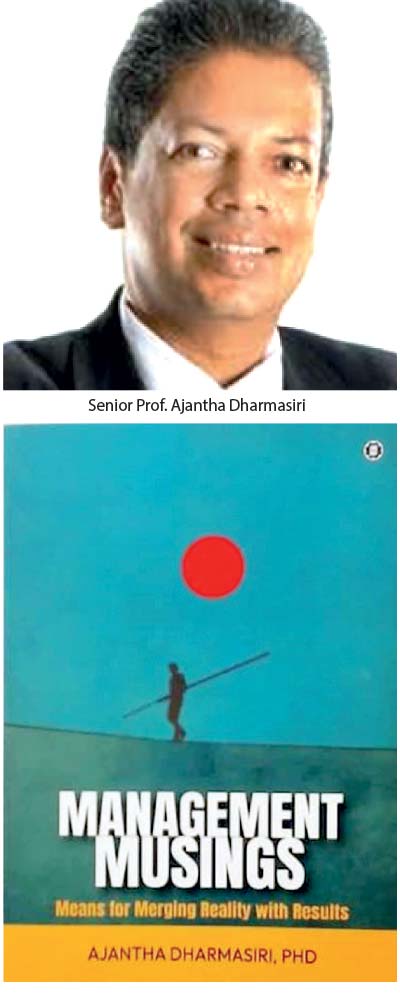
 Ajantha Dharmasiri, a senior professor at the Postgraduate Institute of Management (PIM) and a regular columnist for the Daily FT, has released his newest book titled Management Musings. It contains 30 newspaper articles he had penned from 2021 to 2023 on numerous management issues. This is his 17th publication overall. Dharmasiri has long been an active writer, public lecturer, and human resource expert. Having served as the Director of PIM for two consecutive terms and as the former President of the Chartered Institute of Personnel Management (CIPM) Sri Lanka, he is also a much-loved teacher by his students. This new publication successfully collects some of his most impactful public writings in print form, ensuring they are accessible to a wider readership in Sri Lanka and abroad.
The book offers a direct path toward addressing modern workplace challenges by moving beyond simple common sense into the realm of structured corporate achievements. Through his columns, Dharmasiri functions as a critical link between complex academic theories and the daily ground realities faced by practicing business managers. By compiling these pieces, he provides leaders with a practical handbook that translates everyday corporate situations into sustainable organisational results.
Deeply personal anchor: Family and mentorship
Dharmasiri has always been a dedicated family man who has remained deeply connected to his household throughout his professional career. The present book is intimately dedicated to his family members: his wife, his daughter, and his late son, who left him before attaining adulthood. This connection to family is by no means limited to those in the immediate domestic circle. Within the detailed acknowledgements of the book, he explicitly gives credit to his brothers, parents, and in-laws for shaping his character and making him the individual he is today. He reserves a profound amount of gratitude and particular credit for his late son, whose memory heavily influences his worldview.
In one of his specific articles, Dharmasiri names two distinct mentors who shaped his life path. The first is the late Prof. Uditha Liyanage, a highly respected ex-Director of PIM who directly supervised his doctoral research work. Professor Liyanage served as his traditional academic mentor, providing intellectual guidance, rigorous research standards, and professional direction. However, in the same breath, Dharmasiri gives immense credit to his late son for serving as a "reverse mentor"—a concept where the younger generation guides the older generation.
While reverse mentoring might seem like a strange type of relationship to traditionalists, it is increasingly common and highly necessary in our modern world, as Dharmasiri explains. Belonging to Generation X, he found himself being continuously guided by his son, who belonged to Generation Z. In all matters concerning rapid developments in Information and Communication Technology (ICT), digital media, and modern computing trends, it was his son who proudly served as his Guru.
This dynamic extended far beyond mere technical assistance. Says Dharmasiri: "I learnt how to be cheerful from him. He was always with a smile. This was repeatedly mentioned by his friends who came to pay their last respect. When I was stressful and tired, his warmth and cheerfulness was a relief for me."
Therefore, his son was not merely a technology guide, but a highly effective stress-beater during times of intense professional pressure. This candid admission of what he learned from his young child illuminates the deeply personal, vulnerable side of an otherwise authoritative academic figure. Yet, for many parents who raise children belonging to the new digital generation, this experience is entirely relatable. In a similar personal parallel, it was my own son who first introduced me to contemporary authors like Dan Brown, Michael Crichton, and Bill Bryson, proving that knowledge flow between generations is truly a two-way street.
Dharmasiri has demonstrated his humility and humbleness by admitting that he was a product of two mentors. On the academic side, it was the late Prof. Uditha Liyanage who fashioned him to a world class teacher and researcher. On the technical and personal side, his late son had guided him through the technological developments of the day and provided him with a powerful tool to address the challenges posed by a highly stressful world.
 Power of alliteration: Making complex systems memorable
A defining trait of Dharmasiri’s teaching career is his special skill in breaking down incredibly complex institutional systems into easily graspable terms. He does this by organising his frameworks using words that begin with the exact same letter of the alphabet. His postgraduate students have long noted that this systematic technique helps them visualise and remember the entire big picture involved in an otherwise overwhelming corporate framework. Ordinary readers will easily appreciate this stylistic tool, as it removes the dry, dense nature of typical business textbooks.
In the prologue to the book, he explains that his musings are designed to help a reader execute a four-step mental cycle: recognise, relate, reflect, and reinforce. First, a manager must recognise the unique personal features of diverse people in the workplace. Next, they must relate these basic concepts directly to the current operational challenges faced by their specific company. Following this, they are urged to reflect deeply on the core human struggles of managing performance, before finally reinforcing positive, professional behaviors across multiple operational fronts.
When addressing individuals who wish to pursue higher education, he presents another memorable alphabetical structure. He notes that a master's degree aspirant should strictly evaluate a business school based on seven key vectors: reputation, reliability, relevance, rigour, reach, response, and research. By analysing these criteria, an applicant ensures they are not just buying a credential but are training themselves to put Mind Before Action—offering a completely fresh, strategic meaning for the traditional MBA abbreviation.
This deliberate method is also visible when he addresses the topic of people management. An employer who genuinely wishes to look after their staff must concentrate on nine distinct operational behaviors, all beginning with the letter C:
1.‘Connecting’ authentically with the team on a regular basis.
2.Prioritising long-term ‘career’ development opportunities.
3.Establishing absolute ‘clarity’ of instructions to prevent workplace anxiety.
4.‘Conveying’ the clear message regarding institutional values and goals.
5.Consistently ‘congratulating’ on good work to maintain moral momentum.
6.Ensuring visible ‘contribution’ recognition so individual efforts are validated.
7.‘Controlling’ for consistency and conformance to keep operational quality stable.
8.Preserving the ‘credibility’ of the work standards across all departments.
9.Active ‘confidence’ inculcation in the employee to empower decentralised decision-making.
These structured frameworks serve as highly practical tools. Any manager wishing to improve their day-to-day operations can easily write these simple alliterative points on short notes and hang them around their bedroom mirror or office workstation as a constant mental reminder.
Through the steady publication of these collected essays, Dharmasiri succeeds in merging messy day-to-day corporate realities with clear business results. In the epilogue of the book, he introduces a timeless philosophical perspective by quoting the famous 19th-century French writer Alexandre Dumas, who famously observed that "All human wisdom is contained in these two words, wait and hope
Navigating the modern infodemic: Friend or foe?
During the height of the COVID-19 pandemic, the entire global population faced an identical problem: how could individuals at the micro level, nations at the macro level, and the international community at the global level successfully overcome a sudden catastrophe? While medical professionals worked on treatments, social media channels were deployed across the globe. Unfortunately, these networks were used both correctly to spread vital safety data and incorrectly to spread panic.
Dharmasiri highlights this modern crisis by utilising a specific term coined by the World Health Organisation (WHO): the oncoming surge of digital misinformation known as an 'Infodemic'. In his writing, he poses a fundamental question for our modern age: is this digital information explosion a friend or a foe?
He carefully breaks down the two sides of the issue. Accurate, timely information during a public health crisis acts as a vital friend, providing clear instructions that save lives, coordinate medical distribution, and lower public anxiety. Conversely, bad information, unverified rumors, and malicious conspiracy theories act as a dangerous foe, causing widespread public confusion, institutional distrust, and harmful risk-taking behaviour.
Dharmasiri correctly concludes that modern society must learn to screen its digital information flows with intense care. It is our collective responsibility to actively accept what is beneficial and systematically reject what is harmful. A digital foe can be converted into an educational friend, but that transformation depends entirely on our own media literacy and discipline.
This management lesson applies far beyond the historical boundaries of a global pandemic. In our everyday lives, we are continuously bombarded by false, altered, or highly exaggerated misinformation every single second. These notes are frequently pushed by interested parties, political actors, or commercial entities seeking to exploit our attention and guide us down the wrong path. Dharmasiri reminds us that it is our absolute personal duty to defend our minds from these well-orchestrated digital attacks.
Analysis of a popular teledrama in management perspective
A striking musing he has presented in his collection is the analysis of a popular Sinhala teledrama, Nadagamkarayo or Traditional Drama Folks, telecast for over one year. Management or economics is not a subject that is learned only through textbooks. Since both deal with human beings, they are related to the contemporary cultural and societal ethos. Any effective sustained learning should draw on examples from the critical evaluation of that ethos as presented in contemporary artwork. Dharmasiri has used this universal truth to teach us what management lessons could be learned from this particular drama. Obviously, he has singled out this drama due to its immense popularity among Sri Lankan TV viewers.
In the story, there is a young entrepreneur who had started his life as an illicit bootlegger. However, he changes himself through wise counsel of elders in the village. However, the Government officials who should support new businesses in the village have a totally apathetic approach to them. Says Dharmasiri: ‘The questionable support by the so-called Government officials towards the SMEs is realistically portrayed here. Among many inefficient and insensitive State officials, there was one Business Development Officer who went out of the way to help the four youngsters in going for a business registration, obtaining a bank loan, and purchasing of machinery and equipment. Ironically, she is harassed by another colleague who accused her of doing more to get a promotion’. To succeed in their new venture, they do a SWOT analysis, carefully analysing the Strengths, Weaknesses, Opportunities, and Threats to them on the advice of the Chief Incumbent of the Buddhist temple in the village.
This is where the management perspective comes to the picture.
This is the crude reality which Sri Lanka faces today. SME sector which accounts for about 50-60% of national wealth creation and an equal number of employment generation is given step-motherly treatment by the Government officials who are there to promote the same. That is one of the reasons for Sri Lanka to getting trapped in in eternal circle of poverty and economic stagnation. Dharmasiri has beautifully presented this stark truth which may not be palatable to those to whom it matters.
Management musings offered to you an assortment of serene sharing towards meaningfully engaging the precious human resources with care and clarity. It is a matter of envisioning the future and endeavouring to make it a reality. The twin challenge of employee wellbeing and enterprise progress can be balanced by ensuring humane results. With clarity of purpose and commitment in action we should strive for excellence as essence
Merging reality with results: A guide for modern leaders
Through the steady publication of these collected essays, Dharmasiri succeeds in merging messy day-to-day corporate realities with clear business results. In the epilogue of the book, he introduces a timeless philosophical perspective by quoting the famous 19th-century French writer Alexandre Dumas, who famously observed that "All human wisdom is contained in these two words, wait and hope."
This observation serves as a vital lesson for contemporary corporate executives who often operate under the pressure of immediate deadlines. The management guru advises leaders that they must not simply jump to instant conclusions when an unexpected crisis emerges. Instead, a wise leader waits patiently until the smoke created by an explosive corporate situation completely dissipates, allowing them to view the entire picture with an objective mind.
In the epilogue, Dharmasiri beautifully summarises the core purpose of his essays, offering a long-term vision for the future of professional leadership:
He says: "Management musings offered to you an assortment of serene sharing towards meaningfully engaging the precious human resources with care and clarity. It is a matter of envisioning the future and endeavouring to make it a reality. The twin challenge of employee wellbeing and enterprise progress can be balanced by ensuring humane results. With clarity of purpose and commitment in action we should strive for excellence as essence."
This final perspective encapsulates the lifelong teaching philosophy of a scholar who has trained thousands of business students. By focusing heavily on the human element, ensuring absolute clarity of purpose, and practicing patience during chaotic times, Management Musings provides an enduring blueprint for any leader striving to bridge the gap between initial corporate reality and ultimate organisational results.
(The writer, a former Deputy Governor of the Central Bank of Sri Lanka, can be reached at [email protected])




