Saturday Oct 03, 2026
Saturday Oct 03, 2026
Tuesday, 2 December 2025 03:01 - - {{hitsCtrl.values.hits}}
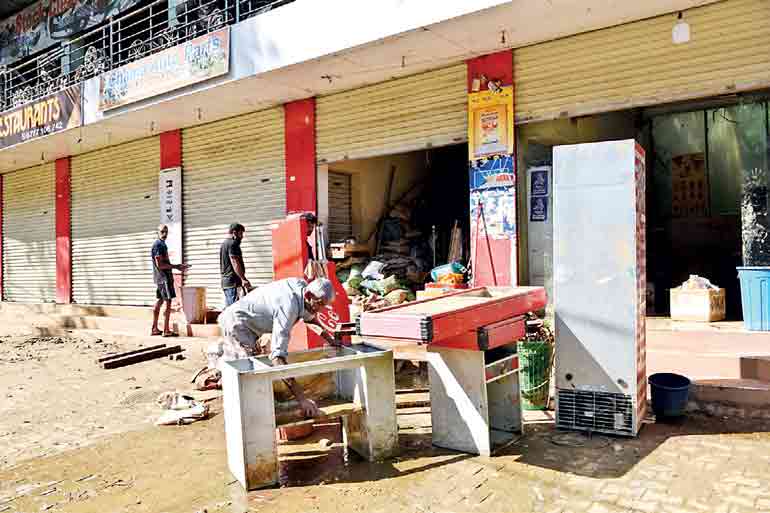
Traders busy restoring their stores impacted by the Cyclone Ditwah in the Central Province - Pic by Shehan Gunasekera
 When Cyclone Ditwah swept across Sri Lanka with days of torrential rain, floods and landslides, the first focus—rightly—was on saving lives. With over 350 deaths, nearly 400 missing, and over 1 million people affected, the country is in the grip of one of its worst disasters in years.
But once the waters recede and media attention moves on, another crisis will remain: the quiet, grinding collapse of thousands of micro, small and medium enterprises (MSMEs) that form the backbone of Sri Lanka’s economy.
MSMEs account for more than 90% of all enterprises in Sri Lanka, contribute around 52% to GDP and provide roughly 45% of employment. Yet this same sector has already been hammered by a series of shocks: the COVID-19 pandemic, the 2022–23 economic crisis, high inflation and interest rates, and a sluggish global environment for exports. Cyclone Ditwah and the associated flooding now threaten to push many of these businesses beyond recovery.
In this context, the key question for Government and policymakers is clear: What must Sri Lanka do—quickly and strategically—to keep MSMEs alive, help them recover, and make them resilient to future climate disasters?
1. Why MSMEs matter for disaster recovery
The importance of MSMEs is already well recognised in national policy. The National SME Policy Framework describes SMEs as the “backbone” of the economy in terms of employment, regional development and inclusive growth. Central Bank reports and recent studies also emphasise that MSMEs are critical for innovation, supply-chain linkages and as breeding grounds for future large firms.
In a post-disaster setting, MSMEs play several additional roles:
For a country already navigating a difficult IMF-supported stabilisation path, letting MSMEs fail after this disaster would undermine both economic recovery and social cohesion.
If Sri Lanka fails to act decisively, the human and economic losses from this disaster will continue to compound long after the floodwaters have receded. But if policymakers seize this moment to protect and empower MSMEs, the country can convert a period of tragedy into a turning point—towards a more resilient, inclusive and climate-ready economy.
2. The specific vulnerabilities of MSMEs in this disaster
Most MSMEs in Sri Lanka entered this climate crisis already weakened. Surveys during and after COVID-19 showed sharp revenue falls, depleted savings, and limited access to formal finance for MSMEs. The subsequent economic crisis intensified these pressures through currency depreciation, high interest rates and supply disruptions.
Cyclone Ditwah and the heavy rains have exposed several structural vulnerabilities:
1.Physical damage to assets and stocks
Many micro and small firms operate from low-lying areas—near rivers, roadsides and dense urban settlements. Floods destroy machinery, inventory, vehicles and business premises. Few of these enterprises carry comprehensive insurance, and even fewer have digital backups of records or data.
2.Cash-flow collapse and liquidity stress
When a business cannot operate for weeks, fixed costs continue: rent, electricity (where still payable), loan instalments and staff wages. For MSMEs already servicing high-interest loans, even short interruptions can tip them into default.
3.Limited insurance and risk-pooling mechanisms
Although Sri Lanka has a legal framework for disaster management and compensation under the Disaster Management Act No.13 of 2005, existing schemes focus more on households and infrastructure than on small businesses. Compensation ceilings for destroyed houses are modest, and there is no comprehensive nationwide mechanism specifically tailored for MSME asset losses.
4.Debt overhang from previous crises
Many MSMEs took on additional borrowing during COVID-19 and the 2022–23 crisis, often through emergency facilities or informal lenders. These legacy debts now limit their capacity to borrow again for reconstruction.
5.High informality and weak documentation
A large share of micro-enterprises operate informally or semi-formally, without proper registration, financial statements or tax files. This makes them invisible to formal relief programmes, bank lending schemes, and even Government data systems.
Given these vulnerabilities, “business as usual” policy responses will not be enough. Sri Lanka needs a targeted, three-phase package for MSMEs: emergency relief, recovery finance, and long-term resilience.
3. Phase One – Immediate relief: Keeping MSMEs alive
3.1 Rapid, targeted grant support
The first priority is to prevent viable MSMEs from closing permanently in the next three to six months.
International partners—such as the ADB, World Bank, UN agencies and bilateral donors—can co-finance such grants, aligning them with ongoing private-sector and climate-resilience programmes.
3.2 Temporary tax relief and administrative easement
The tax system can be a powerful shock absorber if used intelligently:
Such measures would not permanently reduce the tax base but would give breathing space to businesses and protect future revenue streams.
Sri Lanka is once again reminded that climate disasters are not temporary interruptions—they are a permanent feature of our economic landscape. For a country where MSMEs form the lifeblood of local economies, employment and social stability, their collapse would deepen national vulnerability and reverse the hard-won gains of recent stabilisation efforts. This moment demands more than short-term relief; it calls for a decisive national commitment to rebuild, protect and future-proof the MSME sector
3.3 Moratoriums and regulatory flexibility from the financial sector
The Central Bank and the banking sector have previously introduced moratoriums and special credit lines during COVID-19 and the economic crisis. A similar—but better targeted—approach is needed now:
These measures would prevent a wave of defaults and preserve the financial system’s willingness to lend to MSMEs during the recovery phase.
4. Phase Two – Recovery: Financing reconstruction and adaptation
Once immediate survival is secured, MSMEs need support to rebuild better, not simply return to their previous vulnerable state.
4.1 Concessional “build-back-better” credit lines
Government, in partnership with development partners and state banks, should introduce dedicated concessional credit lines for MSMEs in affected regions, with features such as:
Priority could be given to investments that reduce future risk—such as relocating facilities away from high-risk zones, adopting flood-resistant construction, or investing in renewable energy systems that also lower operating costs.
4.2 Public procurement as a recovery tool
Government is the largest single buyer in the domestic economy. It can use procurement to channel demand toward affected MSMEs:
This approach simultaneously accelerates infrastructure repair and injects revenue directly into affected local economies.
4.3 Business development, advisory and digitalisation support
Finance alone is insufficient. MSMEs also need knowledge and networks:
5. Phase Three – Building long-term climate resilience into MSME policy
Climate-related disasters are no longer isolated events; they are part of the “new normal”. Sri Lanka already has a Disaster Management Act and a National Policy on Disaster Management, which call for comprehensive planning across all ministries and agencies. However, MSMEs have not been at the centre of this framework.
A forward-looking strategy should include:
5.1 Integrating MSMEs into national disaster-risk planning
5.2 Developing affordable insurance and risk-sharing mechanisms
Traditional insurance products are often too complex or expensive for micro and small enterprises. Sri Lanka can explore:
Sri Lanka can convert this crisis into a platform for renewal. If policymakers act with urgency, coordination and vision, the MSME sector can emerge not only restored, but stronger, greener and better equipped to withstand the storms of the future—ensuring that national recovery is both inclusive and sustainable
5.3 Promoting green and climate-resilient MSME investment
The next phase of Sri Lanka’s growth must be both climate-smart and inclusive:
5.4 Strengthening data, coordination and accountability
Effective policy requires good information and coordination:
6. Protecting the most vulnerable within the MSME ecosystem
Any MSME strategy must pay particular attention to:
Government can link MSME relief measures with broader reforms in social protection—such as better targeting under programmes like Aswasuma—to ensure self-employed and micro-enterprise workers are not excluded from basic safety nets in future disasters.
7. A call for a “disaster-resilient enterprise compact”
Sri Lanka stands at a crossroads. Cyclone Ditwah has exposed not only physical vulnerabilities in infrastructure and settlements, but also institutional and economic vulnerabilities in the way we support our smallest businesses.
What is needed now is a “disaster-resilient enterprise compact”—a clear, time-bound agreement between Government, the financial sector, development partners, and the business community to:
If Sri Lanka fails to act decisively, the human and economic losses from this disaster will continue to compound long after the floodwaters have receded. But if policymakers seize this moment to protect and empower MSMEs, the country can convert a period of tragedy into a turning point—towards a more resilient, inclusive and climate-ready economy.
Sri Lanka is once again reminded that climate disasters are not temporary interruptions—they are a permanent feature of our economic landscape. For a country where MSMEs form the lifeblood of local economies, employment and social stability, their collapse would deepen national vulnerability and reverse the hard-won gains of recent stabilisation efforts. This moment demands more than short-term relief; it calls for a decisive national commitment to rebuild, protect and future-proof the MSME sector. By combining rapid financial support, smart tax and regulatory easing, targeted recovery financing, and a long-term resilience agenda rooted in climate adaptation and digital transformation, Sri Lanka can convert this crisis into a platform for renewal. If policymakers act with urgency, coordination and vision, the MSME sector can emerge not only restored, but stronger, greener and better equipped to withstand the storms of the future—ensuring that national recovery is both inclusive and sustainable.
(The writer holds an MBA (UK), FCA (SL), FCMA (UK), FCPA (Aust.), CMA (Aust.), FCMA (SL), MCPM (SL), CGMA (GLOBAL) and is Chartered Accountant, Tax and Management Consultant. He can be reached via: [email protected]/www.agsarma.com.)



