Saturday Oct 03, 2026
Saturday Oct 03, 2026
Friday, 20 March 2026 00:22 - - {{hitsCtrl.values.hits}}
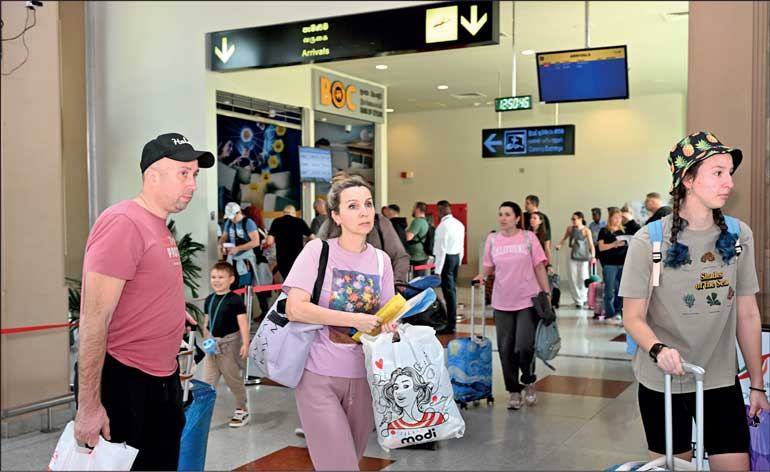
 Amid global disruption, Sri Lanka’s tourism recovery will depend less on demand generation and more on how effectively the country secures and manages its air connectivity and operational stability.
Sri Lanka’s tourism industry, which entered 2026 with strong momentum and renewed confidence, is once again facing an external shock—this time driven not by domestic instability, but by global geopolitical disruption.
The ongoing Middle East conflict, combined with aviation uncertainty and emerging fuel constraints, has already begun to impact arrivals, operations, and industry sentiment. The question before us is no longer whether tourism will be affected, but how deeply and how strategically we respond in the coming month.
A sudden disruption to growth
After a promising start to the year, the industry is now witnessing a noticeable slowdown. Early indicators point to a sharp decline in arrivals, accompanied by increasing cancellations and shorter booking windows.
This is not simply a weakening of demand. It is a disruption of access.
A significant share of Sri Lanka’s inbound traffic is routed through Middle Eastern hubs such as Dubai and Doha. With airspace instability, flight disruptions, and rising travel uncertainty, the country’s accessibility has been directly compromised.
For an island destination, access is everything. When access is disrupted, demand alone cannot sustain performance.
Compounding pressure: Energy and perception
At the same time, Sri Lanka’s structural dependence on imported fuel is beginning to exert additional pressure.
Global energy supply disruptions have translated into higher operating costs, logistical uncertainty, and concerns around continuity of services. Even the perception of instability—whether accurate or not—has a direct bearing on travel decisions.
Tourism, more than most industries, is highly sensitive to confidence. And confidence, once shaken, takes time to rebuild.
What the next six months will bring
If the current geopolitical situation persists, the industry must prepare for a period of continued volatility rather than a sharp decline.
We are likely to see:
This is not a collapse scenario, but it is undoubtedly a contraction phase that requires careful navigation.
In today’s environment, tourism is not constrained by demand—it is constrained by access.
Aviation strategy: The single most critical lever
At the heart of this disruption lies a fundamental issue—connectivity.
Sri Lanka’s reliance on Middle Eastern transit hubs has exposed a structural vulnerability that can no longer be overlooked. With nearly one-third of inbound travellers dependent on these routes, the current crisis has effectively highlighted that tourism performance is now directly linked to aviation stability.
In this environment, aviation is no longer a supporting function of tourism. It is the primary determinant of recovery.
Protect what we have before we seek expansion
The immediate priority must be to protect and sustain existing direct air connectivity, particularly from key European markets such as the United Kingdom, Germany, and France.
These routes, which bypass the Middle East, have now become strategically invaluable. Losing even a single frequency would disproportionately affect high-value segments, including long-stay leisure travellers and wellness-focused guests.
A coordinated effort between airlines, tourism authorities, and the private sector is therefore essential to maintain these lifelines through demand stimulation, joint promotions, and targeted support where necessary.
From passive dependence to active strategy
Sri Lanka can no longer afford a passive approach to air connectivity.
A proactive air service development strategy is required—one that includes incentivising airlines, supporting charter operations, and engaging in risk-sharing mechanisms during periods of uncertainty.
Destinations that actively support airlines during disruption are the ones that retain—and ultimately expand—connectivity.
Repositioning around direct access
In a disrupted aviation landscape, Sri Lanka has a unique opportunity to reposition itself.
The narrative must evolve to highlight the country as a destination that is accessible without reliance on unstable transit corridors.
This is particularly relevant for European travellers seeking reliability, shorter travel times, and reduced risk. Marketing efforts must therefore focus on cities with direct or near-direct access, rather than broad, unfocused campaigns.
Leveraging Charter opportunities
While scheduled airline expansion may be constrained in the short term, charter and hybrid flight models offer immediate potential.
Tour operators in Europe are already seeking stable alternatives. Sri Lanka must move decisively to facilitate charter programs, align product offerings with flight capacity, and provide the necessary support to ensure commercial viability.
These initiatives can serve as a bridge until scheduled capacity stabilises.
A national-level imperative
Aviation strategy must be driven at a national level with urgency and coordination.
This requires:
In aviation, capacity lost today is difficult to regain tomorrow.
The current crisis is accelerating a broader shift from hub-dependent travel toward more direct, point-to-point connectivity.
Sri Lanka must recognise and adapt to this shift—not as a temporary adjustment, but as a long-term strategic direction.
While aviation forms the backbone of recovery, parallel action is required at the industry level.
Greater emphasis must be placed on short-haul and regional markets, particularly India, which offers both scale and resilience.
This is not the time for aggressive discounting. Value-added packages and experiential offerings must take precedence over price reductions.
Performance-driven digital marketing, customer retention, and direct booking channels must be strengthened to reduce dependency on intermediaries.
Local tourism and corporate demand can provide critical support during periods of international volatility.
Cost control measures must be implemented with discipline, without compromising the guest experience.
A defining moment for Sri Lanka tourism
Sri Lanka’s tourism industry has repeatedly demonstrated resilience in the face of adversity.
What makes the current situation different is that the disruption is external, structural, and largely beyond our control.
However, our response is entirely within our control.
This is not simply a challenge—it is a test of strategic agility.
Destinations that act quickly will capture displaced demand. Those that hesitate will lose ground.
Conclusion
The next six months will be demanding.
Arrivals will fluctuate, costs will rise, and uncertainty will persist.
Yet within this disruption lies a clear opportunity.
If Sri Lanka can secure its air connectivity, protect its value proposition, and respond with clarity and coordination, it can not only withstand this period—but emerge stronger and more strategically positioned.
Because in today’s environment, one fact stands above all:
It is not demand alone that drives tourism recovery—
it is access.
Sri Lanka’s tourism future will not be determined by global events alone, but by the speed and seriousness of its own response. Continued delays in aviation policy, weak coordination between key authorities, and the absence of a clear market prioritisation strategy are risks the country can no longer afford. In a rapidly shifting global landscape, inaction is not neutrality—it is decline.
(The author is a senior hotelier with over four decades of leadership experience in Sri Lanka’s tourism and hospitality sector)



