Monday Oct 12, 2026
Monday Oct 12, 2026
Thursday, 4 June 2026 00:26 - - {{hitsCtrl.values.hits}}
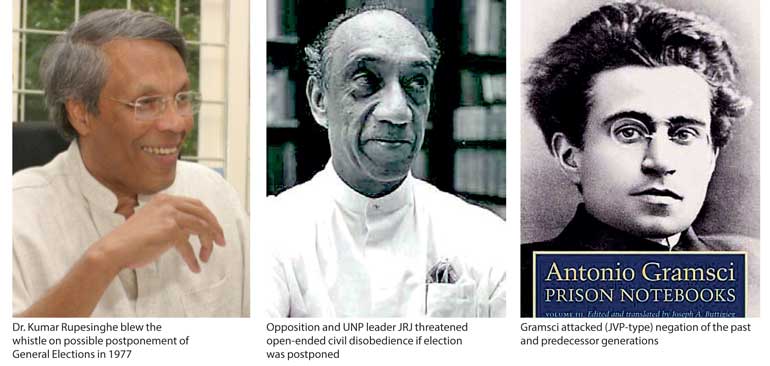
“A generation can be judged by the same standard it applies to the previous generation; a historical period can be judged by its way of looking at the period that preceded it.”
Antonio Gramsci
 The central contradiction within Sri Lankan politics in general and the Opposition spectrum in particular is almost accidentally illumined by the Political Commentary of our sister paper the Sunday Times.
The contradiction revealed is that between, on the one hand, the deadly, systemic danger evident in the publicly articulated intentionality of the JVP-NPP administration, and on the other, the supine silence on the subject, of the Opposition from right to left.
I’m not referring to the obvious effort to postpone indefinitely the Provincial Council election—doubtless due to the Government’s well-founded fear of a sweeping defeat—despite the availability of a wide-ranging consensus on a strictly ‘one time only’ by-pass of the logjam. The Opposition parties and groupings have spoken out on the matter, though they have typically not decided on a united campaign to restore the use of the franchise to this third (provincial) tier of the political system.
What I am referring to is the dangerous anti-democratic implications of public declarations, not by young hot-heads at the JVP’s base but starting from the very top, the President himself, which the ST Political Commentary has commendably tracked.
…“This Government can’t be shaken for decades,” were the President’s words when he addressed an event in Matara this week…The President wasn’t the only NPP member who feels that the party is poised for decades of rule.
NPP Parliamentarian Padmasiri Bandara caused a stir this week when he said the Government needs to be in power for at least twenty years to achieve the objectives of the party’s election manifesto titled ‘A Thriving Nation, A Beautiful Life’. “China has had the same Government for more than 60 years, Cuba for over 70 years and Viet Nam for over 55 years. We also need a long term in office to achieve our objectives contained in our manifesto,” he said.
This is not the first time such sentiments have come from the JVP/NPP side. JVP General Secretary Tilvin Silva, after a visit to China in August last year…[said]:
“In China, there is one party in power, which has its advantages. It allows them to work towards one plan and one policy. If we in Sri Lanka start making changes now but lose power in five years, everything we began could be undone by the next Government. To achieve real change, we need at least 15 to 20 years — maybe even four consecutive election victories — to follow through on a single vision,” the JVP General Secretary said in an interview on a YouTube channel following his China visit…’
When the leaders of the JVP, a party with a history of totalitarian intolerance and untrammelled violence of which the parties of the Opposition have been at the receiving end, make such remarks, one would reasonably assume that the Opposition would collectively sit up and take notice. But all we hear is ‘The Silence of the (Opposition) Lambs’.
Securing elections-1977
This contrasts starkly with the UNP in Opposition in the 1970s when there was some kite-flying in 1976 about a postponement of elections due in 1977 (earlier due in 1975). Senior SLFP Minister T.B. Illangaratne opined publicly that since Madam Bandaranaike as the leader of Sri Lanka had been elected the Chairperson of the Non-Aligned Movement (NAM), and was by extension “the leader of two-thirds of humanity”, elections should be postponed to coincide with her three-year term of office. He was echoed by D.M. Jayaratne.
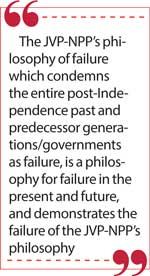
The reaction was swift and sharp. UNP deputy leader Premadasa turned “two-thirds leader” into a Sinhala wisecrack with a salacious subtext (“thunen dekay naaikaava”), generating howls of derisive laughter from audiences. Opposition Leader J.R. Jayewardene pledged publicly that if any such move is attempted, the UNP’s Satyagraha campaign inaugurated in 1973 against the burdens heaped on the masses in the context of the OPEC oil price shock, would be transformed into an open-ended campaign of peaceful civil protest.
Dr. Kumar Rupesinghe, LSE-educated sociologist, Maoist, leader of the Government’s pro-China Janavegaya faction, and son-in-law of Prime Minister Sirimavo Bandaranaike, arose wordlessly from the family dining table at Rosmead Place aghast at the speculation he had just been hearing about possible scenarios, drove late-night to the printing press of his newspaper ‘Janavegaya’ and switched the headline to one that screamed about a plot to postpone elections. He followed it up by calling on Opposition Leader J.R. Jayewardene at Ward Place and alerting him to what was being discussed. Kumar’s (ultimate) fidelity to the principle of democracy cost him his marriage. Mahinda Rajapaksa found him an annexe for rent and took him there with his belongings crammed into Mahinda’s car. 
In the meantime, the island’s Second Aragalaya was brewing, the first being Hartal 1953, the third being Galle Face 2022. In 1976, the students of Peradeniya University were demonstrating against the intrusive security measures implemented by a tough Vice-Chancellor, Prof. Vithanage, a favorite of Prime Minister Bandaranaike but supported also by the UNP on campus. Totally unwarranted shooting by the Police resulted in the death of Arts Faculty freshman Weerasooriya (my batchmate) and the universities boiled over with undergraduates streaming down from the Hanthana hills to all their old schools and mobilising students in an islandwide protest spilling out from classrooms onto the streets—the 50th anniversary of which falls this year.
Trade union agitation that had been sparking since 1974 with an all-island one-day token general strike and a prolonged work stoppage at the Government Printers, took hold in a Railway strike by an independent union (‘Dumriya Seva Ekamuthu Sangamaya’) led by a veteran leftist agitator Olwin Rathnapala who had transported hand-bombs during the August 1953 Hartal. The railway strike mushroomed into a General Strike and converged with the islandwide student uprising which had erupted at Peradeniya. Under pressure from its base, the Communist Party split from the Government, depriving it of the two-thirds majority necessary for any adventure such as postponement of scheduled elections.
UNP student leader of that day Imthiaz Bakeer Markar recounts how J.R. Jayewardene was mildly reproving but Deputy Leader R. Premadasa enthusiastically endorsed and actively assisted the struggle by funnelling to the agitating students of all political-ideological shades, copious amounts of poster paper, tins of paint and pots of homemade paste.
The lessons for today are obvious. Free and fair elections on schedule in 2029 necessitate the social unrest that will probably arise in 2027-2029 against the onerous repayment of private foreign debt and austerity imposed by constricting IMF programs. As in the 1970s, the economic crisis will erode the base of an arrogant, authoritarian Government. The only path to the full reopening of democratic space and timely exercise of the democratic franchise is that of struggle, of democratic resistance by the citizenry—robustly supported by the Opposition.
Hardwired for failure
The JVP-NPP project is already in crisis, flailing about and failing, and will have exhausted itself by 2029. This is due not so much to the superficial reason adduced by the centre-right and new right: ‘they are Marxists, or were Marxists, and do not know how to manage the economy’.
The JVP-NPP is fated to fail because of deeper basic factors. Not having ‘right mindfulness’ (The Buddha) and cultivating its opposite instead; having taken a wrong stance on the wrong ground, the JVP will fail and suffer defeat for the third time. Without ‘right-mindfulness’, the cycle of political karma inevitably catches up. Or as Vietnam’s General Giap warned “if you try to override the objective laws of development of phenomena, the objective laws will override you.”
Antonio Gramsci noted that just as in military warfare one must attack the enemy’s weakest point, which by definition is a secondary one, in the battle of ideas one must do the opposite: identify and attack the strongest point; the main one. What is the foundation on which Anura Dissanayake’s JVP-NPP won, and his administration stands? The strongest point of AKD-JVP-NPP’s ideological dominance of the public mind, is the repeated assertion that:
 The decades since Independence on 1948, under the leadership of earlier generations belonging to a bipartisan elite, have been a long-term failure; a decline, decay and degeneration resulting cumulatively in the current crisis.
Apart from progressive individual strivings which are exceptions, nothing positive in a macro sense has been achieved, and even if it has, it has been dwarfed by the larger systemic failure caused by corruption.
The entire period of 76 years since Independence (1948-2024, when the JVP-NPP won) has on balance been a negative achievement, a failure.
The present JVP-NPP Government has to struggle because it is shouldering the massive burdens of that failure of its predecessor generations.
From 1948 to 2024 we have experienced rampant corruption and systemic failure culminating in bankruptcy, and 2024 was Year Zero, with AKD and the JVP-NPP inheriting a wasteland, having to start from scratch and embarking on an upward climb.
It is not my intention to counter this ‘master-assertion’ with empirical argumentation. My critique is far more fundamental and ‘global’ i.e., total in character.
My perspective is hardly original and derives from a few concentrated paragraphs in a classic work described by famed cultural philosopher Fredric Jameson as nothing less than “one of the fundamental texts of modern thought”, namely the Prison Notebooks of Antonio Gramsci, the finest political thinker-philosopher of the 20th century.
I earnestly request my readers to read, digest and assimilate the extended quote below.
‘Past and Present. A generation can be judged by the same standard it applies to the previous generation; a historical period can be judged by its way of looking at the period that preceded it. A generation that devalues the previous generation and is incapable of recognising its great achievements and its essential significance is bound to be mean and lacking in self-confidence, even if it displays gladiatorial postures and a craving for greatness. It is usually the type of relationship between a great man and his valet. Pretend to have been abandoned in order to arise and distinguish oneself. A strong and vital generation that intends to work and assert itself is inclined, rather, to overestimate the previous generation because its energy gives it the confidence that it will go even further; simply vegetating is already an improvement on what I portrayed as dead.
The Past is blamed for not having accomplished the task of the present: how much more convenient it would be if the parents had already done the work of their children. Implicit in the devaluation of the past is a justification of the insignificance of the present: who knows what we would have achieved had our parents done this or that…but they did not, and so we have not done more. Is a garret on the ground floor any less of a garret one on the tenth floor or the thirtieth? A generation that knows only how to make garrets complains that its predecessors had not already built ten-or thirty story buildings. You say that you are capable of building cathedrals but you are not able to build anything but garrets.
Contrast with the Manifesto that praises the greatness of the moribund class.’
[Notebook 8, No 17, ‘Past and Present’, Antonio Gramsci Prison Notebooks, Vol III, Columbia University Press, New York, pp.243-244.] 
Gramsci’s seemingly casual remark about “the type of relationship between a great man and his valet” is no aside but is an underscoring of his critical contempt towards a generation that devalues the preceding ones—and a moral-ethical condemnation of such a prejudiced successor generation. The common phrase about ‘a great man and his valet’ is used to make an indelible point about comparative perspective by the great German philosopher GWF Hegel and figures in the latter’s The Philosophy of History. The accompanying footnote in Gramsci’s Prison Notebooks quotes Hegel:
‘… “No man is a hero to his valet-de-chambre” is a well-known proverb; I have added—and Goethe repeated it ten years later—“but not because the former is no hero, but because the latter is a valet”...’ —GWF Hegel, The Philosophy of History
Gramsci’s critique and condemnation is a perfect description of the JVP-NPP archetype:
‘A generation that devalues the previous generation and is incapable of recognising its great achievements and its essential significance is bound to be mean and lacking in self-confidence, even if it displays gladiatorial postures and a craving for greatness. It is usually the type of relationship between a great man and his valet.
‘… The Past is blamed for not having accomplished the task of the present…’
‘You say that you are capable of building cathedrals but you are not able to build anything but garrets.’
His description of a generation capable of great tasks is the exact opposite of the JVP-NPP:
‘A strong and vital generation that intends to work and assert itself is inclined, rather, to overestimate the previous generation because its energy gives it the confidence that it will go even further...’
The very fact that the JVP-NPP uses the core ideological argument of ‘76 wasted/lost years’ and adopts a corresponding attitude and outlook, damns it several times over.
Its nihilistic negativism reveals hollowness.
It proves itself incapable of rational, balanced evaluation, and ignorant of past achievements—without the deep study of which no progress is possible.
Its attitude of resentment towards and scapegoating of the past and generational predecessors exposes it as qualitatively inferior to those predecessors (“a great man and his valet”).
Gramsci’s reference in the final standalone sentence of the quoted Notebook entry to the Communist Manifesto of Marx and Engels is instructive. The Manifesto is almost lyrical in its recounting of the achievements of capitalism, the very system it sees as the mortal enemy to be overthrown. This enabled them to envisage socialism as the successor to capitalism which would fulfil the potential unleashed but unrealised by capitalism. Communists would build on the achievements of capitalism and fully realise its potentials while superseding and transcending capitalism.
That’s certainly not the JVP-NPP, which sees no achievements of Lankan capitalism and ‘bourgeois’ or ‘elite’ governments which they would build on and surpass. Thus, they themselves have no real material achievements, and are incapable of them. They look at the past and see nothing but corruption by elites. In reality they cannot come even remotely close to the achievements of their predecessors. “…You say that you are capable of building cathedrals but you are not able to build anything but garrets.” (Gramsci)
Sri Lanka will have to pick up on the post-Independence achievements and move forward. We shall have to go back, so as to go forward. Going back will actually be going forward from where we’re stranded.
The JVP-NPP’s philosophy of failure which condemns the entire post-Independence past and predecessor generations/governments as failure, is a philosophy for failure in the present and future, and demonstrates the failure of the JVP-NPP’s philosophy.




