Wednesday Sep 09, 2026
Wednesday Sep 09, 2026
Wednesday, 9 September 2026 00:24 - - {{hitsCtrl.values.hits}}
 (Reference Article by Prof Asoka Seneviratne - https://www.ft.lk/columns/Budget-2027-From-stabilisation-to-transformation/4-795067#)
Introduction
Whilst appreciating and endorsing Prof. Asoka Seneviratne’s thoughts on transforming the SL economy and ideas for the Government to consider in formulating the next budget, I would like to focus on some practical issues that this entails, as well as elaborate on some proposals that have already been implemented, constrains faced and what changes are required.
If Budget 2027 embraces those three national missions espoused in Prof. Asoka’s article: raising productivity, mobilising investment, and improving living standards, that would indeed create a structural foundation upon which Sri Lanka can build a stronger, more resilient, and more prosperous nation, with sustainable growth rates above 7% being a more realistic aspiration.
The purpose of this article is to show that some of the proposed measures in Prof Asoka’s article have already been thought of and implemented since this Government attained office and some of them face constraints and will take time to be fully implemented. Prof. Asoka’s article made many recommendations for budget 2027, all excellent. In Part 1 of my article, only ‘Digitalisation’ and ‘Modernisation of Agriculture’ will be discussed, to keep this article as short as possible. Comparatively, In Part 2, I will address the others. Digitalisation appears to be doing much better of the two, hence Agriculture will be focussed on as a priority matter with respect to productivity improvement.
Raising productivity via digitalisation
Digitalisation
Since taking office in late 2024, President Anura Kumara Dissanayake’s Government has made digital transformation one of its flagship reforms. Progress varies by sectors mentioned: Energy, Agriculture and Agri Businesses, Industrial, Institutional and Digital Governance, Education and Human Capital, Trade and Logistics.
All four of the areas mentioned below are being implemented, with some achieving substantial progress compared to others.
1. Land registries
This project is well underway. The Government has announced plans to digitise land records and modernise the land administration system. The objectives are to:
This is a major undertaking because many land records date back decades and exist in different formats across Land Registry offices. The project is therefore expected to take several years rather than months.
2. Customs clearance
This is one of the Government’s highest priorities because customs efficiency directly affects exports, imports and tax revenue.
Current reforms include:
The long-term aim is to reduce cargo clearance from several days to a matter of hours for compliant importers. This builds on earlier customs modernisation work but has received renewed emphasis under the current administration.
This project has made good progress, about 60%.
3. Tax administration
This is arguably the most advanced of the four reforms because it is closely tied to the IMF program. Recent improvements include:
The emphasis has shifted from simply increasing tax rates to improving tax collection through better administration and digital systems. Tax revenues have increased substantially as compliance has improved.
This project is reported to be well advanced, about 80%.
4. Business licensing
The Government has begun simplifying business approvals by:
The broader objective is to improve Sri Lanka’s attractiveness to investors by reducing regulatory delays and increasing transparency.
This project has progressed only moderately, about 50%.
Broader digital Government program
These reforms are part of a wider strategy that includes:
Raising productivity via modernising agriculture
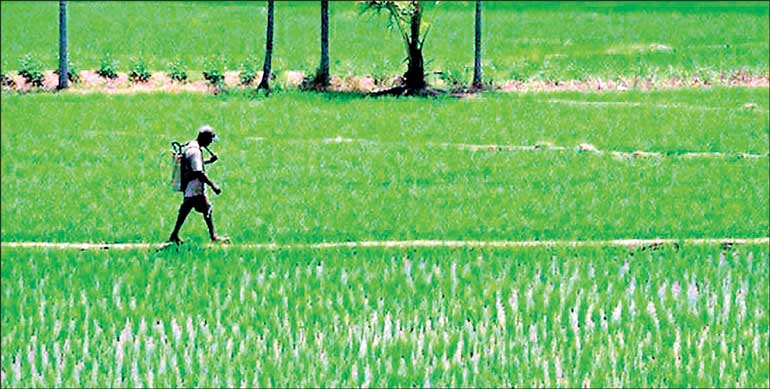
There is growing evidence that the NPP Government is moving in that direction, although implementation is still in its early stages. The policy emphasis has shifted from simply supporting production to improving productivity, value addition and commercialisation.
Several initiatives align closely with the reforms Prof. Asoka’s article outlined, as indicated below:
1. Agricultural modernisation has become official Government policy.
In 2024, Cabinet approved an Agriculture Sector Modernisation Program aimed at:
This is a significant departure from traditional subsidy-based policies.
2. 2026 Budget contains several productivity-focused measures
Rather than focusing solely on fertiliser support, the budget includes funding for:
These investments are designed to reduce post-harvest losses, improve market access and stabilise food prices.
3. Government is encouraging agricultural technology
The Department of Agriculture is actively promoting:
There are also Government announcements describing co-funding for smart irrigation and drone technology, although the scale of these programs is still modest.
4. Rural poverty reduction is explicitly linked to agricultural transformation
President Anura Kumara Dissanayake has publicly stated that agriculture should contribute much more to economic growth and that the sector’s transformation is central to reducing rural poverty. He has also emphasised improved data systems, stronger project implementation and developing livestock as a modern industry.
What is still missing?
Despite these positive signals, several important reforms have yet to be fully addressed.
These include:
Without these reforms, modernisation may improve yields but fall short of creating a highly competitive agribusiness sector.
What needs to be done
The Government’s diagnosis of the problem is largely correct, but its solutions are currently incremental rather than transformative.
The policies announced so far resemble modernising traditional agriculture rather than restructuring the agricultural economy.
If Sri Lanka wants agriculture to contribute 12–15% of GDP with perhaps 12-15% of the workforce, as has occurred in many successful middle-income economies, it will likely need broader reforms, including:
That would represent a much more ambitious structural transformation. Based on the Government’s last Budget, cabinet decisions and public statements, the current agenda can be categorised as a genuine move toward agricultural modernisation, but not yet a full transition to a high-productivity commercial agribusiness model. The direction is encouraging, but the pace and breadth of reform will determine whether Sri Lanka can substantially lift rural incomes and narrow the long-standing productivity gap between agriculture and the rest of the economy.
What are the constraints faced by Government?
The constraints appear to be a combination of fiscal, political, institutional and structural factors rather than a lack of understanding of what needs to be done. In fact, many of the reforms discussed by the current Government are also recommended by the World Bank, International Monetary Fund and the Asian Development Bank.
Here’s how the main constraints could be ranked:
1. Fiscal constraints (High)
Sri Lanka is still recovering from the 2022 economic crisis. The Government has limited fiscal space because it must maintain debt restructuring commitments, generate primary budget surpluses, increase spending on health, education and social welfare, and finance infrastructure.
Modern agriculture requires substantial upfront investment. Cold chains, processing plants, digital systems, irrigation, mechanisation and rural roads. These investments can take years to generate returns.
2. Political constraints (Very High)
Agriculture represents a large voting bloc. Any Government must be cautious about reforms affecting fertiliser subsidies, guaranteed prices, irrigation allocations, land ownership and State procurement.
Even economically sound reforms can trigger strong opposition if farmers fear income losses during the transition. Sri Lanka has experienced major protests over agricultural policy before, making governments cautious.
3. Land ownership and legal constraints (Very High)
Perhaps the biggest structural challenge is the fragmented nature of landholdings.
Many farms are only one or two acres. Commercial farming becomes difficult because machinery is less economical, irrigation is harder to optimise and supply chains become fragmented.
Land laws also make consolidation and long-term leasing more difficult than in many competing agricultural economies. Without addressing land structure, technology alone can only achieve part of its potential.
4. Institutional capacity (High)
Agriculture spans multiple ministries and agencies:
Coordination is often weak and even well-designed policies can stall because implementation capacity is uneven.
5. Labour and demographics (Medium to High)
Many farmers are ageing. Younger Sri Lankans increasingly prefer overseas employment, urban jobs or professional careers. This creates a paradox, agriculture needs skilled young entrepreneurs whilst in reality many young people want to leave farming altogether.
6. Access to finance (High)
Commercial agriculture requires investment in machinery, irrigation, greenhouses, storage and transport. Many smallholders lack collateral, credit history and affordable long-term finance. Banks are understandably cautious because farming income is exposed to weather and market volatility.
7. Market structure (Medium)
Sri Lanka’s domestic market is relatively small. Commercial agriculture increasingly depends on exports, quality certification, reliable logistics and international marketing. Building these systems takes time and private-sector participation.
Is philosophy also a factor?
The current administration has traditionally placed a strong emphasis on:
These objectives are not inherently incompatible with commercial agriculture, but they can create tension if reform is perceived as favouring large agribusinesses at the expense of smallholders. That said, the Government’s recent policy statements suggest a more pragmatic approach than its ideological roots might imply. It has welcomed private investment in areas such as logistics, value-added processing and agricultural technology while continuing to stress support for smallholders.
A less obvious constraint: managing the transition
One of the most difficult challenges is that productivity gains often reduce the need for labour. If agricultural employment falls from around 25% of the workforce to, say, 15%, hundreds of thousands of workers would need opportunities elsewhere.
That requires simultaneous growth in manufacturing, construction, tourism, renewable energy, logistics and digital services. Without those jobs, rapid agricultural reform could increase rural hardship rather than reduce it.
Overall assessment on agriculture
The Government’s speeches, policy documents and budget measures indicate it recognises the need to modernise agriculture. It is therefore, not a lack of vision.
The bigger challenge is sequencing reforms in a country with tight fiscal constraints, politically sensitive subsidies, fragmented land ownership, limited institutional capacity and the need to protect vulnerable rural households during the transition.
Conclusion
A new framework for measuring Budget success, as proposed in Prof. Asoka’s article is valid and necessary. Structural transformation in energy, agriculture, industrial, digital governance, human capital, trade and logistics sectors has well and truly commenced with a plan, determination and commitment by the current Government. However, there are constraints that need to be dealt with and overcome. Linking budgetary performance to key drivers is required for a fast growing economy; productivity, investment mobilisation and improving household living standards is mandatory The performance in these areas need to be continuously measured and reported transparently. Progress or lack of it must be communicated to the public to keep them informed as equal partners with the Government in the growth journey,
As to agriculture, if Sri Lanka’s broader economic reforms succeed, attracting investment, expanding exports and creating more non-farm employment, the Government is likely to have greater room to pursue deeper agricultural restructuring over the next five to ten years. The key question is not whether such reforms are desirable, but whether the Government can build enough political and economic support to implement them without undermining rural livelihoods.
(The author is an electrical engineer with over 25 years’ experience in Australian Electricity Networks as a Manager and a Principal Engineer. He has a keen interest in National Development in Sri Lanka, particularly in the Energy Sector. He could be contacted at [email protected])




