Friday Sep 25, 2026
Friday Sep 25, 2026
Friday, 25 September 2026 00:26 - - {{hitsCtrl.values.hits}}

Health Minister Dr. Nalinda Jayatissa

NMRA Chairman Dr. Ananda Wijewickrama

Sri Lanka’s Constitution contains one of the clearest promises the State can make to a citizen. Article 12(1) says that all persons are equal before the law and entitled to the equal protection of the law. That promise does not disappear when a person becomes sick. A cancer diagnosis does not reduce a citizen’s constitutional status, and the State’s responsibility does not begin and end with the doctor standing beside a hospital bed. The Supreme Court has repeatedly recognised Article 12(1) as imposing obligations of fairness and protection against arbitrary executive and administrative action.
For a cancer patient, the State appears through an entire chain of institutions: hospitals, procurement officials, the Medical Supplies Division, the National Medicines Regulatory Authority, customs, storage and distribution. Decisions made far from the patient can determine whether treatment arrives on time. That is why the controversy over 160,000 doses of Filgrastim is not simply a dispute about labels or procurement. It raises a harder question about what equal protection means when bureaucracy stands between a seriously ill person and treatment.
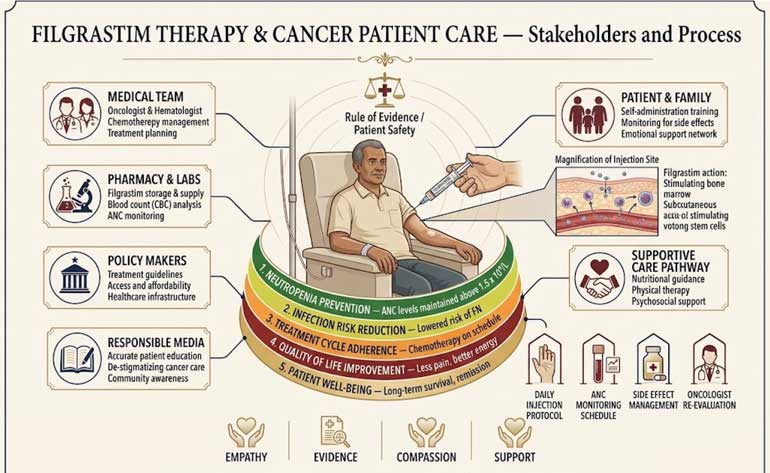
Health Minister Nalinda Jayatissa told Parliament in August that Sri Lanka requires about 300,000 Filgrastim injections a year, roughly 900 a day. Apeksha Hospital in Maharagama alone requires about 325 daily. Filgrastim is commonly used to stimulate white-blood-cell production, including in patients whose immune systems have been weakened by chemotherapy. Yet a consignment of 160,000 pre-filled syringes delivered for the 2026 requirement could not be distributed because it did not comply with NMRA labelling requirements. The Minister subsequently acknowledged shortages in government hospitals and said additional stocks would have to be airfreighted, while hospitals also relied on local purchases.
The arithmetic is difficult to ignore. The stranded stock represents more than half of the country’s stated annual requirement and about six months of national demand. By 12 September, the NMRA said it was exploring whether the consignment could be independently tested. The regulator said the syringes lacked mandatory information including the generic name, and such like and had sought World Health Organisation assistance in identifying a laboratory capable of specialised testing.
Desperation cannot substitute for safety. No cancer patient should receive a medicine whose identity or quality cannot be established simply because the health system has run short. But in an emergency, regulation must become more urgent, not less rigorous. If 160,000 potentially usable doses are already inside the country while hospitals face shortages, the State should mobilise every lawful scientific mechanism available to establish quickly whether those doses meet the required standard. Test the product, verify the batch and manufacturer, and establish its composition, potency, sterility and expiry. If it fails, reject it. If independent testing establishes that it is safe and compliant in substance and any remaining labelling defect can lawfully be remedied, the State should be capable of reaching an expedited decision.
Sri Lankan law already recognises that exceptional medical circumstances can require exceptional regulatory pathways. Section 109 of the National Medicines Regulatory Authority Act allows the Authority, in special circumstances, to permit the import and supply of specified quantities of an unregistered medicine under a waiver of registration. The NMRA itself says those circumstances include medicine used to “save a life”, control an infection or epidemic, or respond to a national emergency or national security need. That provision does not automatically authorise the release of this particular Filgrastim stock, nor does it override legitimate quality concerns. But it establishes something important: Sri Lanka’s medicines law does not assume that every case must move at an ordinary administrative pace.
The real question is therefore not why the NMRA refuses simply to wave the stock through. It is how a consignment representing roughly six months of national demand passed through procurement, manufacture, shipment and importation before a defect serious enough to stop distribution became a crisis. Were the labelling specifications clear to the supplier? Was compliance checked before shipment? What quality-control stage should have detected the problem? What buffer stock existed while the dispute was resolved? Once hospitals began running short, why was urgent independent testing not already part of an established contingency system?
These questions matter constitutionally because Article 12(1) is not confined to crude forms of discrimination. Sri Lanka’s Supreme Court has treated equality as a restraint on arbitrary executive and administrative action. It has said that the guarantee protects persons from arbitrary, capricious and unreasonable State action and has reaffirmed the principle that persons who are similarly circumstanced should be treated alike unless there is a rational basis for the distinction.
That principle becomes especially important when medical urgency meets administrative discretion. Imagine two cancer patients requiring the same medicine with comparable clinical urgency and satisfying the same legal requirements. If one receives immediate assistance because a minister, senior official or influential intermediary intervenes while the other remains in an ordinary queue, the question is no longer merely whether bureaucracy is slow. It is why State power worked differently for two people in materially similar circumstances.
There may of course be legitimate differences. One patient may be clinically more urgent. One medicine may comply with regulatory requirements while another does not. One consignment may present a safety issue absent from another. Equality permits those distinctions because they are relevant. What it cannot comfortably accommodate is a system in which urgency becomes available through influence rather than transparent medical criteria. A public service that becomes efficient only when somebody powerful intervenes is not equally accessible, even if the written rules look identical.
The Filgrastim controversy also sits within a wider picture of pressure on medicine supply. In June, the Daily FT reported that Indian pharmaceutical companies had raised concerns over delays affecting over 1,000 pharmaceutical import licences, with some reportedly pending since January. The dispute also involved pricing and regulatory questions, so a pending licence is not by itself evidence of wrongdoing. But a backlog of that scale in a country heavily reliant on imported medicines is consequential because decisions made months earlier can ultimately appear as shortages at hospital pharmacies.
Warnings extend beyond medicines. On 9 September, over 1,000 cancer patients were reported to be waiting for radiation-treatment planning at a major cancer hospital after its CT-simulation service had reportedly not been functioning properly since late April. This is a separate failure, but it illustrates why the machinery of healthcare cannot be treated as neutral administrative background. For a cancer patient, delay may mean treatment postponed or a family forced into alternatives it cannot afford.
The State therefore cannot hide behind a false choice between safety and speed. A strong regulator should be capable of both. An emergency pathway should mean faster scientific scrutiny, not weaker scrutiny. Critical medicines should trigger immediate laboratory access, clear escalation rules and rapid communication between procurement authorities, clinicians and regulators. If a stock can safely be salvaged, the process for proving that should be activated immediately. If it cannot, replacement procurement should begin before patients experience the shortage.
Article 4(d) of the Constitution makes the wider responsibility clear: fundamental rights recognised by the Constitution must be “respected, secured and advanced by all the organs of government”. The Supreme Court has emphasised the significance of that obligation. It means constitutional responsibility cannot conveniently disappear at the boundary between two State institutions.
If customs officials exercise discretion over an urgent medical consignment, that discretion should be rational and consistent. If regulators assess comparable products, comparable standards should apply. If hospitals prioritise patients, clinical need rather than political influence should determine priority. If procurement failures create shortages, responsibility cannot simply vanish between the procurement agency, supplier, regulator and Medical Supplies Division.
None of this means every failed procurement, broken machine or delayed licence becomes a constitutional violation. Article 12(1) should not be attached mechanically to every administrative mistake. The stronger proposition is narrower and more serious: when State action becomes arbitrary, selectively favourable, irrationally delayed or differently applied to people in materially similar circumstances without legitimate reason, equality before the law is engaged.
Sri Lanka should therefore publish clearer information on essential-medicine stocks, pending critical procurements and major regulatory delays. Urgent medical cases should move through transparent escalation procedures capable of being invoked by any patient or clinician satisfying the same criteria, not through private access to powerful officials. Decisions should be recorded, reasons should be open to scrutiny and failures between agencies should be investigated across the entire chain.
The public servant who moves an urgent medical file is not granting a favour, nor is the regulator who fast-tracks testing while preserving safety. They are exercising public power in a constitutional system that promises equal protection.
Cancer already imposes brutal inequalities that the State cannot eliminate. It cannot guarantee that every treatment will work or that every medicine will always be available. What it can do is refuse to add another inequality of its own: between the patient who knows someone and the patient who does not; between the case that attracts political attention and an identical case that remains invisible; between medicine that exists and medicine that cannot reach the person who needs it because the institutions responsible cannot coordinate in time.
That is why the 160,000 Filgrastim injections matter beyond one procurement controversy. The answer is not to ignore regulation and distribute them blindly. It is to test them with the urgency the situation demands, establish whether they meet the required medical standards and, if they do and any legal defects can properly be remedied, make a rapid decision on their use. If they do not, the public deserves to know how so large and so essential a consignment came this far before failing.
Article 12(1) says all persons are entitled to the equal protection of the law. A cancer patient is one of them. That protection cannot live only in constitutional judgments. It must survive the procurement process, the laboratory, the regulator, the customs desk, the warehouse and the hospital pharmacy.
When State bureaucracy stands between a cancer patient and treatment, bureaucracy is no longer merely administration. It is power and the Constitution requires that power to be exercised lawfully, rationally and equally.
(The author is an International Relations student at Monash University whose writing explores politics, governance, and international affairs)




