Friday Nov 13, 2026
Friday Nov 13, 2026
Friday, 13 November 2026 05:00 - - {{hitsCtrl.values.hits}}
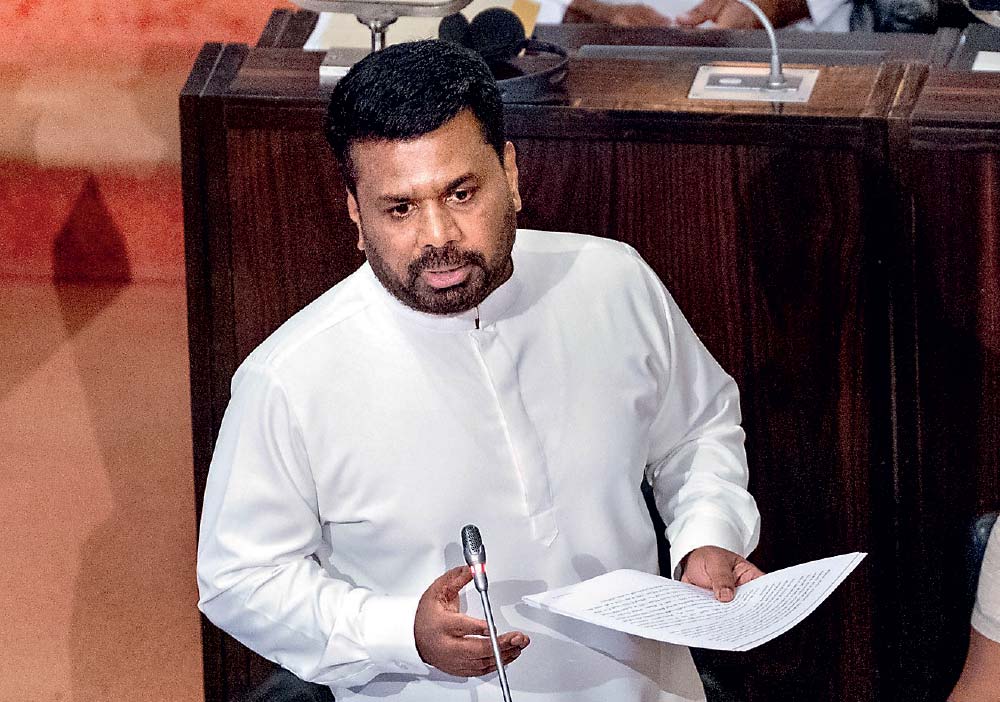
 President Anura Kumara Dissanayake presented the 2027 Budget yesterday promising to move Sri Lanka from economic stabilisation to transformation. The speech offered impressive figures, numerous allowances and major infrastructure proposals. Yet the central question remains unanswered: What kind of economy are we building, and how will ordinary Sri Lankans share in its progress?
A national Budget should explain how a country will create productive jobs, raise real incomes, attract investment and withstand external shocks. Judged against these tests, this Budget is less convincing than its presentation suggests. It is politically attractive, but its developmental direction remains uncertain.
Fiscal stability is necessary, but not the destination
The Government deserves recognition for maintaining macroeconomic stability following Sri Lanka’s devastating economic crisis. Fiscal discipline, stronger revenue collection and improved debt management are important achievements.
The Budget nevertheless raises difficult questions. Its tables project Rs. 6.18 trillion in revenue and grants against Rs. 7.93 trillion in expenditure when supplementary disaster-related spending is included. The resulting deficit is approximately Rs. 1.75 trillion, or 4.5% of GDP. Interest payments alone are estimated at Rs. 2.64 trillion—roughly 43% of projected Government revenue, excluding grants.
Such commitments sharply limit the space available for development.
The Government targets economic growth of at least 7% in the medium term, while the World Bank projects 4.2% for 2027. Its own revenue forecast of 15.8% of GDP for 2027 also sits below its medium-term ambition of at least 16%.
These ambitions require clearly identified investments, institutional reforms and productivity improvements. Economic stability is an achievement, but it is not the same as economic prosperity.
Relief is not the same as an affordable life
The Budget offers genuine concessions: a higher monthly income-tax-free threshold of Rs. 162,500, VAT exemptions for printed and exercise books, and lower levies on selected essential foods. It also provides Rs. 230 billion for social protection allowances, including Aswesuma.
These measures deserve recognition.
But millions of low-income earners do not pay personal income tax. They gain little from a higher PAYE threshold. They struggle with food, transport, electricity, school expenses and insecure earnings.
Colombo inflation had risen to 8.3% in October 2026. Lower inflation in a future month would not mean prices had returned to their previous levels.
The World Bank estimates that poverty was 16.9% in 2025 and notes that food prices remain more than twice their pre-crisis level.
Targeted relief is necessary, but it cannot substitute for sustained improvements in household purchasing power.
The Budget needs a convincing plan to reduce production and distribution costs, improve competition and raise real wages. Families cannot meet their daily expenses with favourable economic statistics.
Young people need careers, not another round of promises
Youth unemployment is among the clearest tests of development policy.
Official labour statistics put overall unemployment at 4% in the second quarter of 2026, but unemployment among those aged 15–24 was 17.8%. Among young women, it was 22.4%.
The Budget proposes training, digital initiatives and further public-sector recruitment. Filling essential vacancies can improve public services. But the state cannot become the principal employer of an entire generation.
Where is the measurable plan for private-sector jobs in export industries, technology, modern agriculture, logistics and high-value services?
How many new jobs will be created, at what wage levels, in which districts, and by when?
Without convincing answers, young Sri Lankans may continue to see migration as their best economic option.
This drains the country of skills, innovation and confidence.
The distribution of growth cannot be an afterthought
The promise of a “beautiful life” must be tested against who actually benefits from economic recovery.
The World Bank finds poverty considerably higher outside the Western Province. Female labour force participation was only 32.7% in the second quarter of 2026.
These disparities require more than general statements about inclusive development.
Allocations for rural programs, housing and welfare are welcome. But how will they raise lasting incomes in the North, East, estate communities and neglected rural districts?
What benchmarks will demonstrate that poor households are moving from welfare dependence towards productive livelihoods?
Social protection shields people from hardship. Development should create opportunities for them to escape poverty permanently.
Growth that fails to improve the distribution of opportunity cannot be considered successful development.
An economy of production or an economy of announcements?
There are constructive proposals: Rs. 2 trillion for public investment including supplementary reconstruction, Rs. 80 billion for railway electrification, concessional finance for smaller enterprises, export-related tax incentives and measures to simplify trade.
The Government also proposes enhanced capital allowances for qualifying Board of Investment projects.
The President himself correctly observed that economic transformation means more than presenting another list of expenditures.
Yet the Budget frequently appears to do precisely that.
Investors seek predictable taxation, reliable energy, secure land rights, efficient approvals, skilled workers and consistent policy.
The proposed national single window for investment is still at the consultant-selection stage. This illustrates the distance between announcing investment facilitation and actually making it work.
Sri Lanka must decide how manufacturing, agriculture and internationally traded services will complement one another.
A competitive future requires export diversification, technology adoption, stronger local supply chains and meaningful access to international markets.
Tourism and remittances are valuable, but they cannot alone deliver the productivity and economic resilience the country needs.
Public expenditure alone will not automatically attract private investment.
The real test is implementation, not allocation
One striking figure comes from public-finance monitoring.
Only 16.3% of the 2026 annual capital-expenditure allocation had been spent by the end of June. Even by September, reported capital spending was only 31.6% of the annual allocation.
Spending need not be distributed evenly throughout the year, but such slow implementation requires explanation.
Against that record, announcing Rs. 2 trillion for public investment in 2027 creates an obligation to explain how procurement, land acquisition, project preparation and inter-agency coordination will improve.
Parliament needs quarterly reports showing funds spent, projects completed, jobs created and economic returns achieved.
Otherwise, the Budget risks becoming another impressive document whose development promises remain largely on paper.
Politics must not overshadow the manifesto
The Government’s manifesto, A Thriving Nation – A Beautiful Life, promised a fairer and more productive society.
Yet the Budget’s immediate political appeal relies heavily on individual allowances, salary adjustments and visible spending commitments.
Beneficiaries may deserve such support, but political popularity is not economic transformation.
The Rs. 50 billion allocation for district and decentralised development, including Rs. 10 million per Member of Parliament, also requires transparent selection criteria and measurable development returns.
There is nothing improper about responding to people’s immediate needs.
The difficulty arises when concessions and political messaging eclipse higher productivity, quality employment and broadly shared prosperity.
This gap between promises and lived experience could deepen public frustration and social tension, even without another immediate economic crisis.
The IMF question cannot be avoided
Perhaps the most revealing passage concerns the International Monetary Fund.
The President stated that the current IMF program is expected to conclude in March 2027 and that a Cabinet-appointed committee is examining the possibility and form of another program.
Therefore, renewed IMF engagement is not merely an opposition allegation. The Government itself is studying that possibility.
Another IMF arrangement would not automatically mean economic failure. A precautionary programme could provide protection against external shocks.
But if Sri Lanka continues to require external financial assistance because exports, private investment and debt-servicing capacity have not improved sufficiently, the promised economic transformation will remain incomplete.
The Budget itself acknowledges a deterioration in the external current account during the first nine months of 2026.
That warning deserves greater attention than political celebration.
Our objective should not merely be to complete one IMF program and prepare for another. It should be to build an economy capable of standing increasingly on its own.
From numbers to national direction
The Government should publish a transparent, time-bound development strategy linking major expenditure proposals to employment, exports, productivity and poverty reduction.
It must remove investor bottlenecks, strengthen public administration and publish independently verifiable results.
Above all, it must explain how economic growth will reach ordinary households rather than remain confined to national accounts.
A Budget can balance columns without changing lives.
Sri Lanka does not need another contest over who announces the largest allocation or distributes the most benefits.
It needs a credible answer to a simpler question: Where are we heading, and how will we know when we are getting there?
Until that answer becomes clear, the 2027 Budget will remain stronger as a political statement than as a convincing blueprint for national development.
(The author is Emeritus Professor of Economics, University of Colombo)




