Friday Oct 30, 2026
Friday Oct 30, 2026
Friday, 30 October 2026 00:22 - - {{hitsCtrl.values.hits}}
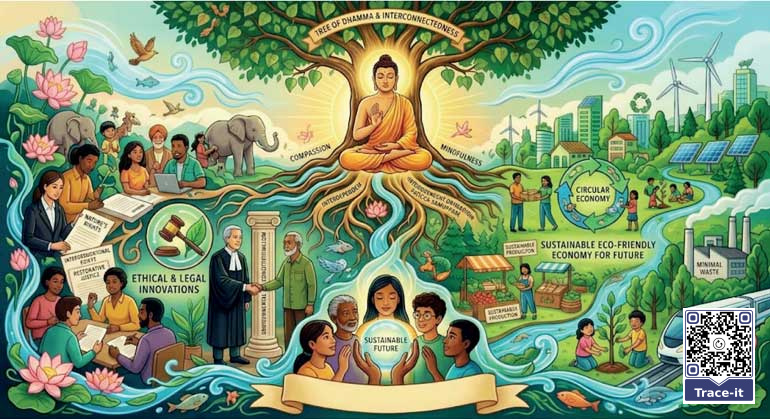

Executive Summary
Buddhism, originating in India between the fifth and fourth centuries BCE and founded by Siddhartha Gautama, the Buddha, offers a comprehensive ethical framework that extends beyond spiritual liberation (Nirvana) to encompass social, legal, and ecological responsibility. Central to Buddhist philosophy are the Four Noble Truths and the Noble Eightfold Path, which emphasise ethical conduct (sila), mental discipline (samadhi), and wisdom (pañña) as the foundations of harmonious living. These principles cultivate compassion (karuna), loving-kindness (metta), non-harm (ahimsa), mindfulness (sati), and interdependence (paticca-samuppada), all of which have profound implications for environmental protection and sustainability. This article examines how Buddhist ethical teachings can inform and reshape contemporary environmental law by challenging anthropocentric legal paradigms and promoting ecocentric, relational, and responsibility-based approaches to environmental governance. Through doctrinal analysis, comparative legal study, and case law examination from Buddhist-influenced jurisdictions, the paper explores ethical and legal innovations inspired by Buddhism. It argues that integrating Buddhist ecological wisdom into environmental law can strengthen normative foundations of sustainability, advance ecological justice, and enhance long-term environmental stewardship, positioning environmental protection as both a legal obligation and a moral imperative rooted in ethical self-restraint and collective responsibility.
Background and introduction
Modern scientific advancement has significantly expanded humanity’s understanding of the natural world; paradoxically, it has also contributed to unprecedented environmental degradation. Life-sustaining resources such as air, water, and soil are increasingly polluted, threatening ecological balance and human survival. This crisis is evident globally, as rapid industrialisation, infrastructure expansion, and unsustainable resource exploitation place severe pressure on ecosystems and local communities.
The scale of environmental degradation reveals the extent to which human activity has disrupted natural systems. Accelerating biodiversity loss has pushed numerous plant and animal species toward extinction, while large-scale deforestation has resulted in soil erosion, declining fertility, and weakened ecological resilience. The widespread use of chemical fertilisers, pesticides, and herbicides has further destabilised soil ecosystems and agricultural sustainability. Compounding these challenges, climate change—manifested through rising global temperatures, sea-level rise from melting polar ice caps, and ozone depletion—poses serious risks to public health and the survival of vulnerable coastal and island populations, underscoring the urgent need for effective environmental governance.
Despite the growth of environmental law through international treaties, national legislation, regulatory institutions, and judicial interventions, its effectiveness remains limited. Predominantly anthropocentric and utilitarian legal frameworks continue to prioritise short-term economic interests over long-term ecological integrity, often treating nature as an object of exploitation rather than a system of which humans are an integral part.
From a Buddhist perspective, environmental degradation is not merely a scientific, technological, or regulatory failure but a moral and spiritual crisis rooted in greed (lobha), ignorance (avijja), and craving (tanha). Buddhist philosophy rejects assumptions of human dominance over nature and instead emphasises interdependence (paticca-samuppada) and impermanence (anicca). Environmental harm thus reflects a deeper ethical and cognitive disconnection from the relational nature of existence.
Buddhist ethical teachings, grounded in the Four Noble Truths and the Noble Eightfold Path, promote values such as non-harm (ahimsa), compassion (karuna), loving-kindness (metta), mindfulness (sati), moderation, and self-restraint. These principles offer a normative foundation for environmental governance by complementing legal regulation with moral responsibility. The doctrine of dependent origination, in particular, highlights how ecological harm inevitably rebounds upon human societies through environmental instability, social injustice, and economic disruption.
This study explores how Buddhist ethical principles can enrich contemporary environmental law by challenging anthropocentric paradigms and supporting ecocentric, responsibility-based approaches. By integrating Buddhist ecological wisdom with modern legal frameworks—such as sustainable development, intergenerational equity, the precautionary principle, and emerging rights-of-nature doctrines—the paper highlights the potential for ethical and legal innovations that foster ecological balance, environmental justice, and resilient systems of environmental governance.
Destruction of the earth as a moral and legal inheritance
Humanity has inherited the planet Earth together with its ecosystems—plants and animals, rocks and minerals, seas, rivers, and lakes. From a Buddhist perspective, this inheritance implies ethical responsibility rather than absolute ownership. While modern science has uncovered many of nature’s mysteries, technological advancement has simultaneously generated severe environmental pollution, rendering nature increasingly inhospitable to human existence. Essential and finite natural resources such as air, water, and soil have been polluted to the extent that human survival itself has become uncertain.
Environmental degradation today is a global phenomenon. The scale and severity of ecological damage reveal how human activity, driven by unchecked exploitation and weak regulatory restraint, has exhausted and destroyed natural resources. Plant and animal life are threatened, with many species already extinct. Deforestation has resulted in soil erosion, exposing barren rock surfaces and undermining agricultural sustainability. The indiscriminate use of chemical fertilisers, pesticides, and weedicides has disrupted natural soil bacteria, producing long-term and often irreversible consequences. Scientists warn of global warming, including the inundation of island and coastal civilisations due to melting polar ice caps. The depletion of the ozone layer exposes humanity to dangerous ultraviolet radiation, while toxic waste accumulation and air and water pollution continue to intensify ecological decline.
From a Buddhist ethical standpoint, the present ecological crisis reflects profound consequences for human well-being and collective happiness. It represents unwise human intervention rooted in ignorance (avijja) and craving (tanha). Buddhism identifies such suffering as arising from wrong views and moral decline. In this context, environmental law informed by Buddhist ethics must aim not merely at regulation, but at transforming human intentions and conduct. Although the ecological catastrophe may no longer be fully preventable, its severity can still be mitigated through ethically grounded legal and policy innovations that promote restraint, responsibility, and interdependence.
Deviation from dependent co-origination (Paticcasamuppāda) and environmental governance
Buddhism teaches that human beings are inseparable from nature. The four primary elements—earth (pathavi), water (apo), heat (tejo), and wind (vayo)—are common to both humans and the natural world (Digha Nikaya, PTS, p. 228). Natural forces such as gravity, climatic conditions, and celestial movements directly influence human life. This causal interdependence underscores the Buddhist principle of paiicca-samuppada, which provides a philosophical foundation for environmental law by recognising the interconnectedness of all phenomena.
Modern technological development often seeks to dominate and ‘conquer’ nature, ignoring its inherent capacity for regeneration and limits of resilience. Human activity has exceeded these limits, resulting in widespread pollution and disease. The Buddha’s guidance on environmental cleanliness, as recorded in the Vinaya Mahavagga (PTS, pp. 109–111), demonstrates early regulatory principles for maintaining healthy surroundings. These teachings illustrate that environmental protection is not merely a modern legal concern but an ancient ethical obligation.
Today, the global atmosphere is heavily polluted by industrial, chemical, and nuclear waste. Technological progress, unrestrained by ethical or legal safeguards, contaminates the air essential for life. Buddhism’s recognition of the close relationship between human conduct and environmental health supports the development of legal frameworks that integrate moral accountability with scientific understanding. Modern experiments confirming that plants respond positively to care further affirm the Buddhist view that human attitudes and actions have tangible environmental consequences.
Causal human effects on the environment and legal responsibility
Buddhism views the world as evolving through immeasurable cycles of formation and dissolution, governed by causes and conditions affecting both physical and moral dimensions of existence. Human beings influence the environment not only through physical actions but also through moral or immoral conduct. According to Buddhist texts, unrighteous governance and unethical social behavior result in environmental decline—manifested as droughts, poor harvests, and diminished human vitality—while righteous conduct produces the opposite effects.
The Aggañña Sutta (Anguttara Nikaya, PTS, pp. 74–76) presents a narrative of co-evolution between sentient beings and their environment. As greed and moral decline increase, natural abundance diminishes. This account offers a conceptual framework for environmental law, emphasising that legal systems must address both material exploitation and ethical degeneration. Environmental degradation is thus not accidental but a conditioned outcome of human choices, reinforcing the need for legal accountability grounded in moral causation.
Moral degradation as the root of ecological crisis
The Gaminicanda Jataka (Jataka No. 257) states that agricultural produce loses its vitality when farmers neglect moral obligations. Buddhism consistently affirms that human intentions and actions—physical, verbal, and mental—shape environmental conditions. Consequently, the ecological crisis is not merely a technical or scientific issue but fundamentally a moral and legal challenge. Environmental law informed by Buddhist ethics must therefore integrate moral responsibility into regulatory structures to ensure sustainable coexistence.
Prominence of mind and wrong attitudes in environmental exploitation
Buddhism teaches that the world is led by the mind (cittena niyyato loko). When societies are driven by greed, distorted values, and unethical desire, environmental imbalance follows, resulting in droughts, famine, and suffering (Anguttara Nikaya, PTS, p. 160). The Dhammapada affirms that unwholesome intentions lead to suffering, while wholesome intentions lead to happiness.
Modern materialistic ideologies, reinforced by industrial capitalism, have legitimised excessive exploitation of nature, often at the expense of vulnerable communities and future generations. From a Buddhist legal perspective, sustainable environmental governance requires a fundamental shift in societal values—from domination and accumulation toward restraint, equity, and compassion.
Moderation and the middle way as a legal principle for sustainability
The Buddhist Middle Way offers a practical ethical foundation for sustainable development and environmental law. Greed and egoism, particularly consumerism and prestige-driven consumption, are primary causes of ecological destruction. Deforestation and large-scale industrial exploitation exemplify the failure to recognize nature as an interconnected system governed by causal laws.
Buddhism advocates small-scale, localized economies using appropriate technology that minimises resource depletion. Avoiding gigantism in industry and agriculture aligns with the Middle Way, ensuring that economic development serves human well-being without violating ecological limits. Environmental policies grounded in moderation would yield long-term social and ecological benefits, preventing irreversible damage.
Wastage, contentment, and environmental regulation
Contentment (santutthi) is a key Buddhist value that discourages waste and promotes environmental protection. The Buddha condemned wasteful practices such as the Udumbara khadika method (Anguttara Nikaya, PTS, p. 22), illustrating early principles against resource misuse. Similarly, Buddhist teachings prohibit water pollution, emphasising legal accountability for environmental contamination (Vinaya, PTS, p. 206). These principles resonate with modern environmental regulations aimed at preventing waste, overexploitation, and pollution.
Moral relationship with nature and legal protection of life
The Buddhist ethical system emphasises a moral relationship with all forms of life. The first precept—abstaining from killing—extends moral concern beyond humans to all living beings. The Metta Sutta articulates a universal ethic of compassion that can inform environmental law by recognising the intrinsic value of non-human life.
Early Buddhist regulations prohibiting harm to animals, insects, and plant life demonstrate a legal–ethical framework that respects ecological balance. Modern practices such as pesticide overuse and habitat destruction violate these principles, leading to biodiversity loss and environmental contamination. Buddhist ethics thus provide a compelling foundation for laws protecting ecosystems and species.
Ethical teachings for environmental stewardship
Buddhist teachings advocate the protection of forests, animals, and water resources as meritorious acts. The Buddha rejected violent sacrificial rituals that destroyed animals and trees, promoting non-violent alternatives. Vinaya regulations restricting tree cutting reflect early conservation principles. These teachings highlight the role of law in safeguarding natural resources against exploitation.
Appreciation of nature and environmental well-being
Early Buddhism emphasises appreciation of natural beauty as essential for mental well-being and spiritual development. Forests, rivers, and parks were valued not only aesthetically but also ethically. Protecting such environments contributes to psychological health and social harmony. Environmental law should therefore recognise nature’s role in human well-being, integrating conservation with public welfare.
Ethical change of lifestyle and sustainable legal reform
Buddhism calls for a radical transformation of human lifestyles and values. Environmental degradation results from materialistic worldviews that prioritize short-term gain over long-term sustainability. Unlike ancient Buddhist civilisations that coexisted with nature for millennia, modern societies face global, human-made ecological crises.
No fragmented legal solution can address these challenges. Instead, comprehensive environmental laws inspired by Buddhist ethics must promote moderation, moral responsibility, and spiritual awareness. Such a value-oriented legal framework offers innovative pathways toward a sustainable and harmonious future.
Buddhist ethical foundations and environmental responsibility
Buddhist philosophy is grounded in the Four Noble Truths and operationalised through the Noble Eightfold Path, which collectively guide ethical behavior, mental cultivation, and wisdom. The ethical dimension (sila)—comprising right speech, right action, and right livelihood—discourages exploitation, violence, and irresponsible economic activity, while promoting livelihoods that minimise harm to living beings and natural systems.
The principle of ahinsa (non-violence) extends moral consideration beyond human beings to animals, plants, and ecosystems, reinforcing the idea that nature possesses inherent moral worth. Compassion (karuna) and loving-kindness (metta) cultivate an ethic of care and responsibility toward both present and future generations. Mindfulness (sati) encourages conscious awareness of consumption patterns, production systems, and ecological consequences, aligning closely with sustainability, environmental impact assessment, and responsible governance.
Interdependence and ecological ethics
The doctrine of dependent origination (paticca-samuppada) provides a philosophical foundation for ecological responsibility by asserting that all phenomena arise through mutual conditions and causal relationships. This relational ontology resonates strongly with modern ecological science, systems theory, and environmental economics, all of which emphasise interconnectedness, feedback loops, and planetary boundaries.
By rejecting the notion of human dominance over nature, Buddhist thought challenges the dualistic separation of humans and the environment that underpins much of Western legal theory. Buddhist texts and practices further reflect environmental consciousness, as illustrated by the Buddha’s reverence for the Bodhi tree and the Vinaya rules restricting monastic activities that harm soil, water, forests, and living organisms. These teachings establish an early normative framework for environmental stewardship, conservation, and restraint, predating modern environmental law by centuries.
Environmental Law: Anthropocentrism and its limitations
Modern environmental law has evolved through international instruments such as the Stockholm Declaration (1972), the Rio Declaration (1992), the Convention on Biological Diversity, and the Paris Agreement (2015). While these frameworks recognise environmental protection as a shared global responsibility, they largely conceptualise nature as a resource to be managed for human benefit rather than as a community of life with intrinsic value.
Judicial decisions, including Massachusetts v. EPA (549 U.S. 497, 2007), Urgenda Foundation v. State of the Netherlands (2019), and Leghari v. Federation of Pakistan (2015), demonstrate increasing judicial willingness to address climate change and environmental harm. These cases advance climate accountability and state responsibility, yet they remain rooted in human-centered rights frameworks, emphasising governmental duties toward citizens rather than recognising the inherent rights or legal standing of ecosystems.
Buddhist ethics challenge this anthropocentrism by promoting ecocentrism, relational responsibility, and moral restraint, offering an alternative legal philosophy that frames environmental protection as an ethical duty arising from interdependence rather than merely a regulatory obligation imposed by law.
Buddhist-inspired legal frameworks and case studies
Bhutan: Gross National Happiness (GNH) — Bhutan’s constitutional commitment to environmental protection reflects deeply embedded Buddhist values, particularly through the principle of Gross National Happiness. Article 5 of the Constitution of Bhutan (2008) mandates environmental conservation and sustainable development, requiring the state to maintain at least 60 percent forest cover. This constitutional approach integrates spiritual wellbeing, ecological integrity, and legal accountability, offering a distinctive model of Buddhist-inspired environmental governance that prioritises collective wellbeing over economic growth alone.
Sri Lanka and Thailand — In Sri Lanka, Buddhist monks and civil society organisations have actively engaged in environmental litigation, advocacy, and grassroots activism, particularly in forest conservation, wildlife protection, and opposition to environmentally destructive development projects. Similarly, Thailand’s recognition of community rights over natural resources and monk-led environmental movements—such as tree ordination ceremonies—demonstrate how Buddhist ethics influence legal consciousness, environmental activism, and community-based conservation.
Japan and Environmental Governance — Japan’s environmental governance reflects Buddhist and Shinto values emphasising harmony, balance, and respect for nature. Judicial decisions and administrative practices increasingly incorporate sustainability, precaution, and disaster risk reduction, aligning with Buddhist principles of restraint, impermanence (anicca), and interdependence.
Legal innovations inspired by Buddhist ethics
Buddhist environmental ethics support several emerging legal innovations, including:
•Ecocentric legal frameworks recognising the intrinsic value of nature beyond human utility;
• Rights of nature doctrines, reflected in constitutional and statutory developments in comparative jurisdictions;
• Intergenerational equity, aligning with karmic responsibility and long-term ethical consequences;
• Restorative environmental justice, emphasising ecological restoration, reconciliation, and healing rather than punitive enforcement alone.
These innovations complement existing legal principles such as the precautionary principle, sustainable development, and the public trust doctrine, reinforcing ethical accountability, long-term thinking, and collective stewardship in environmental governance.
Challenges and opportunities in implementation
Integrating Buddhist ethics into environmental law presents challenges, including concerns over secularism, cultural pluralism, political resistance, and economic priorities. Additionally, the diversity of Buddhist traditions and interpretations complicates uniform legal application.
Nevertheless, significant opportunities exist through soft law mechanisms, judicial interpretation, constitutional environmental rights, education, and policy frameworks that incorporate ethical values without imposing religious doctrine. In this context, Buddhist ethics function as a normative and philosophical guide that informs legal reasoning rather than a prescriptive legal system.
Conclusion
This study demonstrates that Buddhist ethical teachings offer a robust philosophical and moral foundation for reimagining environmental law. By emphasising interdependence, non-harm, mindfulness, compassion, and restraint, Buddhism challenges anthropocentric legal paradigms and supports ethical and legal innovations aimed at sustainability and ecological justice.
Integrating Buddhist ecological wisdom into environmental law can strengthen global environmental governance by aligning legal systems with ethical responsibility, long-term stewardship, and planetary wellbeing. Ultimately, sustainability must be understood not only as a legal obligation but as a moral imperative grounded in humanity’s interdependent relationship with the natural world.
Bibliography
Primary Sources (Pāli Canonical Works and Translations)
Dialogues of the Buddha, Translated by T. W. and C. A. F. Rhys Davids, Part III, Vol. IV. Pali Text Society, London, Fourth Edition, 1977.
Dialogues of the Buddha, translated from the Pāli by T.W. Rhys Davids, edited by F. Max Müller, Vol. II. Part 1. Published by the Pāli Text Society, London, 1977.
Dialogues of the Buddha, Translated from the Pāli of the Dīgha Nikāya by T.W. and C.A.F. Rhys Davids, Part II, Vol. III. Fourth Edition, 1977.
The Book of Discipline - Vinaya Pitaka, ed. Oldenberg, H., 5 Vols., (P.T.S.), London, 1924.
The Book of the Discipline (Vinaya-Piṭaka) Vol. IV (Mahāvagga), Translated by I. B. Horner, M.A., Published by Luzac and Company Ltd., London, 1971.
The Book of the Gradual Sayings (Aṅguttara-Nikāya) Vol. I, II, and IV, Translated by F. L. Woodward and E. M. Hare, Pali Text Society, London.
The Dhammapada, Pāli Text and Translation with Stories in Brief and Notes, Narada Thera, Corporate Body of the Buddha Educational Foundation, Taiwan, 1993.
Secondary Sources and Case Law
Bosselmann, K. (2017). The principle of sustainability: Transforming law and governance. Routledge.
Fisher, E. (2017). Environmental law: A very short introduction. Oxford University Press.
French, R. R., and Nathan, M. A. (2014). Buddhism and law: An introduction. Cambridge University Press.
Gethin, R. (1998). The Foundations of Buddhism. Oxford University Press.
Ginsburg, T., and Schonthal, B. (2018). Buddhism and comparative constitutional law. Cambridge University Press.
Guneratne, A. (2002). Buddhism and the law in contemporary Thailand and Sri Lanka. University of Arizona Press.
Guruge, A. (1991). The Buddha’s encounters with contemporary religious and philosophical thought. Government of Sri Lanka Press.
Harris, I. (1995). Buddhism and the discourse of environmental concern. Journal of Buddhist Ethics, 2(1), 1–33.
Harvey, P. (2000). An introduction to Buddhist ethics: Foundations, values, and issues. Cambridge University Press.
Huxley, A. (1996). Buddhist law in Southeast Asia. Oxford University Press.
Jenkins, W. (2016). Sustainability and spirituality. State University of New York Press.
Jerryson, M. (2018). Buddhism, violence, and the law. Oxford University Press.
Kaza, S. (2005). Hooked! Buddhist writings on greed, desire, and the urge to consume. Shambhala Publications.
Kaza, S. (2008). Mindfully green: A personal and spiritual guide to eco-awareness. Shambhala Publications.
Kaza, S., and Kraft, K. (Eds.). (2000). Dharma rain: Sources of Buddhist environmentalism. Shambhala Publications.
Keown, D. (2018). Buddhist ethics: A very short introduction (2nd ed.). Oxford University Press.
Massachusetts v EPA 549 US 497 (Supreme Court of the United States, 2007).
Moore, M. J. (2016). Buddhism and political theory. Oxford University Press.
Obeyesekere, G. (1995). Buddhism, law, and society in Sri Lanka: A historical perspective. Princeton University Press.
Schmithausen, L. (1991). Buddhism and nature. International Institute for Buddhist Studies.
Schober, J. (2007). Buddhist legal practices in Myanmar: State and religion in conflict. Cambridge University Press.
Sponsel, L. E., and Natadecha-Sponsel, P. (2003). Buddhism and ecology: The interconnection of dharma and deeds. University of Hawai‘i Press.
Taylor, P. W. (1986). Respect for nature: A theory of environmental ethics. Princeton University Press.
White, L. (1967). The historical roots of our ecological crisis. Science, 155(3767), 1203–1207.
(The author is a PhD Candidate in Environmental Law (University of Kelaniya) / PhD Law (Reading) (Col) / PhD Buddhism (Reading) (PGIPBS) / PhD. Trade (Japura) / PhD IR (USA) / PhD Law (Reading) (GA USA) / DLitt - GKU India / M.A. IR. (Aus.) / LLM. (UK) / LLB (UK) / PDip Media (Japura). He is Chairman - Tourism and Cultural Task Force Government Sri Lanka and Visiting Lecturer - University of Colombo, Sri Lanka, Visiting Lecturer - State University of Lumbini, Nepal and Visiting Lecturer - GKU India. He could be reached via email [email protected])




