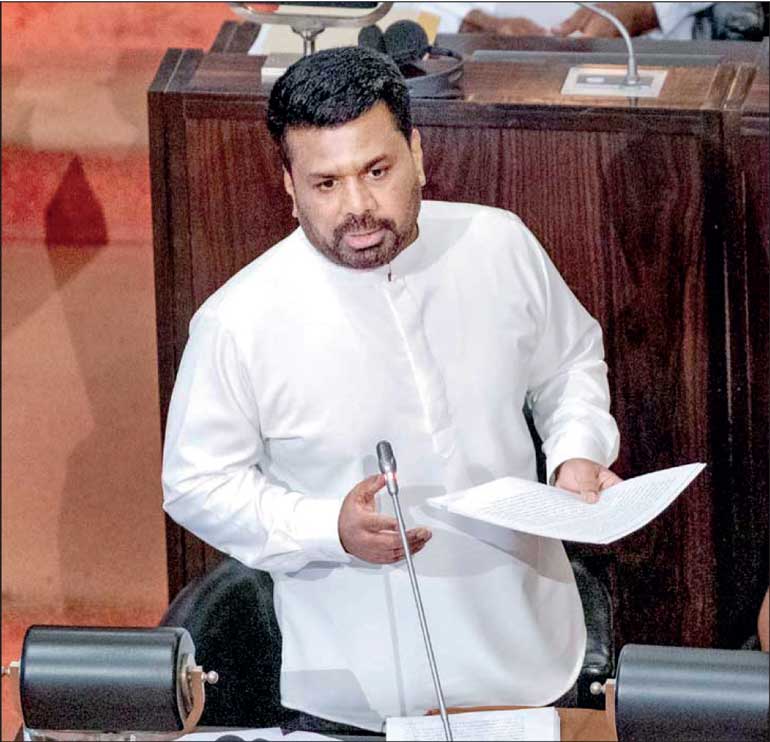
President and Finance Minister Anura Kumara Dissanayake
The effectiveness of the proposed budget will depend not just on the allocation of financial resources but also on the quality of implementation, institutional coordination, transparency and accountability. . Its ultimate success will depend on whether it can translate fiscal discipline into productive investment, economic recovery into sustainable growth and national economic progress into tangible improvements in the living standards of the people
 The 2027 Budget presented to the Parliament of Sri Lanka represents more than an annual exercise in estimating Government revenue and expenditure. It reflects the Government’s broader economic vision and its policy direction towards transforming the national economy from a phase of economic stabilisation to a more sustainable, productive and growth-oriented development model. The important emphasis of the Budget is on strengthening domestic production, promoting investment, expanding export capacity, improving economic competitiveness and ensuring inclusive social development.
The 2027 Budget Speech sets out the Government’s medium-term economic objectives, fiscal management strategies, investment priorities and development proposals across key sectors of the economy. These proposals need to be examined within the context of Sri Lanka’s recent economic challenges, including the accumulated public debt burden, fiscal constraints, foreign exchange pressures, cost of living difficulties and the need to rebuild investor confidence. While economic stabilisation has created a foundation for recovery, achieving sustained economic growth requires structural reforms, greater productive capacity, improved institutional efficiency and a more competitive business environment. One of the most significant challenges facing the Government is striking an appropriate balance between maintaining macroeconomic stability and improving the living standards of the population. Fiscal discipline, increased Government revenue and prudent public debt management are essential to maintaining economic confidence and ensuring long-term financial sustainability. However, these objectives must be pursued alongside measures to address the cost of living, strengthen social protection, generate employment opportunities and improve access to essential public services. Economic growth alone cannot be considered successful unless its benefits are reflected in improved household incomes, better employment prospects and a higher quality of life for ordinary citizens.
Furthermore, the effectiveness of the proposed Budget will depend not just on the allocation of financial resources but also on the quality of implementation, institutional coordination, transparency and accountability. Improving the efficiency of State-owned enterprises, reducing unnecessary public expenditure, strengthening public sector governance and ensuring that development projects deliver measurable economic returns are equally important. In this regard, the Government must move beyond policy announcements and establish clear implementation mechanisms, measurable performance indicators and appropriate monitoring systems to ensure that Budgetary commitments translate into tangible economic outcomes.
Therefore, the 2027 Budget should be evaluated not simply as an annual financial statement, but as a strategic economic policy framework that will influence Sri Lanka’s future development path. Its ultimate success will depend on whether it can translate fiscal discipline into productive investment, economic recovery into sustainable growth and national economic progress into tangible improvements in the living standards of the people. The critical question is whether the policies and financial allocations proposed in the Budget are sufficiently practical, financially sustainable and effectively implementable to achieve the country’s long term economic transformation.
Macroeconomic outlook
The medium term economic outlook within the 2027 Budget aims to achieve sustainable economic growth of 7% or more per annum. To this end, the targets include maintaining a primary surplus of 2.3% of GDP, reducing the Budget deficit to below 5%, increasing Government revenue to 16% in the medium term and 20% in the long term, and sustaining public investment at a level exceeding 4% of GDP. However, the fact that Government revenue for 2027 is estimated at 15.8% of GDP, combined with a substantial interest payment burden of Rs. 2,643 billion, highlights the challenges in achieving these targets.
Therefore, in addition to maintaining fiscal discipline, priority must be given to expanding domestic production capacity, diversifying exports, attracting foreign investment, fostering technological innovation and developing human resources. Ultimately, the success of the Budget is determined not only by achieving the stated financial targets, but by translating them into tangible economic outcomes, such as job creation, growth in public income and an improved standard of living.
Government revenue and expenditure
According to the summary of the 2027 Budget Estimates, total Government revenue and grants are projected at Rs. 6,180 billion, while total expenditure is estimated at Rs. 7,673 billion. These figures indicate that a significant gap persists between Government revenue and expenditure, resulting in an estimated Budget deficit of Rs. 1,493 billion. Notably, interest payments amounting to Rs. 2,643 billion account for approximately 34.4% of total Government expenditure and represent a substantial burden on public finances. This limits the fiscal space available for infrastructure development, social welfare programs and other essential public investments. Furthermore, the high level of interest payments highlights the continuing impact of accumulated public debt and the importance of maintaining long-term debt sustainability. Therefore, efforts to increase Government revenue should focus not only on raising taxes, but also on expanding economic activity, broadening the tax base, digitising tax administration, minimising tax evasion and enhancing the productivity of State-owned enterprises.
From a broader economic perspective, the key challenge facing the Government is not simply the reduction of the Budget deficit but the improvement of the quality and efficiency of public finances. Although increasing tax revenue is essential for fiscal consolidation, excessive reliance on indirect taxation could increase the cost of living, place additional pressure on businesses and discourage consumption and investment. At the same time, expenditure rationalisation should not come at the expense of essential development investments that generate future economic returns. The Government must therefore gradually shift its expenditure priorities from consumption-oriented spending towards productive capital investment, particularly in transport infrastructure, ports, logistics, energy, technology and export-oriented industries. In addition, improving the financial performance of State-owned enterprises, strengthening public procurement and introducing measurable performance targets for public expenditure are essential. Ultimately, the success of the 2027 Budget should be assessed not merely by its ability to achieve short-term fiscal targets, but by whether it can create a sustainable revenue base, reduce the debt burden and generate sufficient economic growth to improve the country’s long-term fiscal position.
Public investment and development projects
A notable feature of the 2027 Budget is the focus on increasing public investment. According to the summary of Budget estimates, public investment for the year 2027 is set at Rs. 1,750 billion; meanwhile, the Budget speech mentions a broader public investment target of Rs. 2,000 billion, which includes supplementary provisions. These investments encompass a range of sectors, including education, health, transportation, roads, agriculture, housing, energy, and digital infrastructure. However, the success of public investment is not determined solely by the amount of funds allocated. It is also essential to ensure the timely completion of projects, transparency in the procurement process, cost control, and the assessment of returns on investment. In particular, priority must be given to completing projects that were initiated in the past but subsequently stalled, ensuring the effective utilisation of existing infrastructure, and conducting rigorous feasibility studies for new projects.
Development of transport and road infrastructure
The 2027 Budget proposes an allocation of Rs. 95 billion for the modernisation of transport and road infrastructure. Key proposals under this initiative include expanding the metro bus service to major cities, providing the necessary facilities for 100 electric buses, procuring 200 small buses to strengthen rural transport, acquiring five railway carriages, and modernising railway stations. Furthermore, investments have been proposed for the expansion of the highway network, including the Central and Ruwanpura Expressway projects.
These investments are expected to reduce transit times and operational costs, improve market access, and expand regional economic activity. However, their success depends on the efficient implementation of projects, the control of costs and timelines, long-term maintenance, and a proper assessment of the economic and social returns generated by the use of public funds. Therefore, implementing these proposals with transparency and systematic management will contribute to enhancing national productivity and fostering sustainable economic growth.
Education, human resources and skills development
The 2027 Budget proposes the allocation of funds for the education and vocational training sectors, with the objective of creating a workforce equipped with the knowledge and technical skills required to meet future economic demands. Accordingly, it is proposed to allocate Rs. 4,000 million for the digitalisation of general education, Rs. 2,000 million for human resource development within the education sector, Rs. 1,500 million for the modernisation of technical and vocational colleges, and Rs. 800 million for the development of facilities at the University of Vocational Technology.
The primary objective of these investments is to develop human resources capable of adapting to technological changes and possessing skills that align with the demands of the job market. However, the success of these programs should not be evaluated solely based on the amount of funds allocated or the scale of physical facilities provided; rather, it should be assessed through measurable indicators such as the development of students’ skills, post-vocational training employment rates, alignment with the labor market, and outcomes in research and innovation. Consequently, it is essential that investments in education are implemented in a manner that strengthens the nation’s human capital and contributes to long-term economic growth.
Digital economy and innovation
Integrating digital technology into every sector of the economy is a key policy direction in the 2027 Budget. Proposals such as the establishment of a Digital Economy Authority and a National Digital Economy Council, the strengthening of cybersecurity, and the digitalisation of public services aim to create a new digital ecosystem. Another significant aspect is the allocation of Rs. 23,800 million for research and development programs. To derive tangible economic benefits from these investments, collaboration must be strengthened among research institutions, universities, private companies, and public sector entities. It is particularly important to develop local capabilities in areas such as artificial intelligence, data analytics, automation, software development, and technology-driven entrepreneurship.
Agriculture and the rural economy
The 2027 Budget focuses on enhancing agricultural productivity and strengthening the rural economy. Although approximately 23.9% of the national workforce is engaged in agriculture, its contribution to the national economy stands at only about 8.4% a figure that underscores the need to improve productivity and the adoption of technology within this sector. Accordingly, key proposed measures include promoting collective farming methods, expanding the use of agricultural machinery, improving product quality and market access, modernising agrarian service centers, and incentivising private sector investment. The success of these initiatives will be determined by their ability to increase farmer incomes, minimise post-harvest losses, and enhance the competitiveness of domestic agricultural products.
SMEs and export growth
Small and Medium-sized Enterprises (SMEs) make a vital contribution to Sri Lanka’s economy. It is essential to provide these enterprises with financial facilities, technical support, market access, and business training. The 2027 Budget proposes modernising the existing TIEP (Temporary Importation for Export Processing) scheme to help small and medium-scale industrialists enter export markets. Furthermore, proposals have been put forward to expand the existing Free Trade Agreement with India, explore a new agreement with China, and engage in regional trade frameworks such as the Regional Comprehensive Economic Partnership (RCEP). However, the success of these policies does not depend solely on the signing of agreements. It is also necessary to ensure that local producers are able to manufacture goods at competitive prices, meet quality standards and maintain consistent access to international markets.
Health and social protection
Ensuring the equitable distribution of the benefits of economic development among the people is another key objective of the 2027 Budget. Provisions have been proposed to enhance healthcare facilities, procure medical equipment, expand ambulance services, and strengthen regional health infrastructure. Furthermore, the Budget incorporates social protection programs for low-income families, persons with disabilities, the elderly, and those affected by disasters. The focus here extends beyond the mere provision of subsidies; it aims to improve the income generating capacity of these groups and enhance their opportunities to participate in the economy.
Key challenges and risks for the Budget
The successful implementation of the development proposals in the 2027 Budget faces several key challenges, including the burden of public debt and high interest payments, delays in project execution alongside rising costs, the risks posed by inflation and the increasing cost of living and concerns regarding the efficiency of State institutions. Furthermore, external factors such as geopolitical crises in the Middle East, fluctuations in international energy prices, climate change and natural disasters could also impact Sri Lanka’s economic stability. In particular, given the burden of total interest payments amounting to Rs. 4,850 billion, the efficient management of public financial resources is essential for future stability of economy. Consequently, it is crucial to prioritise transparency, accountability, the monitoring of project progress and timely policy adjustments during the implementation of the Budget proposals.
The way forward
To swiftly translate the objectives of the 2027 Budget into tangible, practical outcomes, it is essential to establish a mechanism for monthly and quarterly progress reviews regarding the utilisation of Budgetary allocations and to expedite delayed development projects. Furthermore, it is important to introduce Key Performance Indicators (KPIs) for State institutions and implement a results based evaluation framework. The accelerate the digitalisation of tax administration and public services another important factor. The expand financial and technical support for small and medium sized enterprises (SMEs). Additionally, economic stability can be strengthened by enhancing supply chain efficiency and market competitiveness, rather than relying solely on price controls.
Long term measures
To ensure that long term economic growth, priority must be given to building an export oriented production economy, promoting research and innovation and developing human resources with skills suited to the international job market. Furthermore, it is essential to expand the use of renewable energy, strengthen public-private partnerships with transparency and enhance the financial and operational efficiency of State-owned enterprises. Additionally building an economic and social system resilient to climate change and natural disasters can secure the country’s long-term economic stability and sustainable development.
The 2027 Budget aims to advance the process of stabilising Sri Lanka’s economy by fostering an economic transformation rooted in production, investment, exports, technology and social equity. Its success hinges on establishing a coherent alignment between the proposals presented in the Budget speech and the financial allocations set out in the Appropriation Bill. Furthermore, it is essential that the allocated funds are utilised in a timely manner, in accordance with the correct priorities, and in a way that yields measurable outcomes. The primary challenge facing Sri Lanka today lies not merely in maintaining economic stability, but in translating that stability into tangible development one that enhances the public’s income, employment opportunities, business growth and overall quality of life.
This requires robust public financial management an efficient public service, a responsible private sector, technological innovation and human resources equipped with knowledge. Ultimately, the true success of the 2027 Budget should be measured not by the amount of funds allocated or the number of development proposals announced, but by the value added to the national economy and the positive changes brought to the lives of the general public. The 2027 Budget represents another significant opportunity for Sri Lanka to transition from economic stability toward sustainable, productive and equitable development. Realising this opportunity is a collective responsibility shared by the Government, the private sector and the entire population.
(The author is an economist and a Ph.D. candidate at Management and Science University (MSU), Malaysia. He is a former member of the Sri Lanka Council for Agricultural Research Policy (SLCARP), Coconut Research Institute and a former Director of Merchant Bank of Sri Lanka and Finance PLC)


