Saturday Nov 07, 2026
Saturday Nov 07, 2026
Friday, 6 November 2026 00:20 - - {{hitsCtrl.values.hits}}
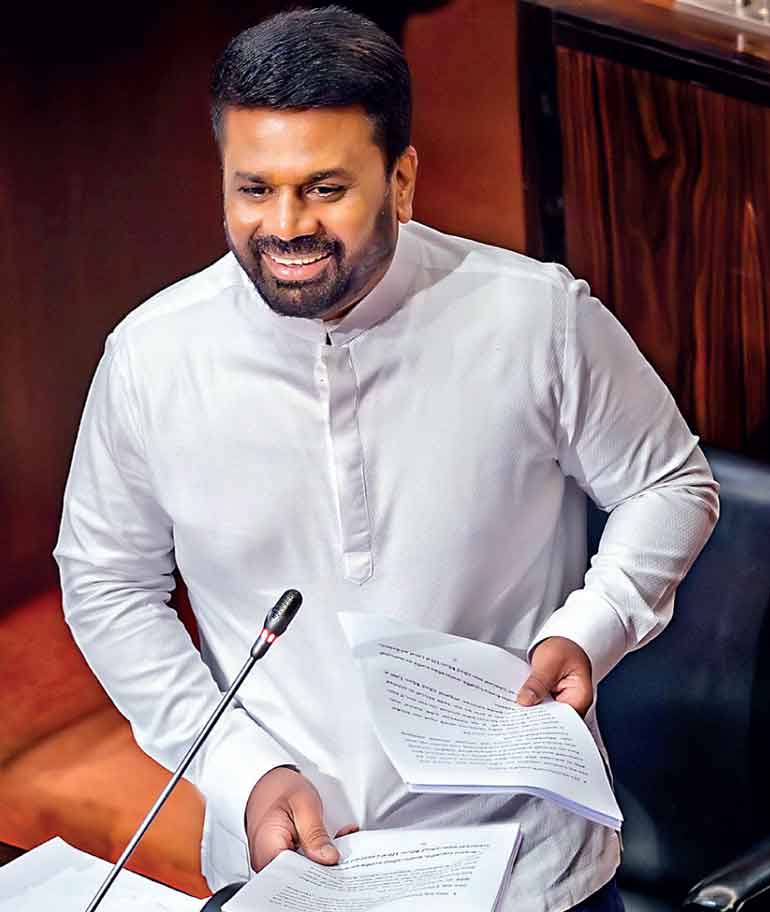
President and Finance Minister Anura Kumara Dissanayake
 The 12 November Budget must go beyond fiscal consolidation and revenue collection to deliver meaningful relief to households, strengthen businesses, stimulate investment and translate economic recovery into
sustainable prosperity
Introduction: A Budget at a critical economic crossroads
Sri Lanka’s 2027 Budget arrives at a pivotal stage of economic recovery. Since the 2022 crisis, the country has restored macroeconomic stability, strengthened public finances and resumed growth. However, recovery remains incomplete, with households and businesses continuing to face financial pressures. Presented on 12 November, 2026, the Budget 2027 offers an opportunity to move beyond fiscal stabilisation towards inclusive growth, employment, productivity and improved living standards.
The challenge is to transform economic recovery into tangible prosperity for the nation.
What exactly is a National Budget?
A national Budget is the Government’s annual financial and economic policy statement, outlining revenue, expenditure, borrowing and development priorities. It reflects the Government’s economic direction and commitment to national development. Through taxation, public spending, subsidies and investment, the Budget directly affects individuals, businesses and the wider economy—shaping living costs, public services, investment, employment and economic growth. Ultimately, a Budget’s success should be measured not merely by revenue collection or fiscal surpluses, but by its ability to transform public resources into tangible economic and social benefits.
Why the 2027 Budget is particularly important
Sri Lanka’s present circumstances demand a careful balance between economic discipline and public welfare.
1. Completing the economic recovery
According to the World Bank’s October 2026 Sri Lanka Development Update, the economy grew by 4.7% in the first half of 2026, with projected growth of 4.4% in 2026 and 4.2% in 2027. Although real GDP has returned to pre-crisis levels, poverty remains elevated, labour-market recovery is incomplete and household welfare improvements remain uneven. Budget 2027 must therefore move beyond macroeconomic stabilisation to strengthen sustainable growth, employment generation and inclusive economic development.
2. Addressing the cost of living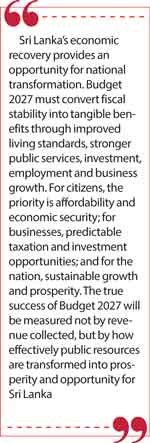
Despite improved economic stability, households continue to face financial pressures from food, transport, electricity, healthcare, education and housing costs. The cumulative impact of the economic crisis and fiscal adjustments has weakened purchasing power. Budget 2027 should therefore prioritise household affordability, improved public services and targeted social protection while maintaining fiscal sustainability.
3. Supporting business recovery and investment
Businesses continue to face higher taxation, compliance costs, financing constraints and operational uncertainties. Private-sector investment is vital for employment, exports, innovation and productivity. Budget 2027 should therefore promote a predictable, business-friendly environment that encourages investment, expansion, technological advancement and sustainable economic growth.
4. Maintaining fiscal discipline and debt sustainability
Sri Lanka’s recovery remains closely linked to its IMF-supported program and debt restructuring commitments. Maintaining fiscal discipline, strengthening revenue mobilisation and ensuring sustainable expenditure are essential. However, excessive taxation without improved public expenditure efficiency could weaken consumption, investment and public confidence. Budget 2027 must therefore balance fiscal responsibility with inclusive economic growth and improved public welfare.
What has the Government achieved through previous Budgets?
The Government’s fiscal performance during 2025 provides an important foundation for assessing the expectations surrounding Budget 2027.
Significant improvement in public finances
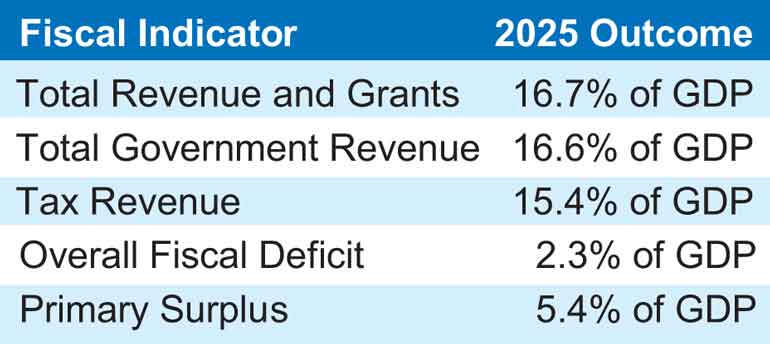
According to the IMF’s 2026 program review, Sri Lanka recorded the following fiscal outcomes in 2025:
The primary surplus reached 5.4% of GDP, significantly exceeding the 2.3% program target, while revenue and grants rose to 16.7% against the projected 14.7%. These achievements reflect improved fiscal management and revenue mobilisation (IMF, Sri Lanka Fifth and Sixth Reviews under the Extended Fund Facility, 2026).
Revenue mobilisation through taxation
Government revenue improved through economic recovery, stronger tax compliance and increased motor vehicle imports in 2025, which contributed approximately 2.8% of GDP in revenue, according to the IMF. However, this exceptional revenue reflects pent-up demand following import restrictions and may not be sustainable. Budget 2027 must therefore strengthen long-term revenue sustainability through broader tax compliance, economic expansion and a more productive tax base, rather than excessive reliance on exceptional or consumption-driven taxation.
Strengthening tax administration
The Government has continued modernising tax administration through expanded taxpayer registration, improved compliance and digital revenue collection. RAMIS 2.0 and enhanced VAT compliance are important developments. However, their effectiveness depends on efficient implementation, taxpayer accessibility and improved service delivery. Budget 2027 should further strengthen a transparent, efficient and taxpayer-friendly system that encourages voluntary compliance, economic activity and public confidence.
Budget 2027: What tax changes could we expect?
Taxation will be a key focus of Budget 2027, with households and businesses expecting tax relief, greater policy predictability and improved administration. However, significant tax reductions must be balanced against revenue requirements, debt sustainability and IMF commitments. The challenge is to introduce reforms that support economic activity and household welfare while preserving fiscal stability. The following areas deserve particular attention:
1. Personal Income Tax: Relief for employees and professionals
Personal income taxation remains an important concern for employees, professionals, consultants and self-employed individuals. Possible policy discussions may include:
A carefully designed revision of personal income tax could improve disposable income and encourage greater formal economic participation. However, the extent of any revision will depend on the Government’s revenue position and the policy commitments announced in the Budget.
2. Corporate Income Tax: Encouraging investment and enterprise development
Corporate taxation is particularly important for businesses operating in manufacturing, exports, tourism, technology, agriculture and professional services. Businesses require a predictable tax environment in which investment decisions can be made with confidence. Potential areas for consideration include:
Targeted tax incentives could stimulate investment, employment and taxable economic activity. Rather than granting indiscriminate concessions, the Government should consider incentives linked to measurable outcomes such as job creation, export growth, technological advancement and regional development.
3. VAT: Will consumers and businesses receive relief?
Value Added Tax (VAT), currently imposed at 18%, remains a major indirect tax affecting consumers and businesses. It influences consumer prices, business costs and working capital requirements. Budget 2027 is expected to address the following key VAT-related issues:
Any VAT rate reduction must be carefully assessed against its fiscal impact, as broad reductions could cause significant revenue losses. Targeted relief on essential goods and services, improved VAT refunds and simplified administration may offer a more sustainable alternative. For businesses, timely refunds, predictable administration, simplified filing and lower compliance costs could provide greater benefits than a general rate reduction.
4. Social Security Contribution Levy (SSCL): A major business concern
The Social Security Contribution Levy (SSCL), imposed at 2.5% on applicable turnover, represents a significant indirect tax burden on businesses. As it is generally based on turnover rather than profit, businesses operating on narrow margins may face considerable pressure, particularly across multiple stages of commercial activity. Budget 2027 could therefore consider:
A reduction or rationalisation of SSCL could improve business cash flow and competitiveness. Nevertheless, any substantial reduction would require careful consideration of revenue implications and the need to avoid creating further distortions within the taxation system.
5. Tax exemptions and concessions: A more targeted approach
Tax exemptions and concessions can promote economic development when properly designed. However, indiscriminate concessions may reduce revenue, create tax inequities and weaken the tax system. Budget 2027 offers an opportunity to review existing exemptions and establish a transparent, targeted framework focused on measurable economic and social benefits. Potential priorities include:
The emphasis should be on concessions that produce measurable economic benefits rather than exemptions granted without clear performance objectives.
The SME sector: The most important opportunity for Budget reform
Small and medium-sized enterprises (SMEs) are vital to Sri Lanka’s employment, domestic production, services and regional economic activity. However, they often face high compliance costs, limited access to finance, administrative complexity and competitive disadvantages. Budget 2027 could introduce a comprehensive SME support framework addressing:
An important consideration is the distinction between providing genuine assistance to small businesses and creating tax structures that encourage businesses to remain artificially below registration thresholds. The objective should be to encourage SMEs to grow, formalise and become more productive.
Beyond taxation: What should the Budget deliver to the general public?
The public’s expectations extend well beyond tax concessions.
Cost-of-living relief
The Budget should examine the affordability of essential goods and services and the efficiency of existing social support mechanisms. Targeted support for low-income households, vulnerable groups and economically disadvantaged communities would be more sustainable than poorly targeted subsidies.
Healthcare and education
Adequate allocations for healthcare, education and public infrastructure are essential for long-term development. The Government should prioritise improvements in service quality, accessibility and efficiency rather than focusing exclusively on increasing expenditure.
Employment and income generation
Sri Lanka requires employment opportunities that provide sustainable incomes and improve household economic security. The Budget should encourage private-sector investment, vocational training, entrepreneurship and productive employment opportunities.
Agriculture and food security
Agriculture remains essential for livelihoods, food security and rural development. Investment in irrigation, agricultural technology, storage facilities, value addition, logistics and market access could reduce wastage and improve farmer incomes.
Housing and infrastructure
Affordable housing, transport infrastructure, urban development and regional connectivity are important components of inclusive growth. Well-designed infrastructure investment can create employment while improving the productive capacity of the economy.
What should the business community expect?
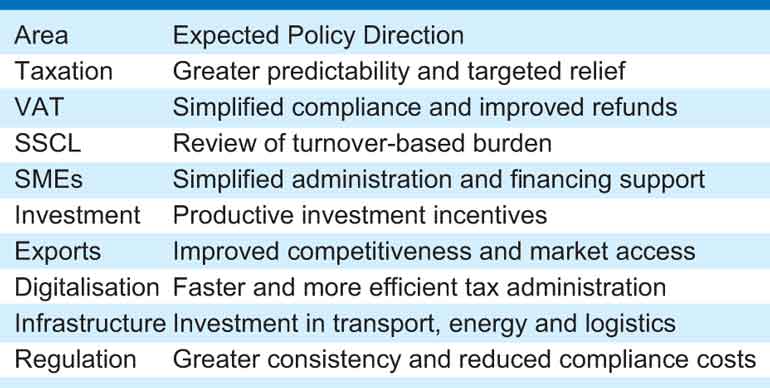
The business community will be particularly interested in whether Budget 2027 introduces a more predictable and investment-friendly environment. The following measures could have a meaningful impact:
Businesses need confidence that the tax and regulatory environment will remain stable. Frequent changes, unclear administrative interpretations and unpredictable enforcement can discourage investment even when headline tax rates appear attractive. The Budget should therefore communicate a clear medium-term economic policy framework.
Public expenditure: The other side of the Budget equation
A Budget must balance revenue mobilisation with expenditure efficiency, transparency and accountability. According to the IMF, total expenditure and net lending reached 19.0% of GDP in 2025, while capital expenditure and net lending accounted for approximately 3.0%. Budget 2027 should therefore balance fiscal consolidation with essential development investment, prioritising:
The objective should be to ensure that every rupee of public expenditure contributes meaningfully to national development.
Fiscal sustainability and the IMF program
Sri Lanka’s recovery depends on fiscal reforms and debt sustainability. The Government must secure adequate revenue to meet expenditure, service debt and maintain essential public services. However, excessive taxation can discourage investment, weaken consumption and encourage informality. Budget 2027 should therefore strengthen revenue quality and efficiency rather than rely solely on higher tax rates. A sustainable revenue strategy should emphasise:
The IMF has also highlighted the importance of sustaining compliance gains while carefully managing revenue risks as exceptional vehicle-related taxation normalises.
A new direction: From revenue collection to revenue productivity
Budget 2027 offers an opportunity to shift towards revenue productivity—generating sustainable tax revenue through economic growth, broader tax compliance, administrative efficiency and an expanded tax base rather than relying solely on higher rates or additional levies. Economic expansion can strengthen revenue through increased incomes, business activity, consumption and investment. Tax reforms should therefore encourage investment, enterprise growth and voluntary compliance while improving revenue efficiency, fiscal sustainability and private-sector development.
What would constitute a successful Budget 2027?
A successful Budget should be assessed against measurable outcomes rather than the number of proposals announced. The following indicators would provide a meaningful framework for evaluating its performance:
Conclusion: A Budget that must deliver more than economic stability
Sri Lanka’s economic recovery provides an opportunity for national transformation. Budget 2027 must convert fiscal stability into tangible benefits through improved living standards, stronger public services, investment, employment and business growth. For citizens, the priority is affordability and economic security; for businesses, predictable taxation and investment opportunities; and for the nation, sustainable growth and prosperity.
The true success of Budget 2027 will be measured not by revenue collected, but by how effectively public resources are transformed into prosperity and opportunity for Sri Lanka.