Monday Sep 14, 2026
Monday Sep 14, 2026
Wednesday, 21 January 2026 00:22 - - {{hitsCtrl.values.hits}}
 Sri Lanka is currently going through educational reforms, along with economic changes and other initiatives. Over the past seven to eight decades, Sri Lanka has undoubtedly achieved notable progress in many areas. At the same time, this journey has also come at a cost, with certain values, capabilities, and opportunities gradually eroding along the way. There needs to be a proper understanding of this. If we reflect carefully, we can see that even before colonial rule, we experienced several remarkable golden eras. The time has now come to reflect on all of these periods.
As an example, in the 2025 Human Development Index (HDI) released by the United Nations Development Program (UNDP), Sri Lanka is ranked 89th out of 193 countries, leading the South Asian region with strong achievements in education, health, and income. It is better for us to understand what is meant by the Human Development Index (HDI). HDI is a metric ranking that was introduced by the United Nations. For this ranking, you need to consider the following aspects:
1. Countries by average achievements in health (life expectancy)
2. education (schooling years), and
3. standard of living (GNI per capita)
The importance of this index is to provide you with a broader view of development beyond just economic growth. Here, you can see better education and health, always helping the country to prosper as two important indicators. Anyway, by looking at the Sri Lankan economy over the past eight years, Sri Lanka has been hit by a series of severe crises that have tested the country’s resilience. Beginning with the Easter Sunday terror attacks, followed by the prolonged disruptions caused by the COVID-19 pandemic, the nation has now faced another major blow with Cyclone Ditwah. Striking in late November, the cyclone stands out as one of the most intense and destructive events in Sri Lanka’s recent history, affecting nearly two million people and about 500,000 families across all 25 districts. Livelihoods were disrupted, essential services were damaged, and large parts of the economy came under pressure.
Passport matters
 Now it is time for Sri Lanka to have a strategic plan for the long run. In that context, there is a need for better policymaking, and we should have our SWOT analysis first. We need to discuss the nation’s branding, which should be one of the essential requirements for the country. Sri Lanka needs to have a better positioning strategy among other countries. And also the recognition of our passports is one of the important requirements.
Whatever country visits I have witnessed, the passport matters a lot for our own dignity. Our nation needs to understand this and analyse the current recognition of our passports. We can see an interconnected global economy in the current world where passport mobility is a proxy for international trust, diplomatic effectiveness, economic credibility, and institutional confidence. Passport strength can be assessed just by looking at factors such as how easily we, as citizens, can travel abroad without facing visa barriers. And also, if you are really fortunate to travel to many destinations without obtaining a visa in advance, that can also be considered an indicator.
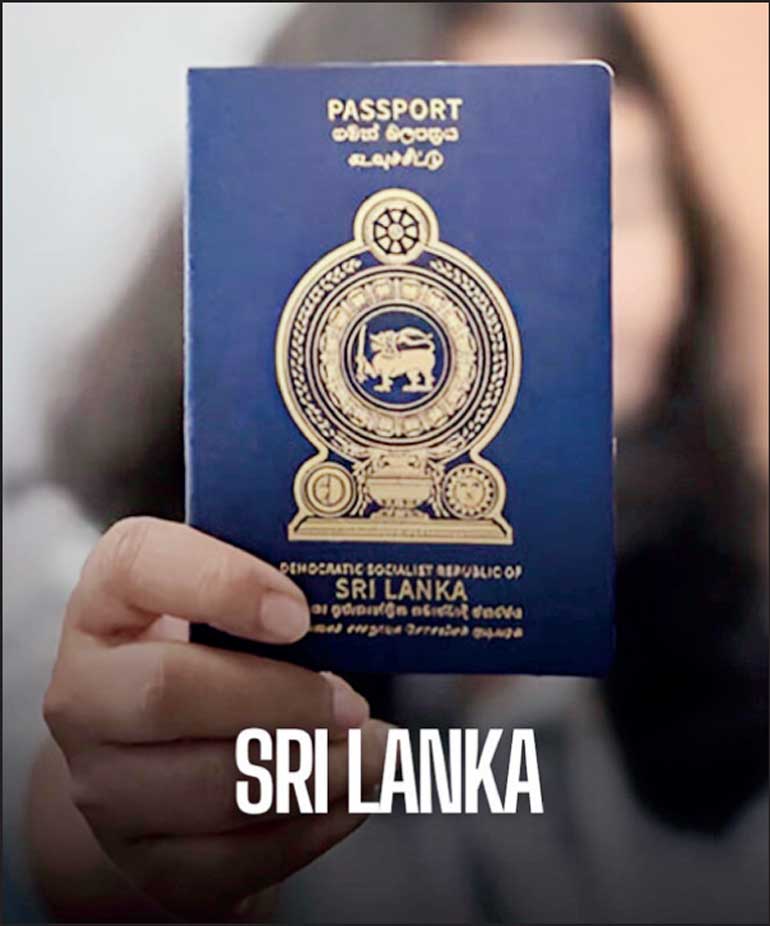
In the world, we can see many indices for benchmarking global passports. One of the most widely cited measures, the Henley Passport Index, ranks countries based on passport strength. In the newly released 2026 index, Sri Lanka is ranked 93rd globally among 199 passports. The top country is Singapore with 192 visa-free destinations. Singapore has held the top position for the past three years. The United Arab Emirates (UAE) can be considered as one of the strongest performers on the Henley Passport Index over the last 20 years. If you analyse from the year 2006 onwards, the country has added 149 visa-free destinations for its citizens. More interestingly, during this period United Arab Emirates moved up 57 places in the global rankings. Today, UAE passport holders can travel to 184 destinations without a visa. This progress was achieved through strong diplomatic relationships and active visa-free agreements with other countries. Sri Lanka can learn some lessons from the best practices of other countries.
We need to understand the recognition of the passport as a strategic national asset for the country. If you want to improve rankings, Sri Lanka needs to have a structured roadmap with clear targets. In case Sri Lanka needs to move into the 50th position in the globe, there should be some effective decision-making. It can be aligned with some strategies, such as proactive negotiations for reciprocal visa-free or visa-on-arrival arrangements and aligning visa facilitation with trade, investment agreements, and investment in secure biometric e-passport systems.
 Conclusion
There is an urgent need for a paradigm shift in Sri Lanka’s economy, where export diversification, strengthened governance, and institutional efficiency become essential pillars of reform. Passport strength reflects how the world sees Sri Lanka. It influences investor confidence, diaspora engagement, professional mobility, and youth aspirations. For a country seeking to reposition itself globally, improving passport mobility is both a practical reform and a reputational investment. Sri Lanka must adopt stronger, more effective strategies across multiple sectors. Building a resilient and prosperous future requires sound policymaking and clear strategic direction.
(The writer is a Professor in Management Studies at the Open University of Sri Lanka. He can be reached via email at [email protected].)




