Monday Sep 21, 2026
Monday Sep 21, 2026
Monday, 21 September 2026 00:20 - - {{hitsCtrl.values.hits}}
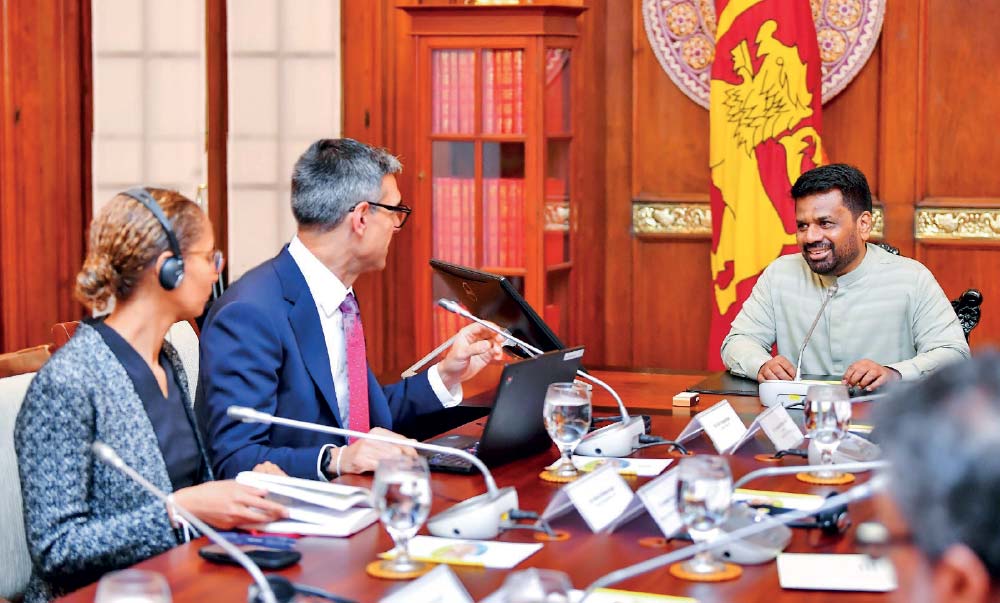
President Anura Kumara Dissanayake with IMF Sri Lanka Mission Chief Evan Papageorgiou and Resident Representative for Sri Lanka Martha Tesfaye Woldemichael during their meeting last week
 The question of what comes after March 2027 deserves a harder answer than an instinctive return to Washington. Four years into this program, it is worth asking not only what the reform effort has built, and for whom, but whether a 17th encounter with the Fund, and now an 18th, is actually capable of fixing what is wrong with the model
Before the mechanics of fiscal policy, it is worth asking who has actually paid for this stabilisation
 Four years after Sri Lanka defaulted on its external debt, the country’s economic stabilisation is, by most conventional measures, a genuine achievement. Reserves have been rebuilt, a primary surplus delivered, debt restructuring is largely complete, and the sovereign rating has been moving in the right direction. It was against this backdrop that Ceylon Chamber of Commerce Chairperson Krishan Balendra, used the Sri Lanka Retail Forum 2026 to argue that Sri Lanka should consider a follow-on International Monetary Fund (IMF)-supported program, or an equivalent framework, once the current Extended Fund Facility (EFF) lapses in March 2027. He deserves to be heard. Few people have watched the mechanics of this crisis and recovery as closely as he has, and his instinct that reform momentum should not evaporate the moment the program’s final review is signed off is not wrong. Where I part company with him is on the remedy.
The question of what comes after March 2027 deserves a harder answer than an instinctive return to Washington. Four years into this program, it is worth asking not only what the reform effort has built, and for whom, but whether a 17th encounter with the Fund, and now an 18th, is actually capable of fixing what is wrong with the model. My own view is that it is not, and that Sri Lanka should resist the pull towards a follow-on arrangement rather than sign up for one.
The human cost
Before the mechanics of fiscal policy, it is worth asking who has actually paid for this stabilisation. Public sector salaries were frozen for extended periods even as inflation eroded their value, hitting hardest the households least able to absorb it. On the Government’s own figures, more than four-fifths of State expenditure still goes on salaries, welfare and debt interest, leaving little room for the infrastructure, health and education spending that builds lasting resilience. In a recent international comparison, Sri Lanka’s minimum wage, adjusted for purchasing power, ranked 120th out of 130 countries, among the lowest anywhere in the world, and the World Food Program has had to mount an emergency response to worsening food insecurity even as Colombo’s investor conferences describe a recovery well under way. None of this means adjustment was avoidable in 2022; it almost certainly was not. It does mean the human cost has been severe, is still being paid, and deserves to weigh as heavily in this debate as the movement of a sovereign rating.
Tax burden
Start with an uncomfortable point at the heart of the program’s own design. Sri Lanka’s overall tax revenue rose from roughly 8% of GDP in 2021 to almost 14% by 2024, one of the fastest fiscal turnarounds anywhere, driven overwhelmingly by value added tax, raised to 18% having been cut to as little as 8% in the tax giveaways of 2019 that helped trigger the crisis. The standard corporate income tax rate rose to 30%, and, at the IMF’s own repeated urging, a raft of opaque tax holidays and what one 2024 assessment bluntly summarised as “corporate freebies” were wound down. That correction was overdue: generous, poorly targeted exemptions were, as researchers have documented, one of the quieter causes of the fiscal collapse, starving public services of revenue while doing little to broaden the economy. Nobody serious should want that regime back.
The trouble is what has, and has not, replaced it. Recent proposals reported by tax advisers narrow the surviving investment incentive regime to a defined category of “strategic investments”, large-scale, capital-intensive projects clearing a high monetary threshold, a sensible way to prevent abuse. But it also means the incentive toolkit that remains is built for multinational-scale capital, not for the small manufacturer, the family retailer expanding to a second town, or the start-up entering a market an established player already dominates.
An incumbent absorbs a higher tax rate out of a margin built over years of trading; a new entrant meets the full rate on day one, with no cushion and no exemption to offset the risk of entering at all.
Remove the tariff wall, as the Government is rightly doing, and cheaper imports flow in; but if entering the market carries a heavier tax burden than before, entry becomes less attractive at precisely the moment competition is meant to rise. That is not liberalisation; it is exposure without invitation, an asymmetry that four years of revenue-first conditionality produced, and there is no reason to expect a follow-on program, built on the same template, to produce anything different.
If Sri Lanka’s business community genuinely wants the durable expansion it says it wants, rather than a stabilisation that simply protects whoever already held the largest market share in 2022, it should be wary of an arrangement whose own record, over four years, has done nothing to correct this. Extending it is more likely to entrench the imbalance than resolve it
Cost-reflective pricing and privatisation
Fiscal reform has not been the only channel through which the program has reached into people’s lives. Successive reviews have pushed Sri Lanka to move electricity and fuel pricing onto a cost-reflective footing, defensible in theory but productive in practice of steep tariff rises for households and energy-intensive industry alike, weakening the competitiveness of the very manufacturers the Government says it wants to support. In parallel, the Ceylon Electricity Board has been unbundled into separate generation, transmission and distribution companies under new legislation, one strand of a wider restructuring of the State-owned enterprise sector, and its unions have moved in and out of industrial action over job security.
Restructuring loss-making State enterprises is not, in itself, a bad idea; many have drained the budget for decades. But doing so to an externally set timetable differs from doing so at a pace reflecting Sri Lanka’s own capacity to absorb the change. A follow-on program would keep that timetable in foreign hands, not domestic ones.
Concerns to the corporate sector
This ought to concern the corporate sector every bit as much as small traders, and arguably more so, in a debate dominated by talk of ratings and reserves. A market with few genuine challengers is not stable in any durable sense; it is simply quiet.
Existing businesses facing little credible threat of new entry have less reason to cut prices, improve service, or invest in productivity, precisely the complacency that leaves an economy exposed when the next shock arrives. Corporate profits have strengthened markedly for a number of large listed firms even as households struggle, pointing to gains flowing disproportionately to capital rather than to broad-based investment and employment. If Sri Lanka’s business community genuinely wants the durable expansion it says it wants, rather than a stabilisation that simply protects whoever already held the largest market share in 2022, it should be wary of an arrangement whose own record, over four years, has done nothing to correct this. Extending it is more likely to entrench the imbalance than resolve it.
And underneath the corporate question sits a socio-economic one that the program’s own design does little to address. When markets stay concentrated because entry is discouraged, ordinary Sri Lankans do not receive the part of the stabilisation dividend that is supposed to reach them: lower prices from genuine competition, more choice, and jobs created by challengers rather than only by existing businesses consolidating their position. Macroeconomic stability and a household’s lived experience of stability are not automatically the same thing, and after four years under this program, the gap between them is still wide. A further term of the same conditionality is unlikely to close it; there is little in the program’s design that even targets it.
A cycle repeating itself
It is worth placing the current program in its proper historical context. This is not Sri Lanka’s first encounter with the Fund; it is the 17th arrangement since 1965, and a follow-on would be the 18th. Analysts who have studied this pattern describe a recurring cycle: a Balance-of-Payments crisis forces the country to the Fund, stabilisation follows, and the underlying weaknesses, a narrow export base, weak domestic revenue mobilisation, and thin productive investment, are addressed only partially before the next shock arrives and the cycle begins again.
Sixteen previous arrangements did not break that pattern, and there is little in the design of a 17th, or an 18th, to suggest this time would be structurally different, particularly if its instruments remain the same: raise taxes, restrain spending, hold the exchange rate steady, and wait.
Macroeconomic stability and a household’s lived experience of stability are not automatically the same thing, and after four years under this program, the gap between them is still wide. A further term of the same conditionality is unlikely to close it; there is little in the program’s design that even targets it
What Sri Lanka has bought with four hard years of adjustment is not a ticket to another program; it is the option not to need one
No more repetitions
None of this is an argument against fiscal discipline, or against the idea that policy predictability matters to anyone committing capital. It plainly does. It is an argument against assuming that discipline has to keep arriving in the shape of a Fund program. The IMF’s mandate is external stability and debt sustainability, not competition policy, and four years of conditionality have shown clearly what that mandate does and does not reach: it will widen the tax base and tighten the primary balance, but it will not build a transparent, rules-based incentive regime open to firms of any size, or protect small businesses exposed to liberalisation without the tools to survive it. There is no reason to expect a follow-on arrangement, built to the same template, to reach further than the current one has.
The case for doing it alone
What Sri Lanka has bought with four hard years of adjustment is not a ticket to another program; it is the option not to need one. Reserves are rebuilt, the debt is restructured, inflation has fallen a long way from its peak, and the rupee no longer prices in imminent default. That is the platform from which a country should start setting its own terms: a domestically anchored fiscal responsibility framework, an independent central bank already legislated for, and a competition authority with the power and the appetite to challenge concentrated markets, rather than a conditionality regime that has had four years to address these questions and has not.
A self-directed path would look different in substance, not only in name. It would deepen domestic revenue mobilisation in a more equitable direction, targeting under-taxed wealth and property rather than repeatedly reaching for VAT increases that fall hardest on lower-income households. It would deepen domestic capital markets so that Sri Lankan savings, not only external creditors, are channelled into national development priorities. It would diversify exports beyond tourism and garments and prioritise productive foreign direct investment over the debt-creating flows that have repeatedly brought the country back to the Fund’s door. And it would pursue state-enterprise reform and public investment on Sri Lanka’s own timetable, not externally set benchmarks.
Reform momentum does not require an external anchor; it requires a Government willing to keep faith with its own targets without Washington’s prompting. Sri Lanka has just spent four years demonstrating, at real cost to its own people, that it is capable of exactly that discipline.
Answering the case for continuity
Balendra’s case deserves to be met on its specifics, not dismissed in general terms. He has argued that a follow-on program would preserve reform momentum and policy credibility; but credibility built on continuous external oversight is not durable domestic reform, and if momentum can only survive while the Fund remains present, that signals a gap in domestic institutions, not a reason to keep renewing the anchor indefinitely. He has argued that continuity would reassure investors and support further rating upgrades that lower borrowing costs; but rating agencies weigh growth, debt sustainability, and social and political stability, not merely the presence of a Fund program, and continued wage stagnation, food insecurity and industrial unrest are themselves stability risks that could offset any claimed ratings benefit, while lower borrowing costs flow mainly to Government and large, capital-market-facing borrowers, doing little for the small retailer squeezed by high interest rates, new taxes and rising utility bills.
He is right that predictability is among the most valuable economic infrastructure a business can be offered; but it can be built domestically, through legislated fiscal rules, an independent central bank, transparent State-enterprise governance and a published medium-term revenue strategy, rather than a rolling cycle of quarterly reviews and shifting performance criteria that are themselves a recurring source of the uncertainty being warned against. And he is right that Sri Lanka’s proximity to India and the Port of Colombo’s transshipment role represent a genuine opportunity; but that is an argument for confidence in the country’s own trajectory, not continued dependence on an external program to validate it, and trade facilitation and customs modernisation can proceed on their own merits and timetable, as domestic reform ownership rather than a loan condition.
There is also a tension worth naming directly, between the Chamber’s wish to see small and medium enterprises grow into national champions and its call for a follow-on program on the same template as the last. It has been precisely the VAT increases, high interest rates and cost-reflective pricing of the current arrangement that have squeezed small and medium retailers hardest. A further program on the same conditionality risks undermining the very sector the Chamber says it wants to nurture, unless its design departs substantially from what has gone before. More broadly, the Chamber’s membership is weighted towards larger, formal-sector and listed businesses, for whom sovereign ratings and capital market access are naturally high priorities, legitimately so. They do not automatically align with the interests of small retailers, informal-sector workers and the households bearing the direct cost of adjustment, and any assessment of whether to continue should weigh both sets of interests, not treat the business case for continuity as the whole picture.
Reform momentum does not require an external anchor; it requires a Government willing to keep faith with its own targets without Washington’s prompting. Sri Lanka has just spent four years demonstrating, at real cost to its own people, that it is capable of exactly that discipline
Other side of the ledger
A fair case against continuity should also weigh the risks on the other side of it. Sri Lanka faces a demanding schedule of external debt repayments that begins to bite from 2028, and some economists warn that stepping away from IMF engagement could unsettle investor confidence at a delicate moment in that repayment profile. Rating agencies and bondholders may read an early exit as reduced commitment to reform, itself raising borrowing costs, the opposite of what continuity is meant to achieve. Forgoing a further program would therefore need to be matched by a credible, clearly communicated domestic reform and financing plan, so the exit is read as confidence rather than retreat. That is a real constraint on how, and how quickly, Sri Lanka disengages from the Fund. It is not, however, an argument for defaulting to another arrangement simply because it is familiar.
Sri Lanka’s business leaders and institutions have every right to a leading voice in this conversation, and the country is better for having them make the case for discipline in public rather than only in private. But the end of the EFF in March 2027 is a genuine choice point, not merely a formality, and the right answer is not an instinctive return for an 18th arrangement, however reassuring that might sound to investors.
The question worth putting to policymakers, and to the business voices calling for continuity, is not simply whether to renew, but whether continued Fund engagement is actually resolving Sri Lanka’s structural weaknesses or merely managing the symptoms, while the human and business cost of adjustment keeps being paid, again and again, by the same people. Tested against that question, rather than a rating agency’s spreadsheet, the case for a follow-on program has yet to be made.
(The author is a President’s Counsel and a Member of Parliament)




