Sunday Sep 13, 2026
Sunday Sep 13, 2026
Wednesday, 8 July 2026 00:20 - - {{hitsCtrl.values.hits}}
 Background
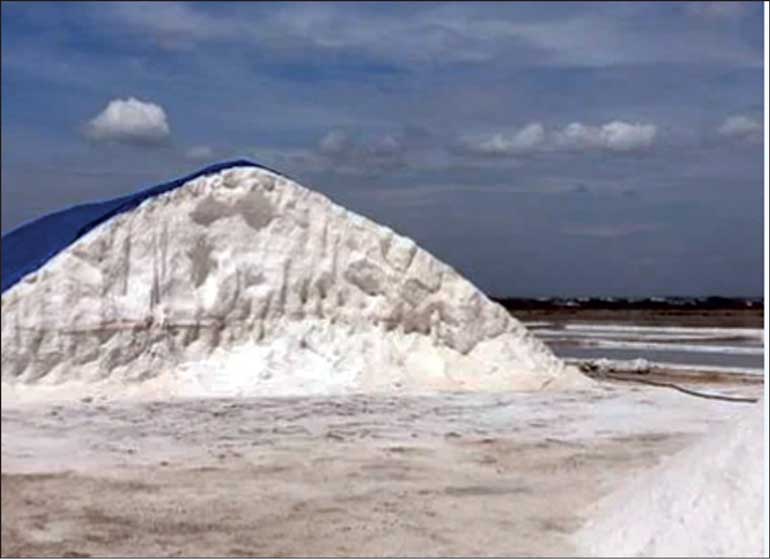
Sri Lanka has incurred an estimated foreign exchange loss exceeding $100 million as a result of the Government's delay of more than one year in deciding the fate of approximately 50,000 metric tons of imported salt. The consignments comprise approximately 42,000 metric tons imported in 1,500 containers and a further 10,000 metric tons imported as bulk cargo.
The prolonged delay has resulted in substantial economic losses, including the locking up of scarce foreign exchange, port and container demurrage charges, storage costs, deterioration in product quality, and the inability to release the salt to the domestic market despite shortages that originally prompted its importation.
Regulatory Background
Under normal circumstances, the importation of salt is a restricted import requiring an Import Control Licence (ICL).
However, due to severe shortages in local salt production caused by continuous rains during January - March 2025, the Government temporarily relaxed these controls by issuing Extraordinary Gazette No. 2437/04 dated 19 May 2025.
The Gazette provided that:
Problems Arising from the Gazette
While the Gazette successfully addressed the immediate shortage of salt, it also created several unintended consequences.
1. No import quantity ceiling
The Gazette exempted licensing requirements but failed to prescribe an upper limit on the quantity of salt that could be imported.
Consequently, importers brought in significantly larger quantities than required, mainly from India and, to a lesser extent, China. The excessive imports defeated the original objective of merely bridging the domestic supply shortage.
2. Mandatory standards compliance
Imported salt is also subject to mandatory inspection by the Sri Lanka Standards Institute before being released for local consumption.
A considerable number of consignments failed to comply with either:
n the prescribed quality standards, particularly the required iodine content.
3. Unequal treatment of exporting countries
The Gazette required shipment on board on or before 10 June 2025.
This requirement unintentionally favoured imports from India, where transit time to Sri Lanka is approximately 4 days, while shipments from China require approximately 20 days.
Although both countries exported within commercially reasonable timelines, the regulation effectively disadvantaged suppliers from more distant origins.
Economic Consequences of the Delay
More than one year has now elapsed without a final Government decision regarding the disposal of these consignments.
During this period:
Expiry of shelf life
The normal shelf life of iodized salt is approximately 18 months.
Given the prolonged delay, much of the imported salt has now exceeded its recommended shelf life. Even if approval is granted today, questions remain regarding its suitability for direct human consumption without further testing and processing.
This has significantly reduced the commercial value of the consignments and represents a major waste of national resources.
The way forward
At this late stage, re-exporting the consignments is unlikely to be commercially viable or economically sensible.
The most practical option may be for the Government to release the consignments to the National Salt Limited for technical evaluation, possible reprocessing, quality restoration where feasible, and controlled utilisation.
This approach could minimise further losses, recover some economic value from the imported salt, and reduce the financial burden already borne by importers and the national economy.
Conclusion
The imported salt was originally permitted under emergency measures to safeguard national food security during a period of inadequate local production. However, the absence of an import quantity ceiling, combined with regulatory non-compliance by some importers and the prolonged delay in reaching a final decision, has transformed an emergency import program into a significant economic loss.
The result has been the locking up of more than 50,000 metric tons of imported salt, the loss of over $100 million in scarce foreign exchange and logistics costs, expiry of product shelf life, and the continued inability to utilise a valuable natural resource.
An urgent and practical decision is now required to recover whatever value remains from these consignments while preventing further losses to the country.
(The author is the President, Customs House Agents and Traders Association)
Reference: https://www.sundaytimes.lk/260125/news/customs-sticks-to-rule-and-importers-wont-re-export-delayed-salt-cargo-629545.html




