Wednesday Oct 28, 2026
Wednesday Oct 28, 2026
Thursday, 23 July 2026 13:24 - - {{hitsCtrl.values.hits}}
By M Peiris
For most of the last century, manufacturing followed a simple pattern: take raw materials, make a product, sell it, and let the customer worry about what happens once it wears out. That model, often called the linear economy, worked well enough when materials were cheap, and landfill space seemed endless. Neither of those assumptions holds up anymore. Raw material prices have grown less predictable, waste disposal has become more expensive and more regulated, and customers are asking harder questions about what happens to a product after they’re done with it. Manufacturers are responding by borrowing an old idea and giving it a new name: the circular economy.
Keeping Materials in Use Longer
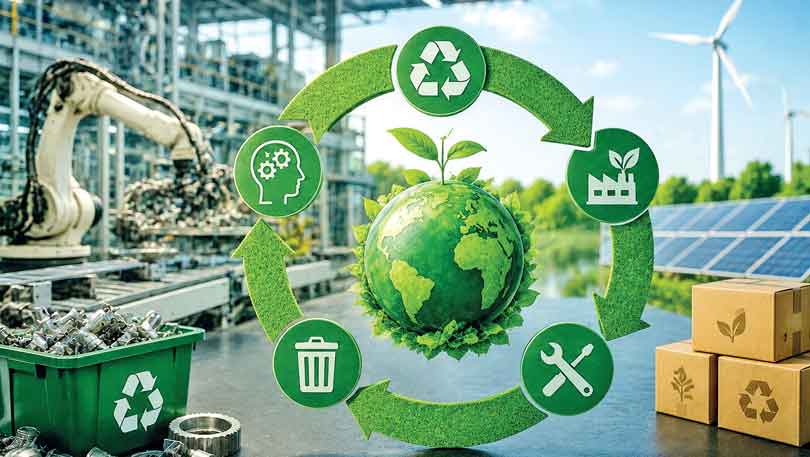
The basic idea is straightforward. Instead of a straight line from raw material to landfill, a circular approach tries to keep materials in use for as long as possible, through repair, reuse, and recycling, before anything is thrown away. A washing machine designed to be taken apart and rebuilt rather than scrapped. A phone manufacturer that buys back old devices to recover valuable metals rather than mining new ones. A furniture company that leases desks and chairs to offices, then refurbishes and re-leases them once a tenant moves out. These aren’t hypothetical examples; companies in each of these industries already run programs like this, and the ones doing it well have found it cuts costs as often as it cuts waste.
The Financial Case for Recovering Materials
The financial case starts with materials. Many of the metals and minerals used in manufacturing, from copper to lithium, come from a small number of countries, and prices can spike sharply when supply gets disrupted by conflict, trade disputes, or simple scarcity. A company that recovers these materials from its own used products, rather than depending entirely on new mining, insulates itself from those price swings. Electronics manufacturers have been especially aggressive here, since the metals inside old devices are often more concentrated and easier to extract than what’s found in freshly mined ore.
Designing Products to Come Apart
Product design plays a bigger role in this shift than most people realise. A product built to be taken apart easily, with screws instead of glue, standard parts instead of proprietary ones, costs a little more to design upfront but saves considerably at the end of its life, when it needs to be repaired, refurbished, or recycled. Car manufacturers have started applying this thinking to batteries, designing them so individual cells can be replaced rather than requiring the whole battery pack to be discarded. This kind of design takes longer to plan and test, but it pays off across the entire lifespan of the product, not just at the point of sale.
Selling a Service Instead of a Product
Manufacturers have also started rethinking their relationship with customers, moving from simply selling a product to offering it as a service. Some equipment makers now lease machinery to factories rather than selling it outright, staying responsible for maintenance and eventual refurbishment. This arrangement gives the manufacturer a direct financial reason to build something durable and repairable, since they’re the ones who’ll deal with it at the end of its useful life rather than passing that cost on to someone else. It also gives customers lower upfront costs and equipment that’s properly maintained throughout its use.
The Real Obstacles Still in the Way
There are real obstacles here, and it would be misleading to suggest otherwise. Building a system to collect, sort, and refurbish used products is expensive to set up, and it doesn’t pay off immediately. Recycled materials are sometimes lower quality than virgin materials, which can limit where they’re used. And coordinating with suppliers and customers on a circular model requires a level of long-term planning that many manufacturers, especially smaller ones, simply don’t have the resources for yet. These aren’t reasons to dismiss the approach, but they explain why adoption has been gradual rather than sudden.
Regulation Is Forcing the Pace
Regulation is starting to close the gap between where manufacturers are and where they need to be. Several countries now require manufacturers to take financial responsibility for their products at the end of their life, covering the cost of collection and recycling rather than leaving it entirely to local governments. This kind of rule changes the calculation quickly: a company that designed products for easy disassembly from the start faces a much smaller bill than one that didn’t plan at all.
The manufacturers moving fastest on circular practices aren’t necessarily doing it out of environmental conviction alone. They’re doing it because it reduces exposure to volatile material costs, meets tightening regulations, and increasingly matches what buyers, especially large corporate and government buyers, are asking for in their contracts. Circular economy practices, in that sense, look less like an environmental add-on and more like a basic update to how manufacturing has always tried to manage cost and risk.




