Tuesday Jul 28, 2026
Tuesday Jul 28, 2026
Tuesday, 28 July 2026 00:34 - - {{hitsCtrl.values.hits}}
 Female labour force participation in Sri Lanka has fallen from a peak of over 45% in 1990 to approximately 30% today, reflecting a significant reversal on decades of hard fought progress.
While the reasons for this decline are not a mystery, they are also not discussed openly enough to have broken into public awareness in any meaningful way. The most recent explanation of why women leave the labour force can be found in the results of the Sri Lanka Labour Force Survey conducted by the Department of Census and Statistics.
56% of women who are not in the labour force cited domestic and care responsibilities as the reason for not seeking paid employment, where only 5% of men gave a similar response. The Time Use Survey conducted by the Department of Census and Statistics in 2017 found that on average, women spend four hours more per day than men on domestic activities, and an additional hour on direct care; children, the elderly, the sick.
In total, it is estimated that 86% of all unpaid care work in Sri Lanka is performed by women. The gap between what women are capable of and what the economy receives from them is not a deficit of ambition. It is a deficit of time — taken by work that no one counts.
Too often, the implications of this growing disparity have been viewed solely from the lens of economic opportunity; the GDP potential, the talent pipeline, the productivity gains available if women could only participate more fully. That framing is not wrong, but it is incomplete.
The disproportionate burden of care work on women is also a human rights issue and a women’s rights issue, and both have to be named and considered together. The issue shouldn’t be centered around how to extract more productive labour from women, but to build a system where all forms of labour – including the labour of care is valued fairly, and every woman is empowered with a genuine choice — to work, to care, or both without one coming at the cost of the other.
Gap in Sri Lanka’s fair care economy
The gendered division of unpaid labour is not incidental. It costs women their time, economic independence, and career trajectories. Unpaid care work is the infrastructure the formal economy depends on, and yet it appears nowhere in a national account or a GDP figure. A woman managing a household, raising children, and caring for an ageing parent is doing labour that keeps everything else running, even though no ledger records it.
That statistical invisibility has consequences. The less this work is counted, the less visible women’s contribution becomes, and the harder it becomes to argue that it should be shared, supported, or valued at all.
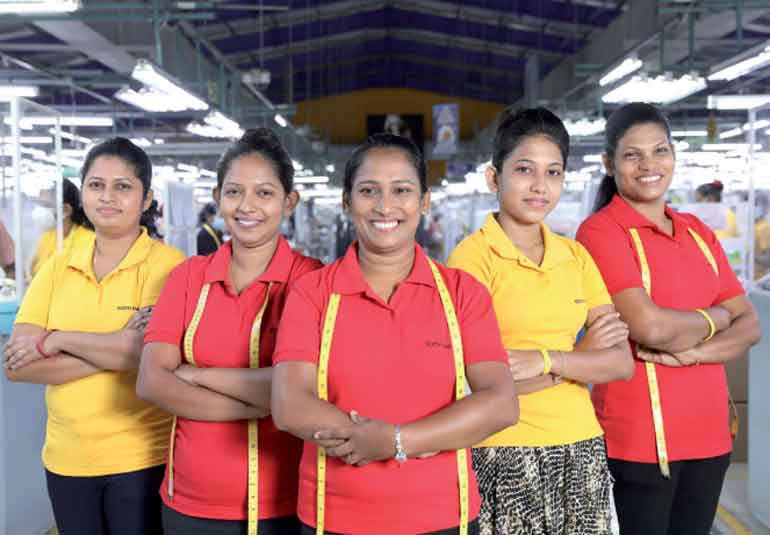
MAS Holdings offers a concrete example of how this plays out at scale across different levels of working life. As an apparel company with a large female workforce and over two decades of work on gender equity, its experience runs from the factory floor all the way up to the boardroom.
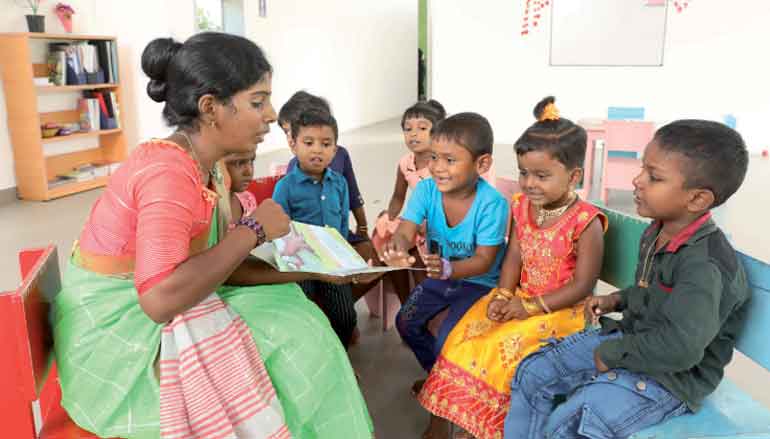
At the factory floor level, a crèche, a subsidy, or a safe transport arrangement can be the difference between a woman being able to hold a job or not. Where childcare facilities have been put in place, absenteeism dropped by around 9%, a clear indication that support at home shows up in performance at work.
Depending on where people are based or the work level or job role they perform, the barrier can look different, though it comes from the same root. A daily creche facility may not be what some parents need, it might be back up care for when grandparents or a nanny is unavailable, it could be after school care for slightly older children.
It is rarely ambition or capability that holds women back. It is the weight of what’s waiting for them at home once the meetings end. Running a household takes a kind of attention that doesn’t switch off the moment someone walks into a meeting. Yet that’s often what sits behind a promotion being turned down.
Addressing the roots, built into norms
This is the more uncomfortable finding: Even when the infrastructure works, it is still not enough. Care support can be built and funded. But that does not touch the burden that is simply assumed. Daycare centres, subsidies, and flexible hours address the visible part of the problem
What they don’t reach is an expectation, rarely spoken but deeply held, that care is solely a woman’s responsibility. These internalised beliefs show up in how children are raised, in how couples divide the work of a household, and in how elderly parents are looked after in homes where three generations live under one roof.
The stigma around institutional elderly care makes this visible. Placing a parent in a care facility is still widely read as a failure of duty, and it is women, more often than men, who carry that judgement. Nor is the reluctance irrational: for most families, the alternatives are neither regulated nor affordable. But where there is no real option, the default is not a decision. It is an assignment, and it is made on the basis of gender.
A childcare subsidy cannot undo an expectation rooted in social shame. Infrastructure eases the immediate pressure; lasting change requires the underlying norm to shift. That is slower work, and harder to measure, but it is where progress actually happens.
What else needs to change?
The ILO’s 2024 Resolution on Decent Work and the Care Economy places this issue on the global development agenda. A well-structured care economy strengthens resilience, advances gender equality, and supports economic development. Governments, employers, and communities each have a role in building it.
Governments need policy frameworks that treat care as a sector in its own right. They need to fund accessible public infrastructure and enable flexible work in practice. Employers also need a range of responses because care needs differ across a workforce.
Backup childcare may work for one employee, crèche access for another, and an allowance or flexible scheduling for someone else. Extending care benefits and flexible arrangements to men is essential because shared access can begin to change expectations inside organisations and at home
Families and communities also shape how care is understood and distributed. The first step is to name what is already happening at home: unpaid care is work, and the way it is divided can be changed. Recognising that gives women greater space to describe what they carry and to influence the solutions developed within households, workplaces, and national policy.
An effective care ecosystem will take shape when the expectations formed at home, the support available at work, and the infrastructure created through public policy begin to reinforce one another.
Families influence who is expected to care. Employers experience the consequences through workforce participation, attendance, retention, and progression. Governments determine whether dependable care remains available only to those who can afford it or becomes part of the infrastructure on which a functioning society depends. When these systems fail to connect, women are left to absorb the gaps between them.
Designing a fairer system also requires listening to the different realities women carry. A factory employee who depends on safe transport, a manager caring for an ageing parent, and a mother returning to work after childbirth face different pressures and require different forms of support. Surfacing those needs is itself foundational to building a care system that works.
Giving care an economic value is an important step, but fairness must ultimately be measured by whether women have a voice in how care is shared and supported, whether responsibility is distributed more evenly, and whether the choice to work, care, or do both is genuinely theirs.
That is the care economy Sri Lanka should work towards: one that recognises care as essential work, strengthens families and businesses, and allows women to protect their independence and future while caring for the people who depend on them
Listen to the full episode on “Conversations That Count 2.0” podcast on Faircare here - https://masholdings.com/podcast-category/conversations-that-count-2-0/?episode=10570
( The authors are Dr. Gayathri Lokuge, Team Leader – Livelihood and Employment at the Centre for Poverty Analysis, and Thanuja Jayawardene, Head of Women’s Empowerment and Advocacy at MAS )




