Sunday Sep 13, 2026
Sunday Sep 13, 2026
Monday, 2 February 2026 01:04 - - {{hitsCtrl.values.hits}}
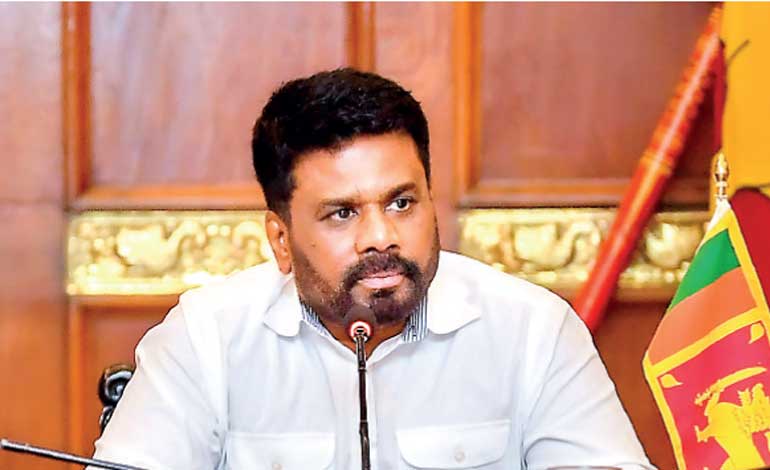
Finance Minister and President Anura Kumara Dissanayake
The President Anura Kumara Dissanayake-led National People’s Power (NPP) Government presented its first full-year Budget last November under the Public Financial Management (PFM) Act, which has exposed persistent weaknesses in disclosure, monitoring, and Parliamentary oversight, according to Verité Research, raising concerns over Parliament’s ability to effectively scrutinise public spending despite recent legal reforms.
Last week, Verité Research released the fifth edition of its annual State of the Budget 2026, which provides an independent analysis of Sri Lanka’s 2026 Budget. It assesses four aspects of the Budget: (1) Assumptions of the financial, economic, and fiscal foundations; (2) accuracy of the basis and calculation of estimates; (3) compliance with the PFM Act; and (4) adequacy with regard to information and integrity of the numbers.
“The State of the Budget 2026 report shows an important improvement from the previous assessed years. That is, the revenue estimates in the Budget are assessed to be realistic and reasonable within the existing policy context, unlike in the past,” the economic policy think tank said.
“However, the report also shows that several longstanding concerns remain unresolved. This includes inconsistent information, missing estimates, and inadequate disclosure of critical assumptions used in Budget preparation,” it said.
While the new public finance framework has strengthened formal fiscal rules, it has not yet translated into effective oversight in practice, pointing to limited analytical and staffing capacity within the Parliamentary Budget Office and the Committee on Public Finance (CoPF).
The report identifies defence sector spending on diets and uniforms and Government vehicle procurement as illustrative of broader governance shortcomings in the Budget process, rather than as isolated problem areas.
Verité shows that total defence sector spending on diets and uniforms is projected to rise by 299% between 2022 and 2026, far exceeding cumulative inflation of around 80% over the same period. Spending on diets and uniforms under the Defence Ministry tripled in 2024, while the corresponding provision under the Public Security Ministry increased 17-fold, reflecting shifts in institutional classification rather than a reduction in underlying expenditure. Although the combined allocation for 2026 is expected to decline by 12.7% compared to 2025, the report noted that “the problem shifted rather than being resolved.”
“The issue is not the spending, nor allocations. It is how they are disclosed or not disclosed,” a market analyst said. “Key economic forecasts vary from the different Budget documents, and there is not clear justifications for them that could give stakeholders a clear picture of the basis on which the Budget is based on.”
The report stressed that the concern was not the legitimacy of compensating military personnel following real income erosion during the economic crisis, but the lack of transparent disclosure at the Budget formulation stage, with key recurrent spending decisions embedded in estimates rather than clearly articulated to Parliament.
A similar pattern was observed in Government vehicle procurement. The Budget 2026 allocates Rs. 19.4 billion for the acquisition of vehicles and a further Rs. 12.5 billion under a new proposal to provide vehicles and machinery to Government institutions and Provincial Councils. The combined allocation of Rs. 32 billion represents a 96% increase from the revised 2025 estimate of Rs. 16.3 billion.
Verité also pointed to a Finance Ministry tender issued in October 2025 for the procurement of 1,775 double-cab vehicles, noting that the implied cost, based on estimated unit prices, exceeded Rs. 37 billion, surpassing the total allocation provided in the estimates.
Beyond individual expenditure lines, the report documented material numerical discrepancies across core Budget documents. The Budget Speech projected tax revenue of Rs. 4,910 billion for 2026, while the Draft Budget Estimates recorded Rs. 4,850 billion, creating an unexplained gap of Rs. 60 billion. Taxes on goods and services showed a larger variance of Rs. 118 billion between the two documents, with no reconciliation provided to Parliament.
The report also highlighted inconsistencies in macroeconomic assumptions. Inflation measured by the GDP deflator was cited at 5.3% in the Fiscal Strategy Statement, but later reported to the CoPF as 3.2%. Real GDP growth assumptions were revised from 3.1% to 4.5% without corresponding updates across all Budget documents, affecting fiscal ratios used to assess compliance with statutory limits.
Verité further noted that 29 proposals in the Budget 2026 lacked disclosed fiscal costs, the highest absolute number since 2021, constraining informed Parliamentary debate on affordability and prioritisation.
While acknowledging that the Budget 2026 complies with statutory fiscal limits under the PFM Act, including the ceiling on primary expenditure, limits on Government guarantees, and the annual Budget reserve, Verité cautioned that compliance on paper should not be conflated with effective oversight.
Without adequate staffing, technical expertise, and analytical capacity within the Parliamentary Budget Office and the CoPF, Parliament remains constrained in its ability to monitor estimates, reconcile discrepancies, and hold the Government to account, limiting the practical impact of Sri Lanka’s new public finance framework.
The report and related analysis are available on PublicFinance.lk: https://www.publicfinance.lk/en/report/state-of-budget-2026




