Thursday Oct 08, 2026
Thursday Oct 08, 2026
Wednesday, 20 May 2026 05:48 - - {{hitsCtrl.values.hits}}
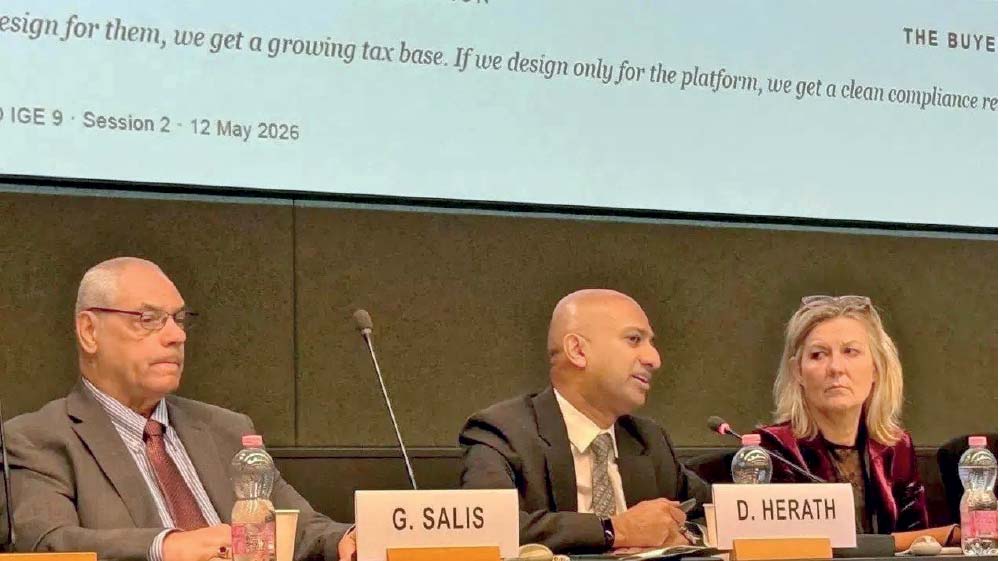
Kapruka Holdings Founder and Chairman Dulith Herath (centre) addresses the 9th Session of the UNCTAD Intergovernmental Group of Experts on E-commerce and the Digital Economy in Geneva. Also present is Vertex Inc. Chief Economist George Salis (left)
The 9th Session of the UNCTAD Intergovernmental Group of Experts on E-commerce and the Digital Economy, held at the Palais des Nations in Geneva from 11 to 13 May 2026, examined how digital platforms can contribute to strengthening fiscal revenues in developing countries. Sri Lankan e-commerce platform Kapruka Holdings PLC (CSE: KPHL) was represented on the panel by Founder and Chairman Dulith Herath.
Session 2, titled “Digital solutions for strengthening fiscal administration capacity and the role of e-commerce platforms as tax collectors”, was moderated by Switzerland’s Ambassador to the WTO Erwin Bollinger. Herath spoke alongside Vertex Inc., Chief Economist George Salis and UNCTAD ASYCUDA John David. The audience consisted of delegates from finance ministries, tax administrations, and customs authorities from developing countries.
Drawing on Kapruka’s 23 years of operating as Sri Lanka’s largest e-commerce platform, Herath argued that digital platforms can be powerful allies for tax administrations, but only when policy is designed around the small seller. He cited Kapruka data showing that new SME seller signups on the company’s marketplace platform, Partner Central, fell between 20 and 40 per cent in the months following Sri Lanka’s January 2024 VAT reform, with the sharpest drops among home-based producers, women selling food and handicrafts, and micro-merchants outside Colombo.
Herath cautioned developing countries against directly adopting the European Union’s “deemed supplier” model, where platforms are treated as the legal seller for tax purposes. He proposed instead a graduated approach: information returns first, tiered compliance by seller size, a single national tax data gateway across agencies, and only then consideration of platforms as legal tax collectors. He also addressed cross-border e-commerce, drawing on Kapruka’s Global Shop service, and noted that price opacity at customs clearance pushes a portion of trade into informal channels.
“We are not adversaries. We are infrastructure,” Herath said in closing. “The countries that treat their domestic platforms as fiscal infrastructure, the way they treat banks and telecoms, will collect more revenue, more sustainably, with less friction, than the countries that treat us as targets to regulate.”




