Friday Oct 16, 2026
Friday Oct 16, 2026
Tuesday, 10 February 2026 04:44 - - {{hitsCtrl.values.hits}}

 At its core, Roar Global builds specialised marketing and technology companies. That includes creating businesses from the ground up, partnering with entrepreneurs to develop category-specific ventures within the group, and selectively acquiring companies that have proven demand but require stronger operating foundations to scale
|
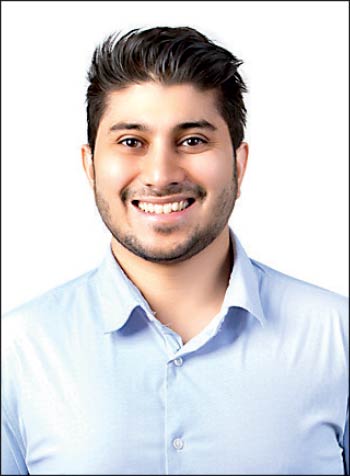
Roar Global Founder/CEO Mustafa Kassim
|
Roar Global’s transition from a digital media startup to a diversified group holding company marks a milestone for the Sri Lankan entrepreneurial landscape. This evolution, underscored by a strategic buyback of shares from early investors, validates a long-term growth trajectory and confirms the organisation’s shift into a mature, self-sustaining entity.
The move represents a rare full-circle success story in the local ecosystem. By reaching a scale that allows for such equity consolidation, Roar Global provides a vital proof of concept for the region: that Sri Lankan ventures can achieve sustainable financial maturity and independence. This feature explores the journey behind that growth and the roadmap for Roar’s next phase of evolution.
Roar Global – The venture builder
With six portfolio businesses, more than 150 team members, and group revenues exceeding $ 30 million, Roar Global has quietly built one of the region’s more substantial mar-tech groups, operating across highly specialised domains at the intersection of marketing platforms and artificial intelligence.
Founded by Mustafa Kassim, Roar Global is a mar-tech venture builder and holding company that builds, acquires, and scales businesses across deep, niche areas of marketing and technology. The group operates a portfolio of specialist companies spanning performance marketing, creator and UGC ecosystems, AI-driven brand visibility, automation, and creative production.
This structure reflects how modern marketing has evolved, moving away from generalist models toward platform-native, highly specialised execution.
Building companies at scale
At its core, Roar Global builds specialised marketing and technology companies.
That includes creating businesses from the ground up, partnering with entrepreneurs to develop category-specific ventures within the group, and selectively acquiring companies that have proven demand but require stronger operating foundations to scale.
Each company is designed to stand on its own, with its own leadership, positioning, and customers. What Roar provides is the shared layer beneath that independence: operating discipline, execution playbooks, platform expertise, talent infrastructure, and governance frameworks that most standalone businesses take years to develop.
“Marketing today is too complex to be handled well by one generalist organisation,” Kassim says. “The work requires depth. The challenge is making that depth scalable.”
Roar’s solution has been to separate focus from infrastructure, keeping individual companies narrow and specialised while centralising the systems that allow them to grow without friction.
A model shaped by platforms
Roar’s structure did not emerge overnight. It is the result of more than a decade spent building businesses in platform-driven markets.
The group began in digital publishing, where growth was tightly linked to platform dynamics and frequent rule changes. That environment forced early exposure to challenges, many companies only encounter later, scaling teams without losing quality, operating across platforms with competing incentives, and avoiding over-reliance on any single channel.
Over time, Roar began building internal solutions to address these challenges. Some were designed to stabilise execution in volatile platform environments, others to improve how teams scaled or how decisions were made under constant change.
As those solutions matured, it became clear they were highly specialised capabilities rather than general fixes. Several evolved into standalone businesses, each focused on a specific niche within modern marketing.
What started as internal solutions gradually became independent companies. What began as one business became a portfolio, built with an emphasis on operational readiness rather than speed.
Building through consolidation
As marketing and technology have become increasingly shaped by AI, Roar has leaned further into consolidation, selectively acquiring and integrating specialist businesses that deepen the group’s overall capability.
The aim is not to assemble a loose collection of companies, but to build a larger, more resilient organisation where each addition strengthens a specific area of execution and improves performance across the group.
“The group is the value engine,” Kassim says. “Every business we build or bring in should make the aggregate stronger.”
With more than 150 professionals across its ventures, Roar plans to continue expanding its portfolio, guided by where platform shifts and AI adoption are creating sustained demand for highly specialised expertise.
Looking ahead
Roar Global is increasingly positioning itself beyond its regional roots, with a clear focus on building a global mar-tech holding company anchored in specialised execution.
While the group operates with strong teams across regions, its growth is centred on deep, niche capabilities rather than geographic expansion alone. The aim is to scale alongside the platforms it works with, and over time, the group expects to expand its portfolio from six companies today to around twenty, adding specialist businesses that strengthen the group’s overall execution depth.
As AI continues to change how marketing is executed, Roar’s view is that durability will come from structure, clear mandates, specialist focus, and the ability to integrate new capabilities without fragmentation.
For Kassim and his team, the focus remains consistent: building a group that grows stronger with each cycle, compounds capability over time, and remains relevant as platforms and technologies evolve.