Tuesday Sep 15, 2026
Tuesday Sep 15, 2026
Friday, 27 February 2026 00:06 - - {{hitsCtrl.values.hits}}
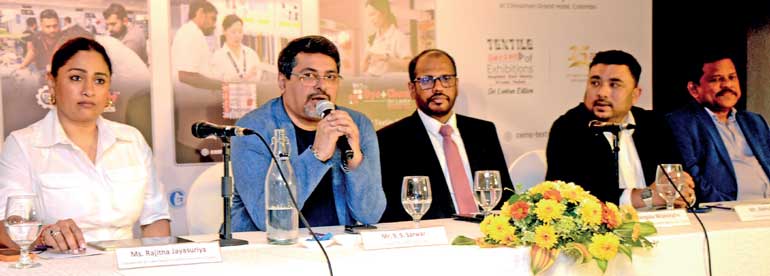
CEMS-Global (USA) Group CEO S.S. Sarwar (second from left) addressing the 15th Textile Exhibition press conference in Colombo. Others (from left): SLAEA Chairperson Rajitha Jayasuriya, EDB Chairman Mangala Wijesinghe, CEMS-Global Group Director Abhishek Das, and JAAF Chairman Felix Fernando
– Pic by Lasantha Kumara
By Amira Cader
Sri Lanka’s leading textile and apparel industry platform will return for its 15th edition from 5 to 7 March 2026 at the Sri Lanka Exhibition and Convention Centre (SLECC), Colombo, bringing together global technology providers, manufacturers, exporters and sourcing specialists under one roof.
Speaking at a media briefing at the Cinnamon Grand Colombo yesterday, Sri Lanka Export Development Board (EDB) Chairman and CEO Mangala Wijesinghe said the exhibition aligns with the EDB’s mission to drive export growth through strategic guidance, policy support and trade facilitation, with the national goal of increasing Sri Lanka’s export revenue to $36 billion by 2030.
Sri Lanka recorded $17.3 billion in exports last year for the first time, reflecting nearly 6% growth, including $13.5 billion from merchandise and services, highlighting the continued strength of the country’s export sector.
Wijesinghe said the apparel and leather sectors together account for roughly 32–35% of total exports, with the broader merchandise sector contributing nearly 40%. The apparel sector alone generated approximately $5.3 billion in export earnings last year, underlining its critical role in the national economy.
“Improving economic indicators, including GDP performance, tourism earnings, foreign investment and export income, position 2026 as a key year for Sri Lanka’s export sector, with expectations of 10–12% export growth, while January exports alone showed growth exceeding 30%,” he said.
The apparel sector contributed around $450 million in export earnings in January, and under the national development plan the target is to increase apparel export revenue to over $8 billion by 2030.
He noted that nearly 50% of Sri Lanka’s exports currently go to the USA, EU and UK, highlighting the need to expand into ASEAN, Middle Eastern and African markets. He added that recent export growth included gains from new products and emerging Sri Lankan brands, particularly in sectors such as food and beverages.
“Last year Sri Lanka exported nearly $930 million to the UK, about 60% of it from apparel. The zero-tariff access from January will give a strong boost to UK exports. The US is also a major market and even a 10% tariff reduction there could significantly strengthen our export performance,” he said.
Sri Lanka has earned a reputation as a reliable, high-quality manufacturing hub for many internationally reputed brands. At the same time, the industry imports raw materials and fabrics worth about $2.7 billion from countries including China, India, Taiwan, Pakistan, Italy and Vietnam.
The exhibition is expected to serve as a single sourcing platform under one roof, bringing together machinery suppliers, material producers and industry stakeholders to support the sector’s continued growth.
Wijesinghe added that the government is working toward expanding trade agreements and preferential market access, with discussions underway on new partnerships and supply-chain cooperation, while embassies have been tasked with supporting entry into priority markets.
CEMS-Global USA Group CEO S. S. Sarwar said the exhibition provides a comprehensive platform linking Sri Lanka’s apparel manufacturers with global machinery suppliers, raw-material producers and technology providers, helping the industry remain competitive in a rapidly evolving global market.
Joint Apparel Association Forum (JAAF) Chairman Felix Fernando said Sri Lanka’s apparel exporters are strengthening partnerships with global brands while also developing new labels to capture upper- and mid-market segments.
He noted that although Sri Lanka attracts roughly $600 million to $1 billion in annual foreign direct investment, higher inflows are needed to achieve long-term export and GDP targets.
“Countries like Bangladesh can sell to Japan more easily, while Sri Lanka still faces many restrictions. We need to make our policies more investment-friendly to improve competitiveness,” Fernando said.
He stressed the importance of improving the investment climate by reducing administrative bottlenecks and ensuring smoother processes for investors, while expressing optimism that economic conditions are gradually improving and that Sri Lanka’s export markets have historically been concentrated in high-income Western countries, while opportunities in markets such as Japan, India, China, Australia, Canada and Korea remain underutilised.
Sri Lanka Apparel Exporters Association (SLAEA) Chairperson Rajitha Jayasuriya said platforms such as the Textile Series are essential for connecting Sri Lankan manufacturers with international suppliers, enabling access to new technologies, sustainable production solutions and emerging global market opportunities.
The exhibition forms part of the internationally recognised Textile Series of Exhibitions and now held annually across regions including South Asia, Brazil, Morocco, Sri Lanka and London.
This 15th edition will feature three co-located exhibitions: the Textech Sri Lanka International Expo on Textile and Garment Technology and Machinery, the Colombo International Yarn & Fabric Show and the Dye+Chem Sri Lanka Expo on Dyestuff and Specialty Chemicals — together presenting a fully integrated sourcing ecosystem covering machinery, materials, trims, accessories and chemicals.
The EDB Chairman also announced that Sri Lanka Expo 2026 will be held from 18–21 June at the BMICH, marking the return of the country’s flagship international trade and investment exhibition after a 14-year gap.
The event is expected to attract over 1,500 overseas participants, around 650 local exhibitors, and numerous international companies, including technology-driven machinery manufacturers and raw-material suppliers. A dedicated international pavilion will showcase foreign companies supplying equipment and materials to export-oriented sectors.
Industry leaders emphasised that the exhibition will play a vital role in strengthening global engagement, supporting export diversification and enhancing Sri Lanka’s competitiveness as a trusted apparel sourcing destination.




