Sunday Sep 13, 2026
Sunday Sep 13, 2026
Friday, 5 December 2025 06:17 - - {{hitsCtrl.values.hits}}
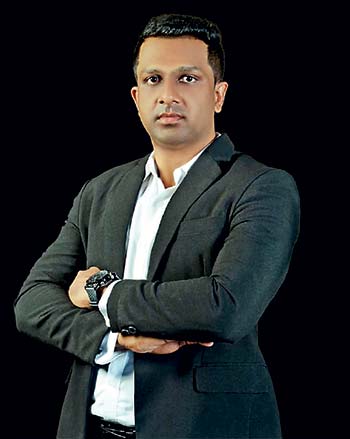
Asia Securities Head of Equity Research Niroshan De Silva

CT Smith Securities Senior Research Analyst Sachintha Siriwardena
In the wake of John Keells Holdings’ strong Q2 2025/26 results, we joined two leading market analysts—Asia Securities Head of Equity Research Niroshan De Silva and CT Smith Securities Senior Research Analyst Sachintha Siriwardena as they discussed the Group’s major projects such as City of Dreams Sri Lanka, diverse segment dynamics, balance sheet strength, market sentiment, and why the latest financials should boost investor confidence in the conglomerate’s medium-term trajectory.
Q: How would you characterise JKH’s Q2 performance against the broader economic backdrop?
Niroshan: The macro environment has clearly stabilised, with inflation around 5%, a steadier currency and interest rates in the high single digits. Tourism has exceeded 1.97 million arrivals, growing double digits, and remittances remain strong. This has supported consumption, with Supermarkets and Consumer Foods seeing low to mid-teens growth in volumes and same store sales.
In this environment, JKH reported an 88% rise in revenue to Rs. 144.8 billion in Q2. The New Energy Vehicle business (JKCG/BYD) handed over about 3,700 units and has more than 3,800 orders in the pipeline. EBITDA more than doubled to Rs. 18.4 billion, with PBT up 243% and PAT up 176%. Leisure moved from a loss to an EBITDA profit, and City of Dreams Sri Lanka, though still in its launch phase, was already close to EBITDA breakeven. The Group’s broader confidence in its strategy and cash generation ability was also reflected in the doubling of its first interim dividend to Rs. 0.10 per share; a Rs. 1.8-billion payout.
Sachintha: Performance was broadly in line with expectations, but particularly strong where structural tailwinds exist. Retail remained a standout, led by BYD, though the customs dispute and broader policy headwinds around EV imports remain near term challenges. Nations Trust Bank delivered another strong quarter as well, supporting Financial Services.
Transportation posted solid volume growth but margins were affected by an unfavourable cargo mix, even as CWIT scaled faster than expected and SAGT benefitted from higher throughput at the Port of Colombo. City of Dreams Sri Lanka was almost at EBITDA breakeven. Despite finance costs from newly operational components, gearing remains comfortable and the core businesses continue to generate strong cash flows.
Q: What are the key indicators that demonstrate the Group’s underlying resilience?
Niroshan: The clearest indicator is the step up in earnings. First half EBITDA reached Rs. 31.3 billion, up 98%, and the Group is on track to exceed last year’s Rs. 45.7 billion. Even excluding CODSL and JKCG, Q2 PBT rose to about Rs. 4.3 billion from Rs. 1.6 billion, showing how broad based the improvement is.
Operating cash flow over the last twelve months is around Rs. 41.3 billion, with Rs. 2.9 billion generated this quarter alone, supporting commitments as the Group moves from investment to harvest mode. ROCE has improved to roughly 3.5% on a last 12 months basis; still below pre crisis levels but clearly trending up.
Sachintha: A major factor is that JKH has now completed its heavy capex cycle and moved into a phase focused on generating returns. Recurring EBITDA has strengthened, making cash flows more predictable. With rising earnings, improving cash generation and a stable near term capex outlook, the Group is well placed to meet upcoming obligations comfortably.
Q: How comfortable are you with JKH’s balance sheet, gearing and management of financial risk?
Sachintha: As at 30 September 2025, gearing was around 32%, or closer to 30% excluding JKCG’s trade facilities, which is very manageable for a conglomerate of this scale. The debt maturity profile is weighted toward FY26 and FY27, but the Group has ample refinancing flexibility.
Currency and interest rate exposure are managed through a mix of Rupee and US dollar balances and by aligning borrowings with the broader debt profile. Strong foreign currency contributions from Leisure and Transportation add liquidity and help absorb movements in both the Rupee and global interest rates. Meanwhile, the borrowing book is actively balanced across fixed, variable and hedged positions.
Niroshan: Net debt to EBITDA is about 3.5 times, a marked improvement from 8.4 times in FY2020/21. The Group’s liquidity is solid, supported by operating cash flows, and it has moved beyond the capital-intensive phase of projects like CODSL. Furthermore, noncurrent borrowings exceed current obligations, reducing near term refinancing risk, and a refinancing planned for next year should extend maturities and improve the overall cost of debt. Thus, for a diversified group of its size, the financial positioning is healthy and manageable.
Q: JKH has gone through a heavy capex phase. How do you view the investment strategy and return profile of assets like City of Dreams and West Container Terminal?
Niroshan: City of Dreams Sri Lanka is a landmark $ 1.2 billion investment. The Nuwa Sri Lanka hotel, the first phase of The Shoppes mall and the luxury casino all opened in August 2025, and the project is now fully operational with no further outflows. The resort’s EBITDA loss narrowed to Rs. 64 million in Q2, versus about Rs. 1.2 billion a year earlier, supported by rising occupancies, casino footfall and MICE bookings.
The West Container Terminal is also progressing well; Phase 2 is underway and full completion is targeted for end 2026. WCT 1 is expected to be close to PAT breakeven this financial year, ahead of the typical first full year trajectory for a project of this scale.
Sachintha: JKH is now moving past its most capex-intensive phase, with major projects like City of Dreams Sri Lanka and the West Container Terminal entering their operational ramps. COD is still early in its lifecycle, but the initial traction shows that the asset has the potential to scale meaningfully as tourism and MICE-related activity improve. Meanwhile, WCT is a strategically important long-term infrastructure asset, and the steady progress in construction positions it to contribute once volumes build at the Port of Colombo.
Q: How do you assess the performance and outlook of retail, transportation and leisure?
Sachintha: Transportation recorded strong volume growth, though profitability was held back by the cargo mix. Even so, rising activity at the Port of Colombo and CWIT’s rapid ramp up point to a positive outlook, dependent on stronger Indian demand and smoother East-West shipping routes.
Retail was led by BYD sales, although the customs dispute and broader regulatory headwinds for EV imports are important considerations in the near term.
Leisure has sustained its recovery, with Sri Lankan Resorts broadly posting higher occupancies and improved rates, while Colombo Hotels are seeing occupancy gains despite rate constraints from the larger inventory. Maldivian properties too delivered strong rate and occupancy growth. With City of Dreams now operational, the segment has moved from preopening costs to revenue generation, supported by increasing MICE and gaming activity.
Niroshan: Retail EBITDA rose to around Rs. 10.1 billion in Q2, more than tripling year on year. Financial Services EBITDA grew nearly 40%, Consumer Foods by about 6%, Transportation remained stable at roughly Rs. 1.9 billion, and Leisure (excluding CODSL) grew by more than 40%. Taken together, these results show momentum across the portfolio rather than reliance on any single segment.
Q: How is JKH protecting margins in retail, and what role do operational and digital initiatives play?
Sachintha: Supermarkets are inherently low margin, but JKH has managed pressures through efficiency and disciplined expansion. The modern distribution centre has strengthened supply chain capability and reduced handling costs, and Sri Lanka’s shift from general trade to modern trade is creating a structural backdrop that supports margin resilience.
Niroshan: Digital transformation is central to sustaining margins. JKIT and the OCTAVE Analytics Centre are embedding data and technology across the Group, from supply chain optimisation to IoT enabled production in Consumer Foods, AI-driven work in logistics, and energy management in Leisure. The rollout of SAP S/4HANA is enhancing real time visibility and operational reliability. These improvements are particularly significant in businesses where margins are structurally thin.
JKH’s strong standards of disclosure and reporting also give investors clearer visibility than many regional peers, reinforcing confidence in execution and long-term strategy.
Q: How do external variables and market perception affect the outlook, and where do you see the greatest value creation over the next few years?
Sachintha: Near-term earnings will be shaped by global interest rates, trade flows, tourism arrivals and domestic consumption. JKH’s diversified structure means that results reflect a blend of these drivers. Thus, Leisure should continue its recovery with rising occupancies, and Transportation/port related operations stand to benefit from stronger throughput, while Retail and Consumer Foods will move in line with improving household spending. Meanwhile, investor sentiment typically follows visibility on these earnings streams, and that visibility has been improving across the portfolio.
Niroshan: Conglomerates often trade at a discount to their sum of the parts, but as City of Dreams and the West Container Terminal mature, and as core businesses continue to build recurring cash flows, there is room for that discount to narrow. Investors will be focused on three key areas: returns from the heavy investments made over the past decade, continued improvements in leverage and cash flow, and disciplined capital allocation. Therefore, if JKH sustains the execution seen recently, it is well positioned to deliver significant shareholder value over the medium term.




