Friday Oct 23, 2026
Friday Oct 23, 2026
Tuesday, 10 February 2026 04:38 - - {{hitsCtrl.values.hits}}
By Divya Thotawatte
Marking a corporate structural shift in Sri Lanka, what was once voluntary ESG disclosure is now hardening into mandatory reporting, regulatory, and strategic requirements, said a panel of experts recently.
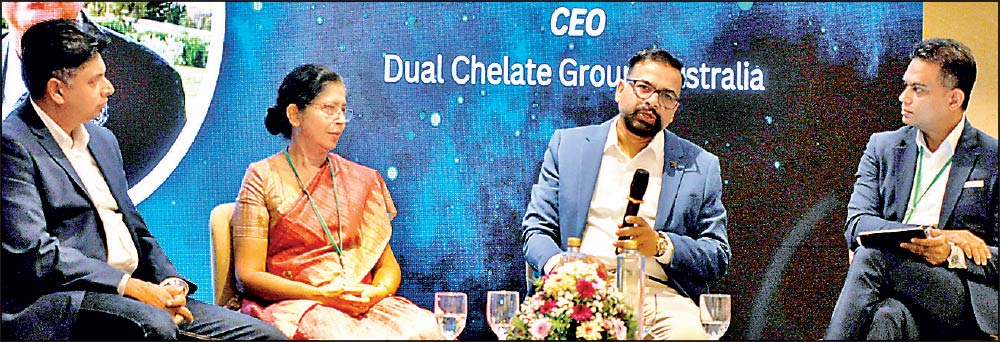
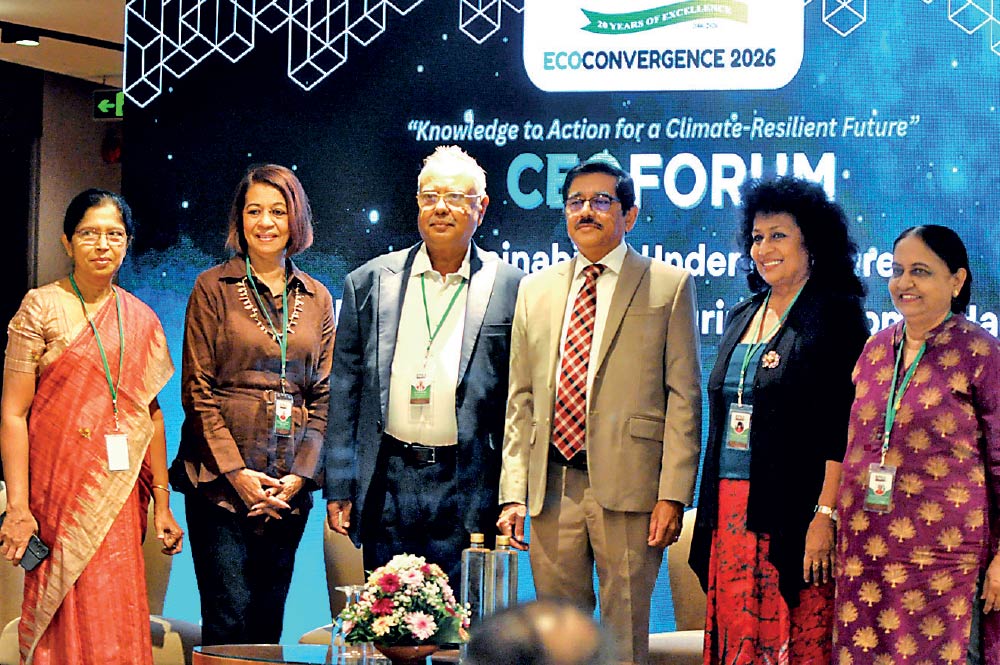
This discussion, organised by The Institute of Environmental Professionals Sri Lanka (IEPSL), was themed ‘Sustainability Under Pressure: How CEOs Make ESG Work During Economic Hardship.’ It was an exclusive CEO Forum and breakfast meeting that brought together senior business leaders, policymakers, and sustainability experts to engage in focused dialogue on maintaining Environmental, Social, and Governance (ESG) commitments amid economic constraints.
The forum was a key component of EcoConvergence 2026, the IEPSL Annual Technical Sessions operating under the broader theme ‘Knowledge to Action for a Climate-Resilient Future.’ The event assumes heightened significance as Sri Lanka navigates post-crisis economic recovery while confronting mounting pressures to align business practices with international sustainability frameworks.
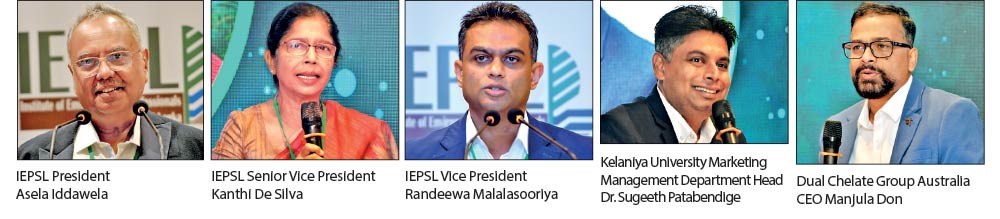
During the event, University of Kelaniya Department of Marketing Management Head Dr. Sugeeth Patabendige said, “For many years, we had a voluntary regime. If you like, you do it. It was nice. Reputational management was critical. But now, it is mandatory.”
He explained that the shift was driven by International Financial Reporting Standards (IFRS) sustainability standards such as S1 (General Sustainability-related Disclosures) and S2 (Climate-related Disclosures), and Sri Lanka was among the early adopters of these standards. While from 2025, the top 100 companies listed on CSE were required to comply, with coverage expanding annually, he noted that by 2028, even private companies exceeding Rs. 10 billion in revenue would be subjected to mandatory sustainability reporting.
“It’s not just about Sri Lankan capital markets that are there. It’s about other capital markets where we raise capital,” he said, explaining that there were structural implications to these changes. Under S1, companies must disclose across four integrated pillars: governance, strategy, risk management, and metrics and targets. Complying required internal change, not just external reporting.
“It’s not telling what’s the current governance. It is adhering to the standards, so you have to change,” Patabendige explained.
Governance, ownership, and accountability
One of the most immediate consequences of the new regime was the requirement for explicit ownership of sustainability at the board and senior management level. Boards were now required to identify who was responsible, how sustainability risks were governed, and how climate targets were now tied to executive remuneration.
“Clearly, there should be somebody owning this within the board. A committee or an individual. And their remuneration needs to be connected to those climate targets.”
This represents a significant escalation from earlier ESG practices, where environmental disclosures remained outside core decision-making. Patabendige stressed that under the new IFRS sustainability standards, climate-related risks could no longer be treated as separate ESG issues, but must be considered as part of the enterprise risk management (ERM).
“The standard says climate change cannot now sit outside the normal ERM,” he said, adding that companies were now also required to extend this integration to scenario planning that would directly test the resilience of their business models.
Climate risk was no longer theoretical, Patabendige stressed, pointing to the recent Cyclone Ditwah as evidence of future scenarios that companies must model, quantify, and disclose, along with their strategic responses.
Reforming the National Environmental Act
While international accounting standards are tightening disclosure obligations, Sri Lanka’s regulatory system is also evolving.
Central Environmental Authority Environmental Management and Assessment Division Former Deputy Director Kanthi De Silva outlined major reforms underway to the National Environmental Act (NEA), the country’s primary environmental legislation. “The National Environmental Act is the umbrella legislation with respect to environmental management and sustainable development. It mainly focuses on sustainable development, not on environmental conservation solely.”
The forthcoming amendments, which were long-delayed but were now being approved by the Parliament, will introduce several significant changes. De Silva explained that they expanded environmental assessment beyond individual projects to higher-level decision-making.
“The CEA is trying to introduce the Strategic Environmental Assessment… for policies, plans and programs,” De Silva said, highlighting how this was a critical step in a country where land-use planning had historically been weak or fragmented.
She explained that one of the biggest problems linked to development projects was the lack of land-use plans in Sri Lanka. Strategic Environmental Assessment (SEA) aimed to integrate environmental considerations at the planning stage, enabling authorities to identify flood-prone, landslide-prone, or erosion-vulnerable areas before development occurred. This could formalise no-build zones and impose conditional development requirements based on climate risk, she said.
De Silva also added that the amendments strengthened post-approval enforcement, another area where Sri Lanka has struggled historically.
Load-based licencing and producer responsibility
Two further reforms will directly affect industry operations. First, there was a shift from concentration-based to load-based environmental licensing. “At present, CEA considers only the concentration of wastewater. It does not consider the waste load discharged into the environment.”
Under the new system, industries discharging higher volumes of waste, even if compliant on concentration, will pay higher fees.
Second, the introduction of Extended Producer Responsibility (EPR), especially targeting plastic waste, has placed responsibility for disposal back into owners, De Silva noted, underlining the international shift toward industrial accountability. “Whoever produces the plastic is responsible for the disposal also.”
The competitive advantage
While Patabendige and De Silva emphasised obligation, Dual Chelate Group Australia CEO Manjula Don noted that sustainability could be utilised for its commercial advantages.
“When you become an industry leader, you face a problem. Everyone else is looking at you, and if you are not concerned about the environment or sustainability, you are losing your competitive advantage.”
He discussed his decade-long experience in Australian agriculture, where resource scarcity, especially phosphorus, had triggered a shift in business thinking. He warned that if Sri Lanka did not utilise the resource effectively now, it would cause great difficulty in food production.
In response, Dual Chelate had built sustainability into its core business model since its inception, structured around five principles: sustainable raw materials, efficient processing, waste-free delivery, renewable energy, and carbon offsetting.
Don said that Dual Chelate used more than 60% of its raw materials for fertiliser production from sustainable sources, explaining how plant-based fertilisers were converted into highly efficient fertilisers using chelation technology. “If you want to use 100 kilos traditionally, with new technology you can see the same result with a few kilos.”
Operational choices followed the same approach where fertilisers were delivered in bulk liquid form using tankers, eliminating packaging waste. Manufacturing waste was reused across 7,000 acres of company-owned farmland. Don added that energy needs were also met entirely through solar power.
“At the moment, we’re not using any grid power. We produce more renewable energy than we use,” he noted, explaining that carbon emissions from logistics were also neutralised through the cultivation of 1,600 acres of perennial trees, achieving operational carbon neutrality.
The commercial outcome has been tangible, Don said. In a market with over 65 fertiliser manufacturers, Dual Chelate is the only company with ISO 14001 environmental management certification, making it a preferred supplier for institutional investors focused on sustainable agriculture.
“When the overseas multi-billion investors come to Australia to invest in the agriculture project, they want to invest in sustainable agriculture,” he pointed out.
During this high-profile gathering, experts highlighted how as Sri Lanka’s industries enter this new phase, companies that treat sustainability lightly or dismissively may struggle. The only way forward, according to them, was integrating it into governance, risk, and strategy.
-Pix by Lasantha Kumara





