Tuesday Sep 15, 2026
Tuesday Sep 15, 2026
Thursday, 30 July 2026 05:23 - - {{hitsCtrl.values.hits}}
By Charumini de Silva
Sri Lanka is accelerating reforms to modernise its intellectual property (IP) ecosystem as policymakers, regulators, law enforcement agencies, industry leaders and legal experts urged stronger protection of innovation to support trade, attract investment and deepen economic ties with the United States.
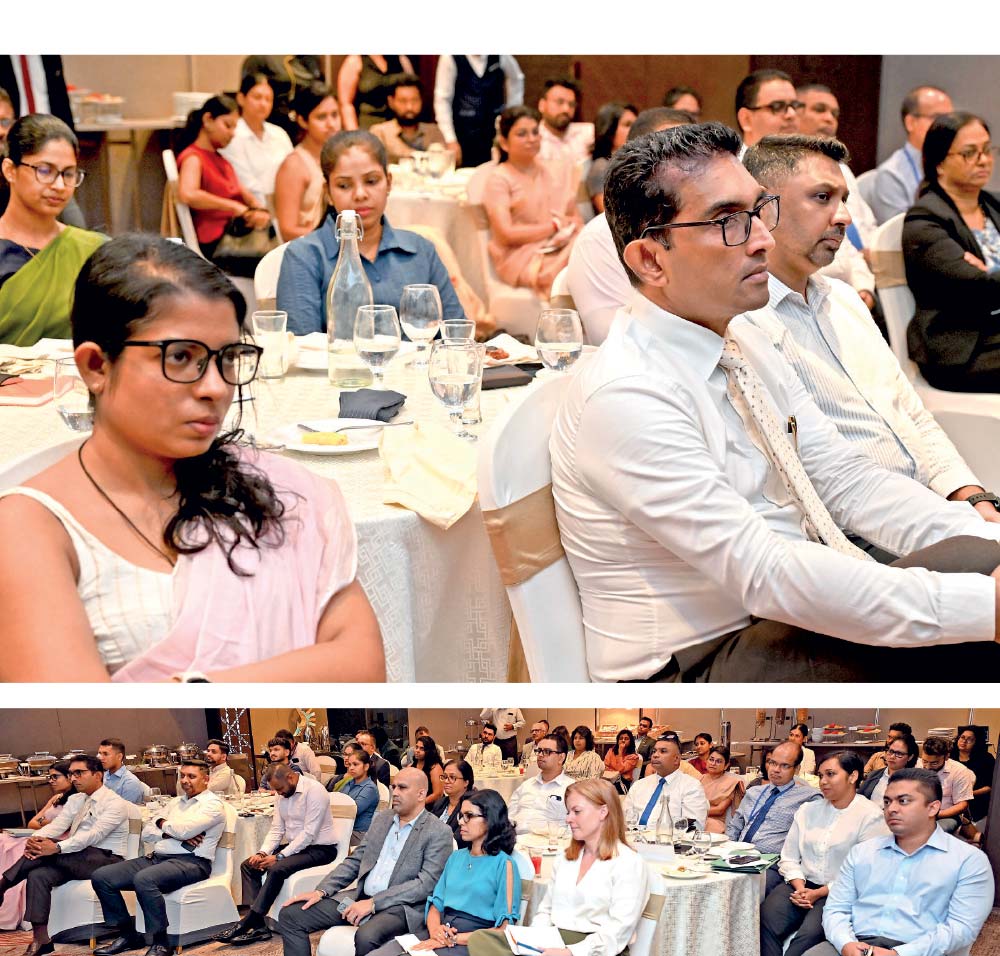
The message emerged at the Sri Lanka-USA Business Council (SLUSABC) of The Ceylon Chamber of Commerce breakfast forum titled “The IP Trade Corridor – Strengthening the US-Sri Lanka Economic Partnership through Intellectual Property Protection,” where stakeholders acknowledged significant progress in digitising the country’s IP system, whilst cautioning that institutional capacity, enforcement and public awareness must improve if Sri Lanka is to compete effectively in the global knowledge economy.
Opening the forum, SLUSABC President Tilak Gunawardana said robust IP protection had become increasingly important, as Sri Lanka sought to strengthen its economic partnership with the US, one of its largest export destinations.
“Stronger IP protection was essential to enhancing investor confidence, safeguarding local innovation and enabling access to higher-value global markets,” he added.
The forum brought together an unusually broad cross-section of stakeholders, from the National Intellectual Property Office (NIPO), Criminal Investigation Department (CID) and Sri Lanka Customs to the apparel industry, Microsoft and legal practitioners, allowing the discussion to cover the full spectrum of IP protection, from registration and enforcement to digital governance and commercialisation.
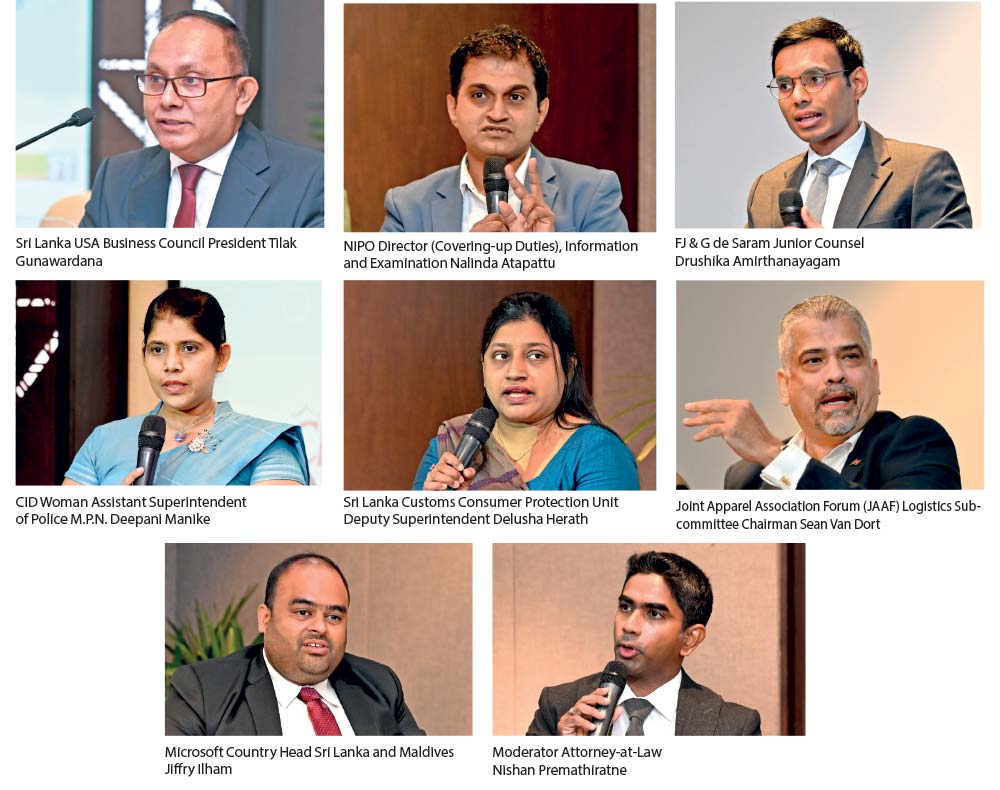
The panel comprised NIPO Director (Covering-up Duties) Information and Examination Nalinda Atapattu, F J & G de Saram Junior Counsel Drushika Amirthanayagam, CID Woman Assistant Superintendent of Police M.P.N. Deepani Manike, Sri Lanka Customs Consumer Protection Unit Deputy Superintendent Delusha Herath, Joint Apparel Association Forum (JAAF) Logistics Sub-committee Chairman Sean Van Dort, Microsoft Country Lead for Sri Lanka and Maldives Jiffry Ilham. The session was moderated by Attorney-at-Law Nishan Premathiratne.
NIPO targets eight-month registration timeline
Responding to concerns over lengthy registration delays, NIPO Director said the Office had undertaken major reforms to address long-standing bottlenecks.
He acknowledged that criticism over delays in trademark and patent registration had been justified, attributing much of the backlog to a shortage of technically qualified patent examiners and the absence of digitised historical records.
“To address these challenges, NIPO recruited new patent examiners over the past two years, while completing a comprehensive digitisation program supported by the World Intellectual Property Organisation (WIPO). The project, launched in January 2025, was completed recently and has converted decades of paper records into searchable electronic files,” he explained.
He said the digitisation is expected to significantly improve examination efficiency and reduce processing times.
Atapattu said NIPO now aims to reduce the average registration period; including patents, to around eight months by mid-2027.
“Currently, trademark applications face a backlog of about one year, while patent registrations remain delayed by approximately two years,” he said.
Atapattu noted that NIPO is also exploring a voluntary copyright registration mechanism, while maintaining compliance with the Berne Convention, under which copyright protection arises automatically.
“Sri Lanka is already a member of the Patent Cooperation Treaty (PCT), through which over 1,000 international patent applications have originated from the country,” he said, adding that they are also considering joining the Hague System for international registration of industrial designs.
Digital transformation gathers pace
Responding to questions from participants, Atapattu said trademark searches have been available online since February 2026 and that the database has now been integrated with WIPO’s Global Brand Database, allowing overseas applicants to conduct preliminary searches remotely.
“Although verification of historical data continues, businesses no longer need to visit NIPO physically to verify information,” he added.
He also disclosed that following the completion of historical digitisation, most IP registration services are expected to become fully online by next year.
Participants noted that Sri Lanka’s Registrar of Companies (RoC) had significantly improved efficiency through digitalisation and encouraged NIPO to pursue a similar transformation.
Resource constraints still hamper investment
Despite the reforms, Amirthanayagam pointed out that practical challenges continue to discourage investment.
He described Sri Lanka’s legislative framework as fundamentally robust, but said implementation remained constrained by limited institutional resources.
He cited a recent trademark application seeking exclusive rights over the term “True Cinnamon”, a phrase synonymous with “Ceylon Cinnamon”, as an example of why stronger examination capacity remains critical.
“Although the application has been challenged, opposition proceedings could take years to conclude,” he said, illustrating the uncertainty businesses continue to face.
Amirthanayagam also pointed to an unintended consequence of lengthy registration delays.
“Under Sri Lanka’s Intellectual Property Act, trademark protection takes effect from the original filing date, while owners are expected to commence genuine commercial use within five years. Against this backdrop, businesses may receive their registration certificates with little remaining time before facing potential non-use cancellation proceedings,” he added.
He stressed that such uncertainty disproportionately affects smaller Sri Lankan enterprises that lack the financial capacity to wait years before investing confidently in building brands.
Nevertheless, Amirthanayagam noted encouraging improvements in the Commercial Court system, observing that IP litigation is progressing faster than before, with Courts becoming increasingly willing to grant interim relief, where necessary.
Counterfeit trade remains organised challenge
CID Woman Assistant Superintendent of Police acknowledged that counterfeit trade continues to evolve into increasingly sophisticated criminal operations.
She said one of the greatest challenges remained public awareness.
“Many traders unknowingly purchase and sell counterfeit goods because they struggle to distinguish fake products from genuine ones and are unaware of the legal consequences,” she added.
She said investigations are often complicated because organisers behind counterfeit operations remain hidden behind complex supply chains, requiring extensive evidence gathering and technical support from rights holders.
“To date, the CID has investigated around 20 intellectual property cases, including around 25 trademark-related counterfeit investigations in recent years,” she said.
Manike also said that businesses, particularly trademark owners can lodge complaints through the CID Director to the Commercial Crime Investigation Unit-2.
She stressed that specialised training for Police officers remains essential, noting that IP investigations involve highly technical legal concepts unfamiliar to many investigators.
Manike also called for greater public awareness campaigns through both traditional and social media to educate consumers and businesses.
Customs strengthens border protection
Sri Lanka Customs Deputy Superintendent highlighted its growing role in intercepting counterfeit goods before they enter or leave the country.
She said Customs possesses both complaint-based and “ex-officio powers”, enabling officers to detain suspected counterfeit shipments even without prior complaints from rights holders.
“Counterfeit imports and exports are classified as prohibited goods under the Customs Ordinance, allowing Customs to seize, forfeit and destroy such consignments without requiring Court orders,” she added.
Herath acknowledged that public criticism occasionally arises when counterfeit goods are destroyed instead of donated.
However, she explained that disposal decisions must respect the wishes of rights holders, particularly where there is a risk that counterfeit goods could re-enter commercial circulation.
She encouraged brand owners to register trademarks not only with NIPO but also under Customs’ dedicated brand recordation system, enabling officers to rapidly verify suspicious shipments through authorised legal representatives.
“In some investigations, technical verification has required product samples to be examined overseas before forfeiture proceedings could continue,” Herath added.
Apparel sector warns of sophisticated counterfeit networks
Providing an industry perspective, Van Dort warned that counterfeit apparel had developed into a highly ‘organised criminal enterprise’.
He recalled identifying around 380 individuals as early as 2016, who regularly travelled overseas to purchase counterfeit branded products and smuggle them into Sri Lanka through organised networks.
“Despite awareness among enforcement agencies has improved since then, counterfeit operations have become increasingly sophisticated,” he stressed.
Van Dort explained that intellectual property protection within the apparel sector now extends far beyond logos and trademarks to include fabric technologies, garment construction techniques, production processes and manufacturing specifications.
“Global apparel brands consequently impose exceptionally stringent IP safeguards throughout their supply chains,” he added.
He noted that counterfeiters now reverse-engineer genuine products almost immediately after export, enabling replicas to reach local markets within days.
“The industry therefore invests heavily in helping Customs distinguish authentic products from counterfeits through detailed product identification systems,” he said.
Van Dort also called for greater investment in modern cargo scanning technology to minimise physical inspection of export consignments while reducing opportunities for theft and maintaining security standards.
Digital economy raises new IP challenges
Microsoft Country Lead for Sri Lanka and Maldives said IP protection increasingly intersects with cybersecurity and digital governance.
He notes Microsoft continues supporting Sri Lankan startups through initiatives such as its “Born in Sri Lanka, Going Global” program, while encouraging innovators to build IP on secure digital platforms.
Ilham said the recent legislation, including the Personal Data Protection Act (PDPA) and broader digital governance reforms has strengthened investor confidence by creating a more predictable technology environment.
However, he warned that organisations frequently misunderstand software protection.
“Many businesses continue operating outdated software after purchasing legitimate licences, mistakenly believing one-time licensing provides indefinite security. In reality, AI-powered cyber threats require continuous software updates, security patches and supported systems,” he said.
Ilham observed growing awareness among both Government institutions and private companies regarding the importance of maintaining properly licensed and updated software infrastructure.
Geographical indications seen as untapped opportunity
Discussion also focused on Sri Lanka’s underdeveloped geographical indications (GI) framework.
Responding to audience questions, Atapattu said Sri Lanka remains at an early stage of GI development despite international recognition for products such as Ceylon Cinnamon.
He stressed that GIs differ fundamentally from trademarks because they are collective rights protecting entire producer communities rather than individual companies.
Accordingly, industries must first organise themselves collectively before seeking registration.
NIPO is also working towards joining the Lisbon Agreement to strengthen international recognition of Sri Lankan geographical indications.
Building an IP culture
A recurring conclusion throughout the forum was that legal reforms alone would not be sufficient without stronger public awareness.
Atapattu said NIPO is now expanding outreach programs through universities, provincial chambers, Divisional Secretariats and Science and Technology Officers after years spent primarily clearing registration backlogs.
“Patent filing analysis revealed that 14 districts recorded fewer than 10 patent applications over the past decade,” he said, highlighting significant regional disparities in innovation awareness.
He said Technology and Innovation Support Centres established with WIPO support are also being revived following disruptions caused by the COVID-19 pandemic.
Van Dort argued that awareness campaigns must increasingly target younger audiences through platforms such as TikTok and Instagram, while introducing basic IP education into school entrepreneurship curricula.
Amirthanayagam echoed the same view, noting respect for IP ultimately depends on culture and education.
He noted that universities generate significant research and innovation every year, but unless students understand commercialisation, licensing and technology transfer, much of that intellectual capital never reaches the marketplace.
The forum concluded as Sri Lanka has made measurable progress in modernising its IP framework through digitisation, institutional reforms and stronger enforcement, sustained investment in awareness, capacity building and technology will be essential if the country is to fully leverage IP as a catalyst for innovation, exports and deeper economic engagement with the US.
- Pix by Daminda Harsha Perera