Sunday Oct 18, 2026
Sunday Oct 18, 2026
Tuesday, 1 September 2026 04:14 - - {{hitsCtrl.values.hits}}
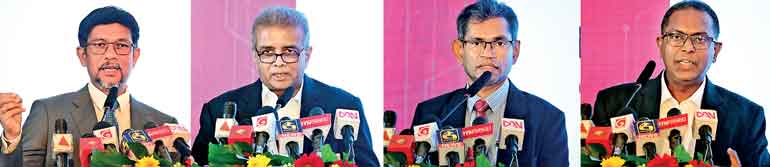
Digital Economy Deputy Minister Eng. Eranga Weeraratne, Chief Adviser to the President and ICTA Chairman Dr. Hans Wijayasuriya, Digital Economy Ministry Secretary Waruna Sri Dhanapala, FinTech Forum Sri Lanka Chairman Channa de Silva
By Amira Cader
Sri Lanka is seeking to turn its increasingly sophisticated digital-payment infrastructure into a wider engine of innovation, investment and economic growth, as Government and industry leaders look to strengthen the country’s position within Asia’s expanding FinTech landscape.
The ambition was outlined at the launch the inaugural Sri Lanka FinTech Festival 2026 by the FinTech Forum Sri Lanka, in collaboration with the Digital Economy Ministry.
The two-day festival, scheduled for 2-3 November at Shangri-La Colombo, will bring together Government, regulators, financial institutions, FinTech companies, investors and international industry leaders to connect Sri Lanka’s growing ecosystem with global opportunities.
The festival is being positioned as more than an industry conference, with organisers seeking to create a national platform connecting the local financial and technology ecosystem with international investors, networks and expertise.
Digital Economy Deputy Minister Eranga Weeraratne placed FinTech development within the Government’s broader digital-economy agenda, highlighting trust and collaboration as critical to expanding the adoption of digital financial services.
As consumers and businesses increasingly move towards digital transactions, he stressed the importance of maintaining confidence across an ecosystem involving Government, regulators, financial institutions, FinTech companies and other stakeholders.
The challenge is not simply to increase digital transactions but to ensure consumers remain confident that the systems through which their money moves are secure, accountable and reliable.
Digital Economy Chief Adviser to the President Dr. Hans Wijayasuriya highlighted the importance of infrastructure in enabling the next generation of digital services.
He placed FinTech within Sri Lanka’s wider digital transformation, where interconnected infrastructure can expand access to financial services while providing businesses and innovators with a foundation to develop new solutions.
The next phase, therefore, extends beyond simply digitising existing processes towards creating an environment in which innovation can take place on top of the infrastructure already established.
Digital Economy Secretary Waruna Sri Dhanapala stressed that creating an enabling environment for FinTech would require Sri Lanka to balance innovation with security, accountability and public confidence.
He highlighted closer engagement between Government, regulators and industry as important in creating conditions that enable emerging FinTech companies to achieve scale, noting that access to capital, markets, talent, regulatory clarity and partnerships would also be critical for companies seeking to compete internationally.
Governance and accountability will assume greater importance as the volume and complexity of digital transactions increase.
FinTech Forum Sri Lanka Chairman Channa de Silva said the country has already established much of the underlying infrastructure, or “rails”, required for a modern digital financial system, but must now focus on translating those foundations into greater economic value.
“The idea of having an annual event is to bring everyone together into a single forum to discuss, debate, identify issues and find solutions, while working with international organisations, speakers and companies,” de Silva said.
He stressed that international visibility was particularly important if Sri Lanka was to convert its technological capabilities into investment, partnerships and opportunities for local companies.
“We can do things but if others do not know what we have done, they will not give us opportunities. We should be able to deliver, but also talk about what we have done and expose it to the outside world,” He added.
The scale of Sri Lanka’s existing digital financial infrastructure was highlighted through industry data presented at the launch.
Real-time gross settlements exceeded Rs. 429 trillion in 2025, while real-time payments amounted to more than Rs. 23 trillion. Digital Government payments exceeded Rs. 3.2 trillion, while over 460,000 merchants were registered on LankaQR.
Sri Lanka also recorded over 438 million point-of-sale transactions, supported by approximately 20.7 million debit cards.
Together with infrastructure including RTGS, CEFTS, CITS, SLIPS, cards and LankaQR, the figures point to a substantial digital-payment foundation already being in place, with attention now shifting towards leveraging it to generate greater economic and social value.
FinTech Forum Sri Lanka, established around three years ago with industry participation, has developed a governance framework comprising a governing board, advisory council and specialist forum committees to provide a structured platform for addressing common challenges and promoting responsible practices.
The broader objective is to create an ecosystem where innovation and consumer confidence can progress together.
Sri Lanka’s FinTech ambitions are also increasingly outward-looking, with the country’s payment ecosystem expanding its links with international payment networks and digital wallets.
These connections are strengthening access to regional markets and creating opportunities extending beyond domestic transactions to tourism, cross-border commerce and international business.
FinTech Forum Sri Lanka’s membership in the Asia FinTech Alliance further provides opportunities for collaboration, knowledge exchange and business relationships with FinTech ecosystems across the region.
The festival is expected to provide a platform not only to bring international companies and expertise into Sri Lanka, but also to showcase the country’s capabilities and create opportunities for local businesses overseas.
A trusted and efficient digital financial ecosystem could also have implications beyond financial services, helping SMEs participate more effectively in the formal economy, expanding financial inclusion and enabling Sri Lankan technology companies to develop solutions for regional and international markets.
This takes on particular significance as Sri Lanka continues its economic recovery, with digital transformation increasingly expected to translate into productivity, investment, entrepreneurship, employment and broader economic participation.
FinTech Forum Sri Lanka Vice Chairman Conrad Dias said the festival has been structured to connect different components of the ecosystem while creating opportunities for collaboration, knowledge-sharing and international engagement.
The program will commence on 2 November with CEOs Night, an invitation-only gathering of senior representatives from banks, FinTech companies, Government, regulators, sponsors and other stakeholders.
The main Sri Lanka FinTech Expo will follow on 3 November featuring an international keynote, expert sessions, panel discussions and an exhibition showcasing FinTech and technology solutions.
Key discussions will focus on the future of banking and FinTech, building scalable businesses, sustainable and inclusive finance, cybersecurity and fraud prevention, as well as digital assets and asset tokenisation.
Global banking and FinTech commentator Chris Skinner has been announced as a keynote speaker, while the festival will conclude with FinTech Night, incorporating networking and the presentation of FinTech Awards.
For Sri Lanka, the opportunity now extends beyond simply moving more money digitally. The next phase will depend on how effectively the country can use the infrastructure already built to strengthen trust, enable innovation, attract investment and connect Sri Lankan companies with international markets.
The Sri Lanka FinTech Festival 2026 is being positioned as a platform to accelerate that transition and give the country’s emerging FinTech ecosystem greater visibility on the global stage.
- Pix by Sameera Wijesinghe




