Thursday Oct 22, 2026
Thursday Oct 22, 2026
Friday, 12 June 2026 00:00 - - {{hitsCtrl.values.hits}}
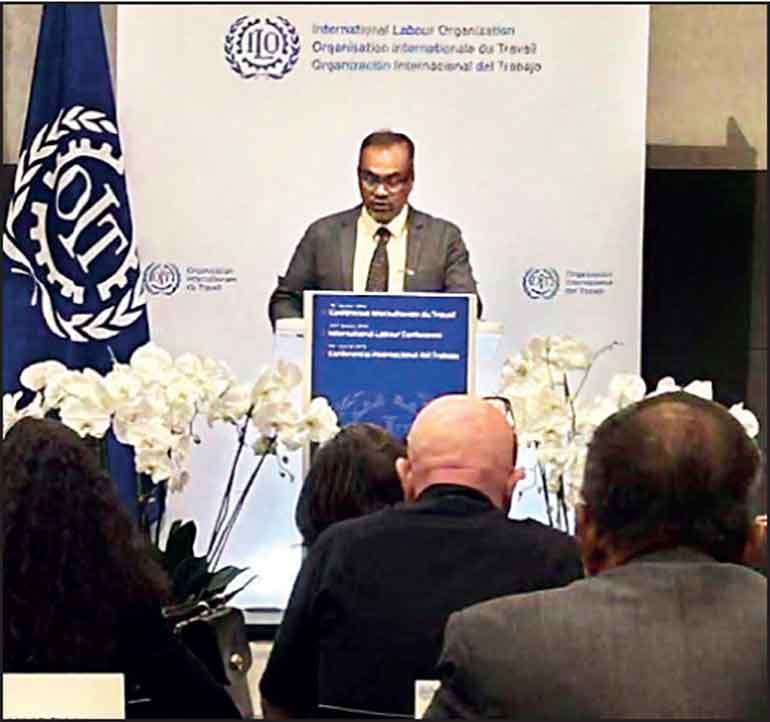
Sri Lanka has called for a fundamental shift in how governments and policymakers approach artificial intelligence (AI), arguing that the technology should be viewed not as a threat to employment but as a catalyst for transforming production systems, enhancing productivity, and generating shared prosperity.
Addressing the General Assembly of the 114th Session of the International Labour Conference, Labour Minister Dr. Anil Jayantha Fernando said the global debate on AI has been largely framed around concerns over balancing machine intervention with human labour or protecting workers from technological displacement.
“Sri Lanka proposes a shift in this paradigm. We should start viewing technology and AI as a catalyst to re-architect our production relations to enhance productivity and value generation for shared prosperity,” he said.
The Minister stressed that labour policies should remain focused on ensuring access to quality employment, fair distribution of economic value, and improved living standards, regardless of technological change.
Citing recent research conducted by the Institute of Policy Studies (IPS) using International Labour Organisation (ILO) methodologies, Dr. Fernando revealed that approximately 22.8% of Sri Lanka’s employed population is exposed to generative AI technologies.
Significantly, the study found that exposure is concentrated among professional and office-based occupations that have traditionally been viewed as secure pathways to upward social mobility. In contrast, workers in agriculture, craft-based occupations, elementary jobs, and the informal sector face comparatively lower levels of exposure.
Rather than viewing this trend as a threat, Dr. Fernando said Sri Lanka sees AI as an opportunity to reshape the labour market and unlock new sources of productivity.
He outlined a strategy in which AI would serve as a “multiplier” to improve the productivity of professional services, a “catalyst” to help workers transition into higher-value occupations, and a “transformative force” capable of modernising traditional sectors such as agriculture and informal employment.
“We are leveraging AI to unlock the potential of human capability,” he said.
The Minister noted that Sri Lanka’s approach is centred on three pillars; adoption, adaptation and acceleration, as the country seeks to embed an “AI-first mindset” across institutions and economic sectors.
He said under the leadership of President Anura Kumara Dissanayake, digital transformation has become a national priority, adding that the Government is implementing a roadmap aimed at expanding the digital economy, increasing export earnings, and developing a stronger digitally skilled workforce.
At the same time, he emphasised that Sri Lanka remains committed to protecting labour rights and ensuring that technological progress does not come at the expense of workers’ welfare.
Dr. Fernando announced that Sri Lanka ratified ILO Convention No. 190 in May 2026, with the necessary legal framework currently being finalised. The Convention seeks to eliminate violence and harassment in the world of work.
He also disclosed that Sri Lanka is in advanced discussions to ratify ILO Convention No. 188, which establishes labour standards for workers in the fishing industry.
In addition, an expert committee is currently conducting consultations on comprehensive labour law reforms designed to strengthen worker protections while supporting inclusive and sustainable economic growth.
Reflecting on Sri Lanka’s recent economic challenges, Dr. Fernando said the country had demonstrated resilience in overcoming the impacts of Cyclone Ditwah and a severe energy crisis, while continuing to manage the economy transparently and in the best interests of its citizens.
He called for greater international cooperation to bridge widening digital and AI divides between and within countries.
“Sri Lanka welcomes global collaborations and partnerships to ensure that AI-integrated production relations generate a fair share of value and living wages for all. Let us choose to harness AI not to replace humanity, but to elevate it,” he said.




